Thursday, July 02, 2026

Every bike tells a story - Elro Snacks Clemenso

Some bikes tell a little more story than other bikes.

I picked this up going on 15 years ago now. It's previous owner had acquired it in the Netherlands, under the operating assumption it was a former Clemenso-Mavic team frame. A fair assumption - the Clemenso-Mavic team raced in 1982 under the joint sponsorship of Mavic (which this blog on a rare occasion talks about...) and Clemenso, a small frame builder based in Belgium.

On closer inspection though, a 1982 build date seemed improbable given the date stamped on the frame - 2 83.

I've since seen a white Mavic-Clemenso team frame that's marked 3 82.

Instead, the far more likely story had this as a Elro Snacks-Autobrabant-Mavic team frame. Originally it would have been an all red frame, and properly decaled as a Clemenso. This frame, though, had clearly been resprayed, possibly multiple times, and is sporting a Colnago-esque retinato style paint job.

A quick history of Elro Snacks' involvement in cycling. Elro Snacks was, up until 2012, a producer of "snack foods" in the Netherlands. Near as I can tell, this primarily meant meatballs, croquets, hamburgers and other meat products. The company was established by Jos Elen, the El in Elro, who was also the manager of the Elro Snacks--Autobrabant-Mavic team. Elro Snacks would sponsor, and Jos Elen go on to manage, a slew of teams through the 80s and in to the 90s.

Clemenso was a brand produced by Clement Schmitz, in the Diest, a city in the Vlaams-Brabant region of Flanders. He did in fact produce the Clemenso-Mavic team frames, but also built for Elro Snacks in 1983 and 1984.

In 1990, Elro Snacks became the lead sponsor of a team alongside Isolco (construction goods) and Walmar (no clue, you tell me), and they rocked the color scheme seen in the pics above. Red/Blue/Yellow/White bikes with a neon green, yellow and purple kit is a lot to take in at once - so's the Rolls Royce team car.

As I outlined in my Instagram post, the most likely explanation for the frame is this frame was carted around with Elen and his teams for close to a decade, probably getting resprayed multiple times and seeing multiple uses. In 1990(ish), it received its final paintjob, and was probably relegated to training, occupying a middle seat in a roof rack, or some purpose that's likely lost to time.

Just last year - a small period of time relative to when I got the Clemenso or last posted to this blog - I spied a frame on eBay that I truly never expected I would see, let alone make my own.
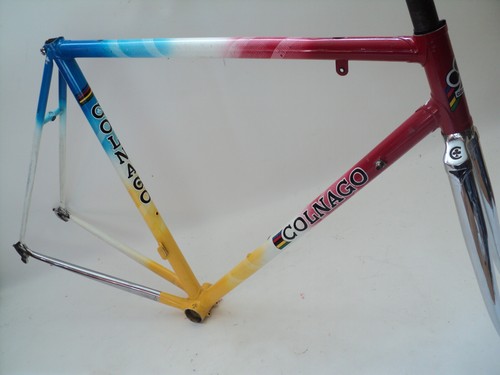
That, dear reader, is a 1990 Elro Snacks Colnago Super. Same team mechanic paint job as the Clemenso, thick, not terribly pretty, but incredibly of its time with its gauze-stenciled fade.
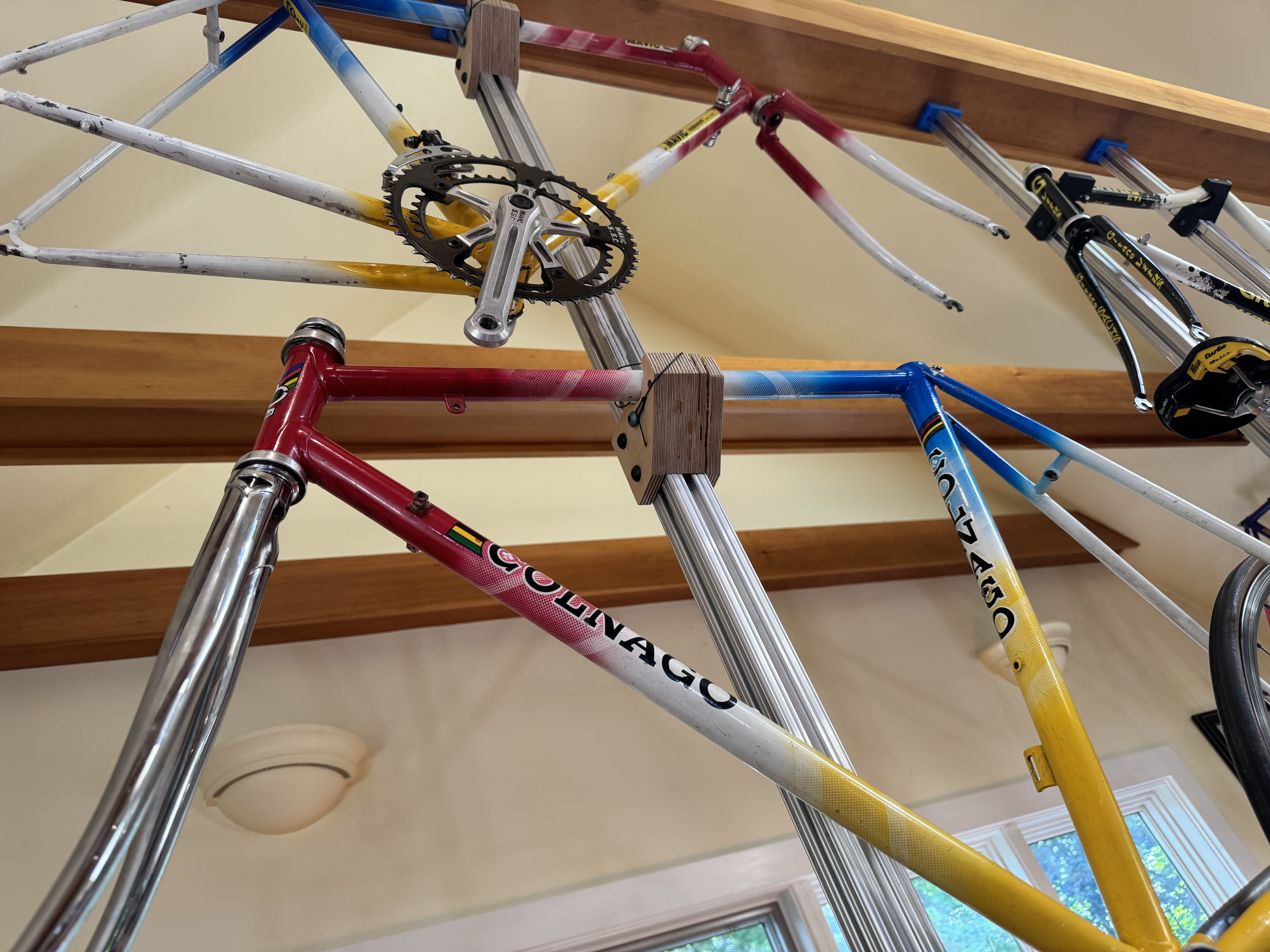
The two reside together, reunited after 30 something years. Pretty neat.

Sunday, November 22, 2015

2002 Mercatone Uno Time Trial frame

Hey! How goes? I'm doing ok - been a while huh?

Lest you think I've abandoned bikes for motorcycles or cars, or whatever it is people spend their time on, I'm still very much collecting. Picked up a few cool things over the last, oh, year or two since I posted anything actually bike related on here. I figure it'd be ok to show off a little.

We'll start with this frame. It's a 2002 Wilier-Triestina time trial frame, issued to Roberto Savoldi of the Mercatone Uno team. It was his last year with the team he got his start in as a stagiaire in 2000.

Not a lot of documentation on these frames. It's labeled as an Izoard, but it's not - and doesn't really match up with anything I've seen in catalogs. Custom? Likely. Built by Wilier? Maybe. It's aluminum - Easton Aero if we're to believe the label. The carbon is a wrap on the tube - Wilier did this on the actual Izoard of the same timeframe. The claims were stiffer than, more dampened than mumble mumble mumble. I suspect it was a majority marketing and aesthetics.

I suspect these frames were used the prior year by the Liquigas team - maybe even literally the same frames.

Savoldi, and if we're honest, the entire Mercatone team was largely anonymous in 2002 - they barely left a mark on the Giro, and didn't get a Tour de France invite. They'd limp on - sans Savoldi - for another year before Pantani died in 2004.

Friday, May 09, 2014

Cool tools

I'm a big proponent of the idea that the correct tool can make even the most painful job a little easier. There are certain tools that, while I suppose technically are the right tool, I rarely use. Socket wrenches are a great example - I find them to be heavy and awkward to use on a bike. That's totally not the case with thumbwheel ratchets, palm ratchets - whatever you want to call them, I've found myself using them frequently since I acquired them. The above are the ones I went with - I like the large rubberized grip, but there are all metal and gimbaled versions available.

Because there's no extension, there's no leverage - so you can't generate a ton of torque. But because you can put force parallel with the fastener, you're less likely to strip a bolt head or nut. Their diminutive size also means you can chuck one with a few frequently used sockets in a small saddlebag.

3/8" drive, 1/4" drive and a 3 piece set that also includes a 1/2" drive. If you have any, or pick some up, let me know what you think - are they as useful for you as they've proven to be for me?

Thursday, June 27, 2013

Mavic's 640 Pedals

Picking a favorite Mavic component is a lot like picking which of your children is your favorite. It's unseemly, when we should be celebrating the unique beauty of all of them. But in the recesses of our minds, we all know there's one we favor just a tiny bit more. Sometimes it's rational, sometimes it's just because.

If you pushed me - and I mean really pushed me, it's possible I might admit a slight bias towards the 640 pedal, which is a little odd given that I never ride quill pedals. It's just one of those irrational loves for an unorthodox design. A design which probably isn't Mavic's at all.

The Mavic 640 is a traditionally shaped quill pedal, with a finish quality that has few rivals - with the innards to match. The more common version was intro'd in the early 80's, though a version was available in the 70's as well. Similar inside, but with a riveted (or maybe domed/hammered on, I don't know) cage.

This generation of 640 has replaceable, hard anodized cages, secured with hex head screws. They varied somewhat over the years, with slight color variations in the anodization color, and slightly different logos. I believe the one labeled 'Made In France' on the same side as the Mavic name is the older one, with the other two cages in the picture above being later.

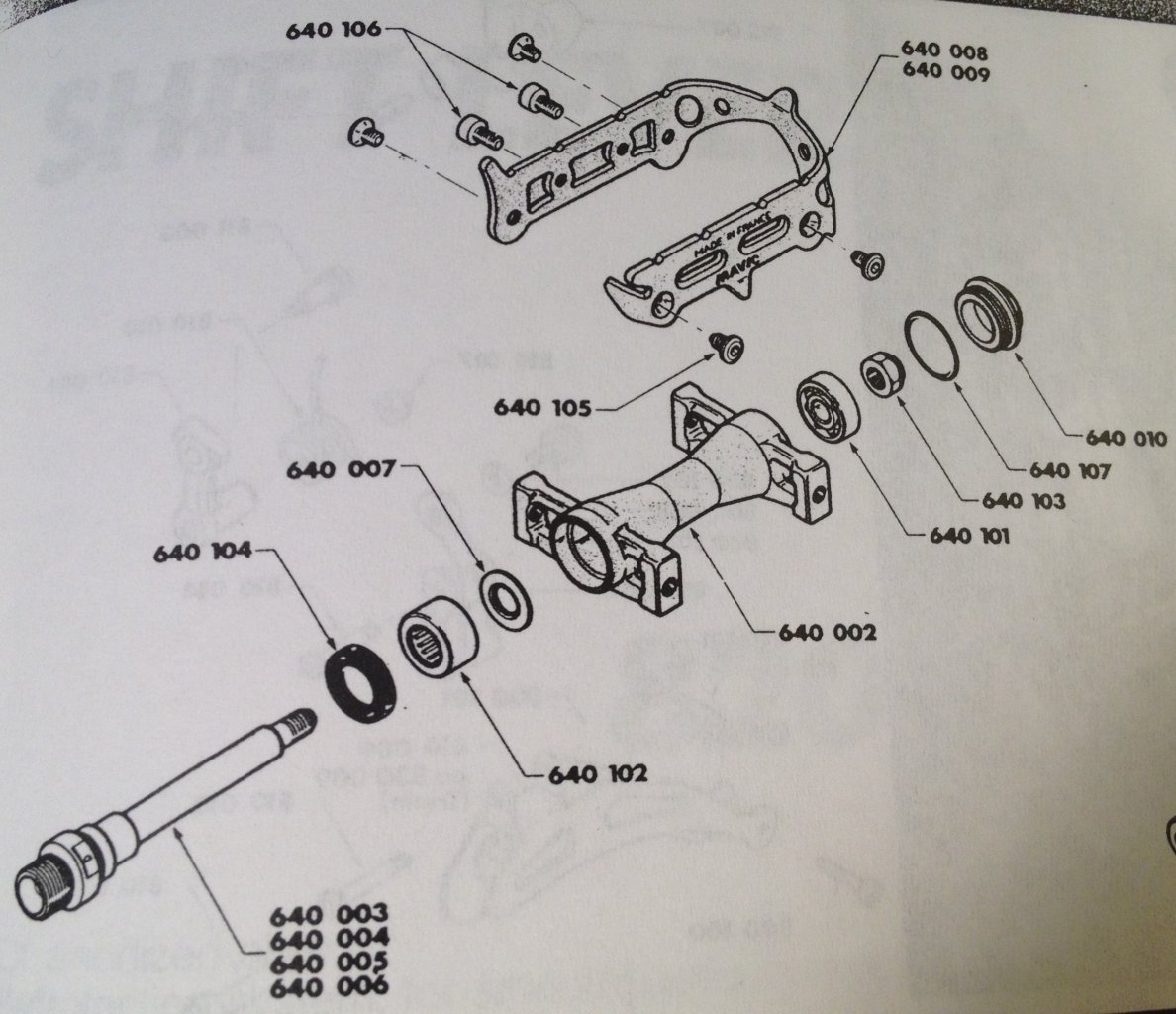
Inside things get get interesting. After removing the the aluminum dust cap, removing the spindle nut and spindle, the inner roller bearing and a traditional sealed bearing are exposed. Roller bearing on the inside bearing surface, traditional on the outer.

If you think the 640 bears an uncanny resemblance to the Specialites TA pedal, you're not alone. While I can't find definitive proof, I think it's a given that the 640 is at least based on the TA pedal. It's possible that Mavic licensed the design, worked from forgings provided by TA, or had TA do everything - the latter two possibilities all things they're known to have done with other components and manufacturers. By all rights, the TA version is nicer - grease port in the end cap, replaceable flip tabs, curvier cage. A very elegant quill pedal - if you're in to that sort of thing.

Parts explosion for those who find themselves with 640's in need of a rebuild.

Kids, if years from now you're reading this, know that it's totally you (whoever is reading this) that is my secret favorite. I never liked that other kid.

Tuesday, June 04, 2013

Mavic's other flight of fancy

Besides electronic shifting, that is. The scale of this, however, was a little grander...

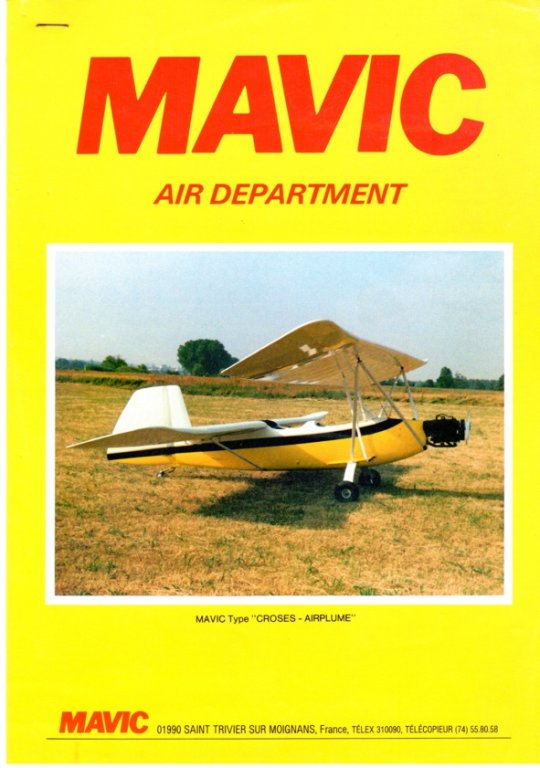
Apparently, around 1984, Mavic opened their Air Department. Bruno Gormand, head of Mavic and the driving force behind their innovation since the mid-60s, was, it would seem, something of a modern renaissance man, pushing Mavic beyond the earth-bound limitations of bicycles. Those limitations would return following his death in 1985, and the dissolution of the Air Department.


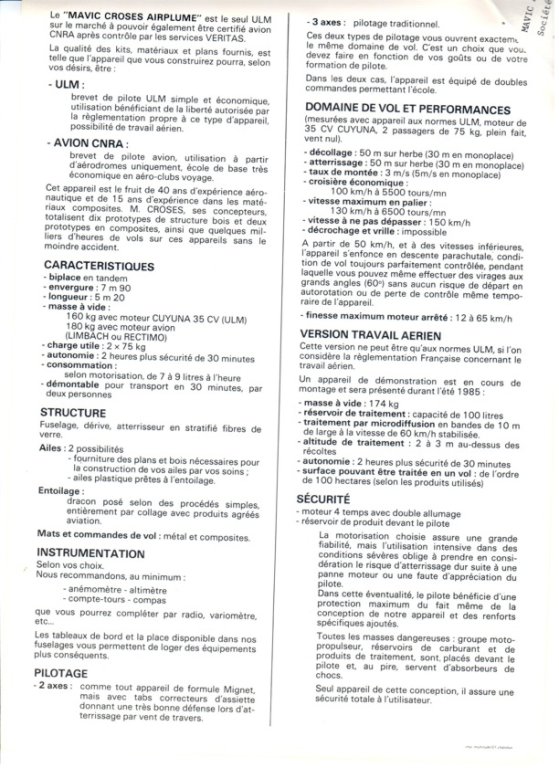
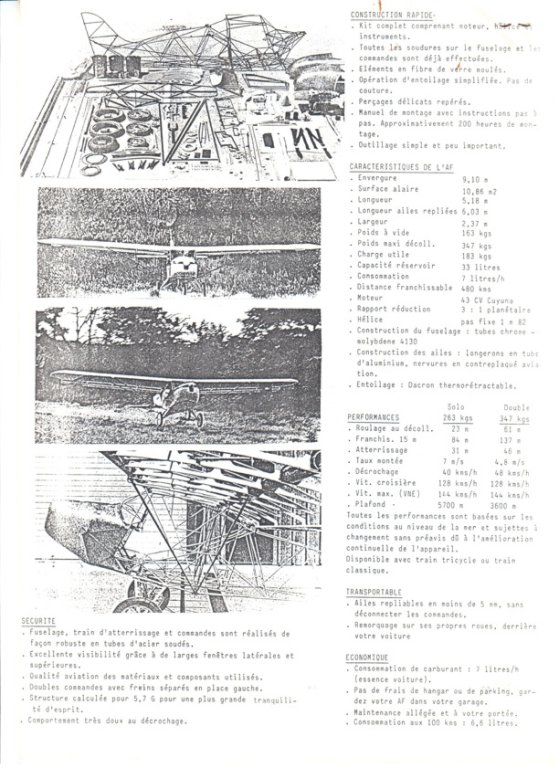
The top image is of the 'Airplume' plane, an open cockpit 2 seater. The 2nd image is its spec sheet. The third shows photos and specs for the 'Avid Flyer' variant Mavic made, which is simply labeled 'Avion Experimental' in the photocopied sheet I have. I haven't included the cover as the quality is fairly low - but would be happy to if requested.

Friday, May 31, 2013

Patent Searching

Patent searches are tons of fun. Here are a couple of patents I found that I wanted to share:

Online patent searches provide a wealth of information about the workings of some of our favorite equipment - as well as the innovations, successful and otherwise, that preceded them. The slight variations and changes that happened from patent submission to real world implementation (note the spring setup on the Syncro patent, for instance) are really cool. Even cooler are the abortive attempts - take for instance this patent from Campagnolo, which was issued around the same time - it seems to be a slip-proof shift lever where the hinged part sort of acts as a brake on the spring (???), the need for which was probably negated by their "success" with Syncro. WTF indeed.

The pictures are truly worth the thousands of words that comprise the patents. If you come across anything cool, leave it in a comment below.

The picture-linked patents above are for the Mavic 571 face-pawl cassette hub, the Campagnolo Delta Brake, the Campagnolo Syncro 1 shifter and the original Shimano STI shifters