Sunday, September 23, 2007

The Tears for Gears Merckx Team bike challenge

So as I noted in my last post, there are probably a ton of Merckx team frames I know nothing about. There are some main stream(ish) teams I haven't been able to track down, and dozens and dozens of continental teams I've never heard of, let alone seen a picture of.

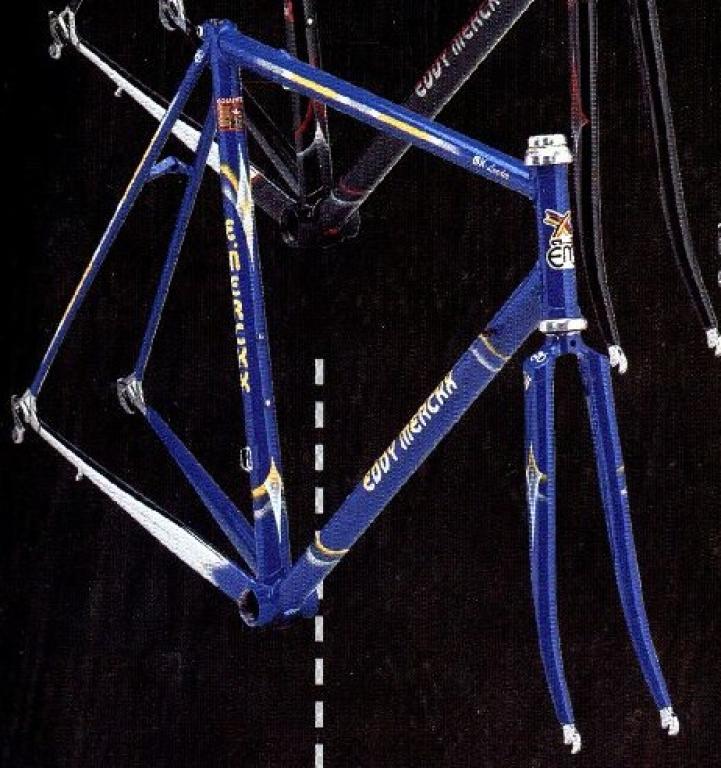
There are also a couple of frames I suspect are team frames I've just never been able to figure out, including


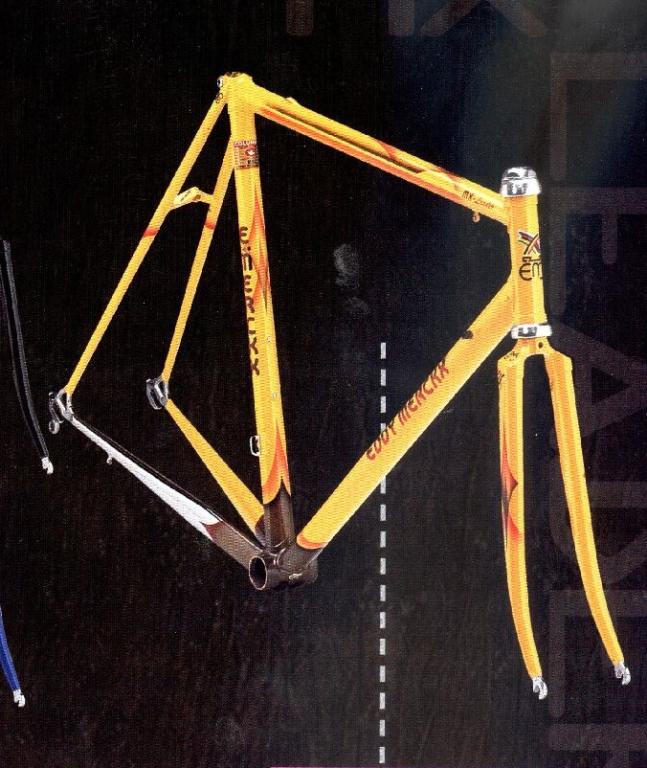
and


So here's the challenge. The person who can find and identify the most Merckx team frames which I do NOT have not talked about in my blog posts or in the serial list will win a prize:


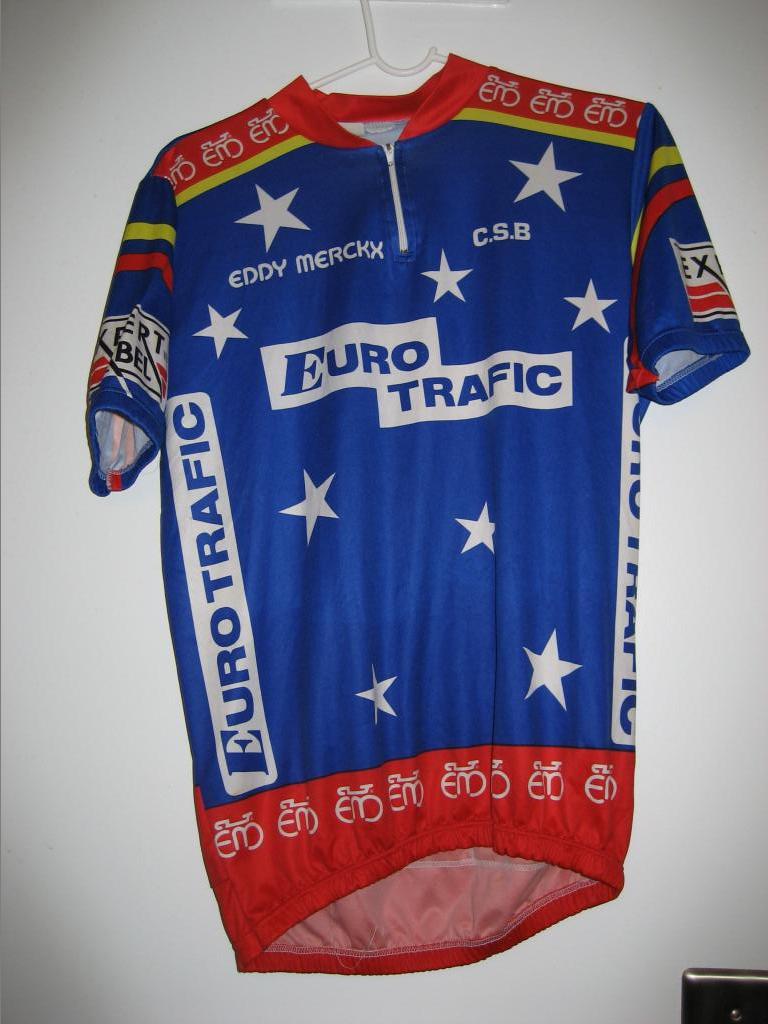
A Euro Trafic Merckx team jersey. Its not a new jersey, its actually a former team jersey, so it has some wear and tear, but I bet no one else will show up at your next club ride wearing one! I'll pay shipping and everything...all you have to do is follow some simple rules...

I'm looking for more teams riding Eddy Merckx bikes from 1980 through about 1998. This primarily means steel frames, built in the Merckx factory in Belgium. To positively identify a Merckx team color scheme, you need only send me a clear picture of a team rider on the frame that shows the primary details of the color scheme. A team color scheme means that the whole team rode/rides that scheme. If there's a color scheme i've missed for a team I've already identified, that counts -- I bet there's at least 1 other Kelme. I'll set a deadline of November 1, 2007.

You can send me info at merckxteams AT tearsforgears DOT com. The two frames above are a decent place to start -- that I can't ID them is driving me crazy. The top is from 1986/87, and the bottom from 1988/89. Good luck, and send me what you have! If you're the only person to respond, you just may win!

Still no new teams sent in! All it takes at this point to walk away with the super cool jersey above is identifying one new team. That's it! I'll mail the jersey anywhere in the world, postage paid for by me!

The last of the Merckx team frames...

Wow, today is going to be a 3 post day. I figure, before my little challenge can begin, I need to put out the last of the team frames I know about up. Without further ado...


The United States' first team to make it in the pro peloton ranks, 7-Eleven! After years of having their downtubes sullied with Huffy and Murray decals, they switched in 1989 to Eddy Merckx frames for their final two seasons.

In 1990, 7-Eleven folded and was reborn as...


Motorola. The above is Michael Dernies' team issue Motorola Merckx, in Columbus TSX. Motorola is best known by many as the team Lance Armstrong rode for when he won the worlds in 1993. Here's a picture of Michael Dernies on his Motorola Merckx. Maybe its the same one (or maybe not).

OK, we're on a roll. Here are some of the Merckx riding teams in the last years of steel:


In 1996, Gan rode blue MX Leaders and Arcabaleno's, as you can see in this picture. In 1997, they switched to white frames, that look like steel -- . If they were riding steel in 1998, I'd be pretty surprised.

And contrary to what I thought, they were riding white Arcabaleno's as late as 1998


Vlaanderen 2002 rode yellow MX Leaders, as seen here, here, and here.

Finally, it looks like S.E.F.B. Spaarbank rode the same colors as Domex/Weinmann in 1989.

So thats all of the Merckx team frames I've found. There are a few I know I'm missing, including IPSO/Euroclean, Hueso, Westwood...I know someone out there knows a couple of those. With my next post, hopefully I'll motivate some of you to lend me a hand.

Telekom and Kelme Merckx Team Bikes

The procrastination has gone on long enough! It's time to publish my next installment of Merckx team bike frames. Let's go!


Telekom used Merckx frames from 1991-1995. The above is the color scheme I most associate with Telekom -- you can see it in this team photo from 1994.

What you might not know is, in 1995, Telekom changed its name to Team Deutsche Telekom, and changed its bike color scheme to the one you can just make out in this picture of a young Jan Ullrich. Its a pink head and top tube, with purple points. Its more or less as if they flipped the colors on their previous scheme, and called it new. At least they didn't have to change their jersey colors. They shifted to Pinarello frames in '96, so this color scheme only lasted a year -- so if they were available to the public, it would have been a pretty short time frame.

OK, its Kelme time. Given how long Kelme was around, you'd think I'd have seen more examples of bikes in the public sporting Kelme colors, but you'd be wrong.

In early years, Kelme rode an all white frame, as seen here, as well as a all blue frame, as seen here.

In 1985 and/or 1986, Kelme used the same red/pink/white frames that Lotto and Teve Blad did, as seen here.

In 1987, they switched to what I think is a pretty awesome color scheme, seen here, that matched their jersey's perfectly. I think they kept this frame through 1989.

At some point, for reasons I can't fathom, they switched to this color scheme. The switch was in either 1990 or 1991...I can find pictures in this scheme that I'm sure are 1991, but I haven't found any good shots of a rider on one wearing the Kelme/Ibexpress jersey from 1990. Anyhow, the color scheme looks a lot like Telekom, but with a green bottom bracket and rear triangle. Its fine, but its no '87-89 color scheme if you ask me. Not that you did.

Next team post will cover the 7/11, and two of the last pro teams that Merckx sponsored on steel, Motorola and Gan.

This post is a little light on the eye candy...so light in fact, that later tonight I'm going to post a CHALLENGE! With a really excellent prize! Stay tuned...

Wednesday, September 12, 2007

Still more Merckx team colors...

Still hanging in there? Only 10 or so more teams to go! And this post is going to be a big one...


Panasonic seems to be primarily thought of as a Raleigh team, but in 1986, they were riding white with blue points Merckxes.

The color scheme was a popular one. Another top pro team got the same color scheme, relabled as Caloi, in 1993/1994...that team being Lotto.

Speaking of Lotto...those guys rode quite a few different Merckx color schemes.


No, not all of the above! In 1985, they rode a yellow with white panels color scheme, as seen in this team photo. To be honest, I'm not sure they used the font in the picture above. It's possible it was the same font that...

Europ Decor rode in 1984. Prior to that, they rode blue metallic with white panels.

Back to Lotto. In 1986, they moved to an all red scheme, and kept it (I think!) through 1987. The only thing that differentiates it from the normal stock frames is that the seat tube has vertical Eddy Merckx lettering, while bikes for us mortals just had the EM logo and the France/Italy world champ bands. Here's a mediocre picture where you can see what I'm talking about.


In 1988, they moved to the above, red and white, pointed scheme, as seen here. And in 1989, they moved off Merckx bikes, and on to Vitus.

Michel Dernies seems to have ridden on teams Merckx sponsored for all but the earliest years of his career -- starting in 1985 for Lotto, to Domex/Weinmann in 1989-1991, to Motorola through 1995. Being from Belgium, I guess its not that odd, but I thought it was worth noting. It also has nothing to do with team paint schemes.

Remember that red and white pointed bike I was talking about before that nonsequitor? Well, it was also ridden by Teve Blad, in 1986 and 1987. I highly recommend looking at the pics of their riders -- they did a photoshoot that makes them all look fairly ridiculous. I have no idea what color frames they rode in 1985, so let me know if you do.

Wow, I'm tired! I know I promised Kelme in this post too, but its too much! Panasonic, Lotto, Europ Decor and Teve Blad, combined, rode 5 color schemes. I think Kelme rode at least 3, possibly 4, so they have to wait. I'll get to them in the next post, along with Telekom.

Monday, September 10, 2007

Merckx Rebranding (and another team frame)

Yes, yes, I promised the next post would be more team bikes, but sometimes a guy gets busy, and can't get things together for a proper post.

Luckily, someone who read one of my previous posts sent me me interesting catalog scans. Michele lives over in Sweden, and was the person who let me know that in his area of the world, the Stuttgart color scheme is also know as the PK-Banken scheme. He owns a stunning example of a frame in the same color scheme, fitted out in full Croce d'Aune. He has a few other bikes that are really nice as well.


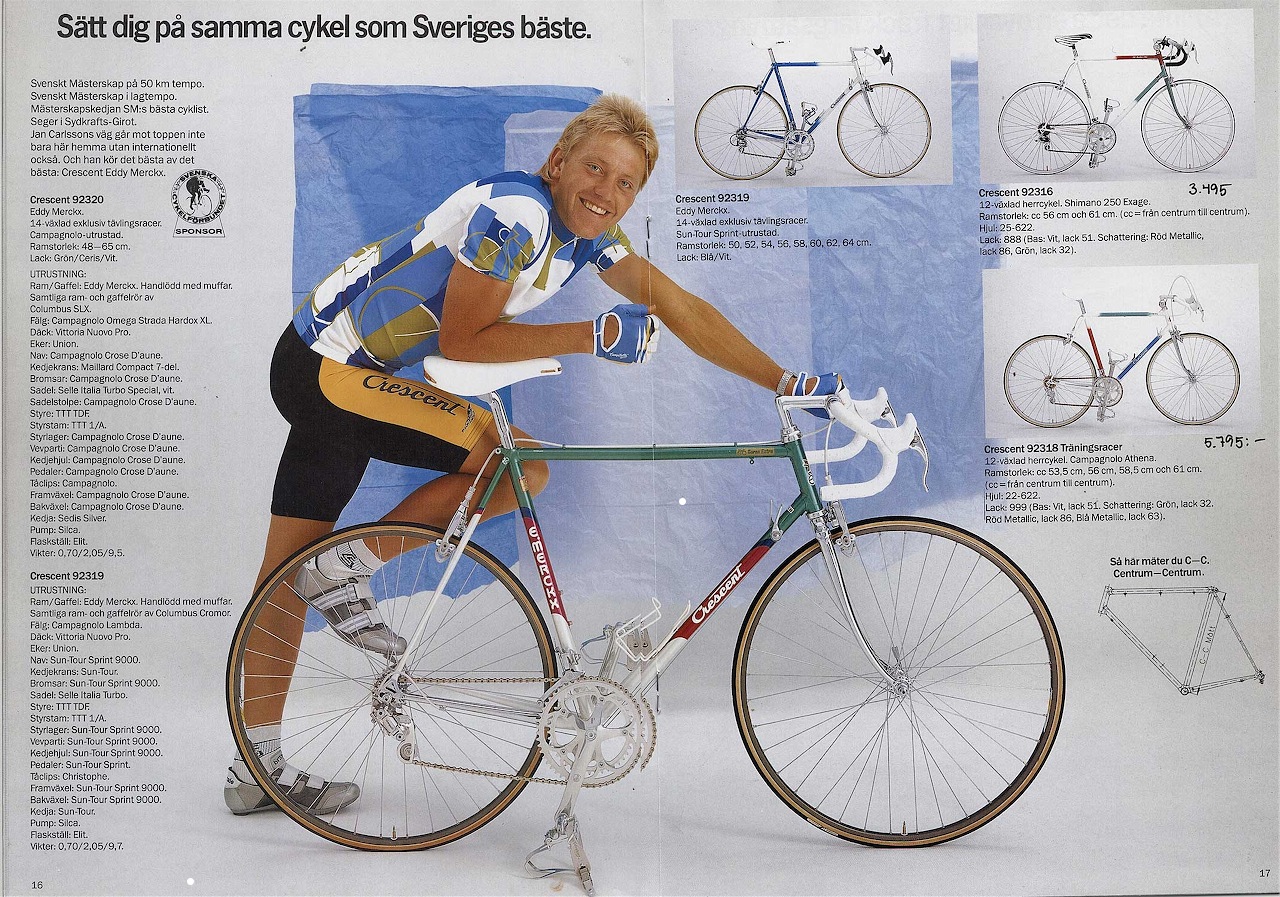
He sent along this scan from the 1990 Crescent catalog. In it, you can see a Crescent AND Merckx labeled frame in the Stuttgart/PK-Banken color scheme, ridden by Jan Carlsson, who I'm told was the Swedish time trial champion.


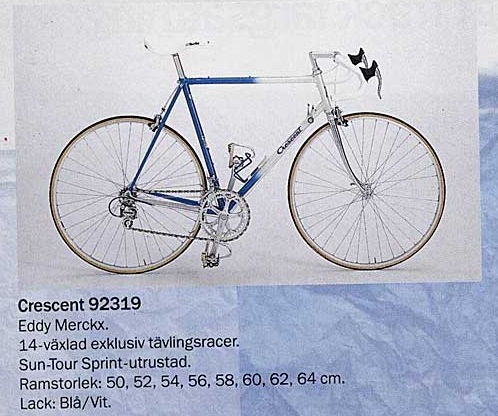
In the same scan, you can also see a blue and white fade Merckx. The same color scheme was used by...

Intral-Renting in 1988.

He also sent along a scan of a relabeled Merckx frame from the 1989 catalog...but since its the same color as the frame of 2 teams we haven't discussed yet, it'll have to wait...

Monday, September 03, 2007

More Merckx team bikes...

First up, we have the La William team from 1989. They rode a yellow and blue frame, with a lighter blue point. I've never seen one. I have no idea if the scheme was ever available to the public. Anyone have one?

Domex/Weinmann, and later just Weinmann, were responsible for 2 separate team liveries.

The Domex/Weinmann team frame was a pretty attractive one, in white and blue, with orange accents. While the team photo, in black and white, is entirely useless, a picture here shows it off nicely. Strangely, however, my serial number database doesn't have any examples. I'm almost positive, however, that I've seen them. Do you have one? How is it you haven't sent me pictures and your serial yet?!


In 1990 and 1991, Domex and Weinmann split up. The Weinmann team continued on Merckxs, in a new color scheme, as seen above. To go with the worlds ugliest jersey, they settled on a color scheme that, strangely, works. Course, I'm the guy with the purple and orange blog color scheme, so take that opinion with a grain of salt. For those of you who don't believe anyone would match hot pink with neon yellow and purple, here's just one sample of a team member in a publicity shot. They all look equally confused at how a color blind person managed to design their color scheme.


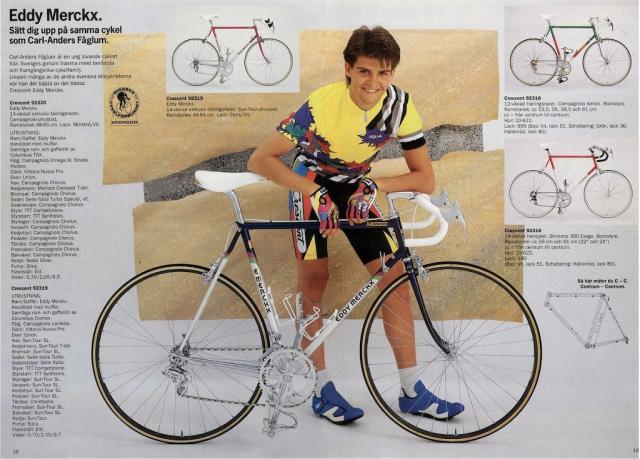
I finally found evidence of what I've suspected -- that the Weinmann color scheme in 1990 is a little different. You can see it above from a Crescent catalog. It lacks the pink rear triangle and bottom bracket areas, and reverses the green and pink in the points -- as seen here.


You may be noticing, I'm a big fan of de weilersite, aka cyclingwebsite.net for those of you who, like me, don't speak dutch, as well as hour.be. I don't speak flemish either, but the list of teams can be found here, and riders here.

Next up, we'll shift to some of the pretty well known teams: Lotto, Kelme and Panasonic.

Saturday, August 11, 2007

Merckx team bikes

In the mid-80's through mid-90's, Merckx sponsored a number of professional cycling teams. Each had a specific color layout for their frames. Some of them are very familiar -- the purple and pink of Telekom, the red and green of 7-11, while some of them are a little less familiar. Here's a list of the ones I've documented. Where there are examples in the Merckx serial list, I show a picture. Where I don't have a sample frame picture, I'll link to a picture of a team member astride one. I'll post a few color schemes each day. I'm lazy like that.

Its worth noting that some of the team livery frames were ridden by multiple teams, seperated by a few years...in at least one case, 7 years.


ADR, from 1988. You can see a picture of Eddy Planckaert astride one here.


Team Stuttgart, 1989 and 1990. Here's a picture of the entire team. These guys went on to form the basis of Team Telekom in 1991. Kinda makes you wonder just whats in that puma bag in the picture...

A reader was kind enough to drop me an email, letting me know that in Sweden, this color scheme was associated with the PK-Banken semi-professional team. We'll see another example of this with a different color scheme, where the second team rode the same frame labeled as a Caloi. Any guesses on the teams?


Team Hitachi, 1988/89. Claude Criquielion riding his, in the 1988 TdF.

Next post, I'll cover the Domex/Weinmann team frames (there are a few), and La William. Exciting, no?

Thursday, June 21, 2007

Syncro Tips and Tricks


I've had a few people email me looking for some insight on setting up Syncro shifters. I don't claim to be all knowing on the subject, but I have had some success based on info I've read, as well as a couple of tricks I've picked up.
 
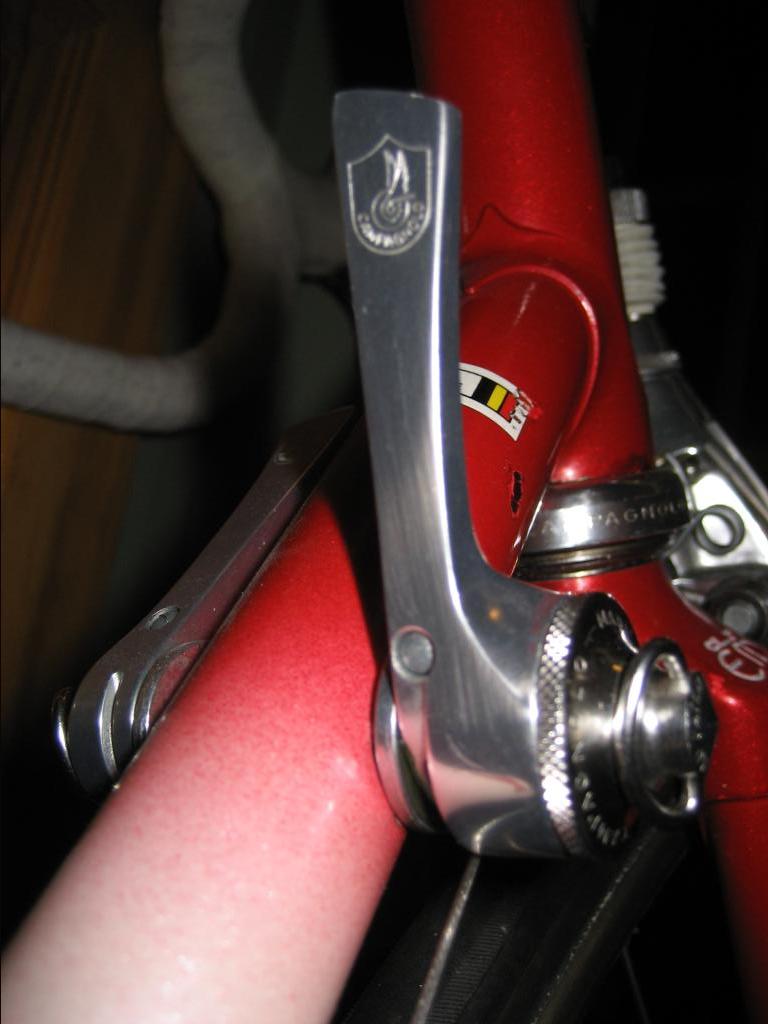
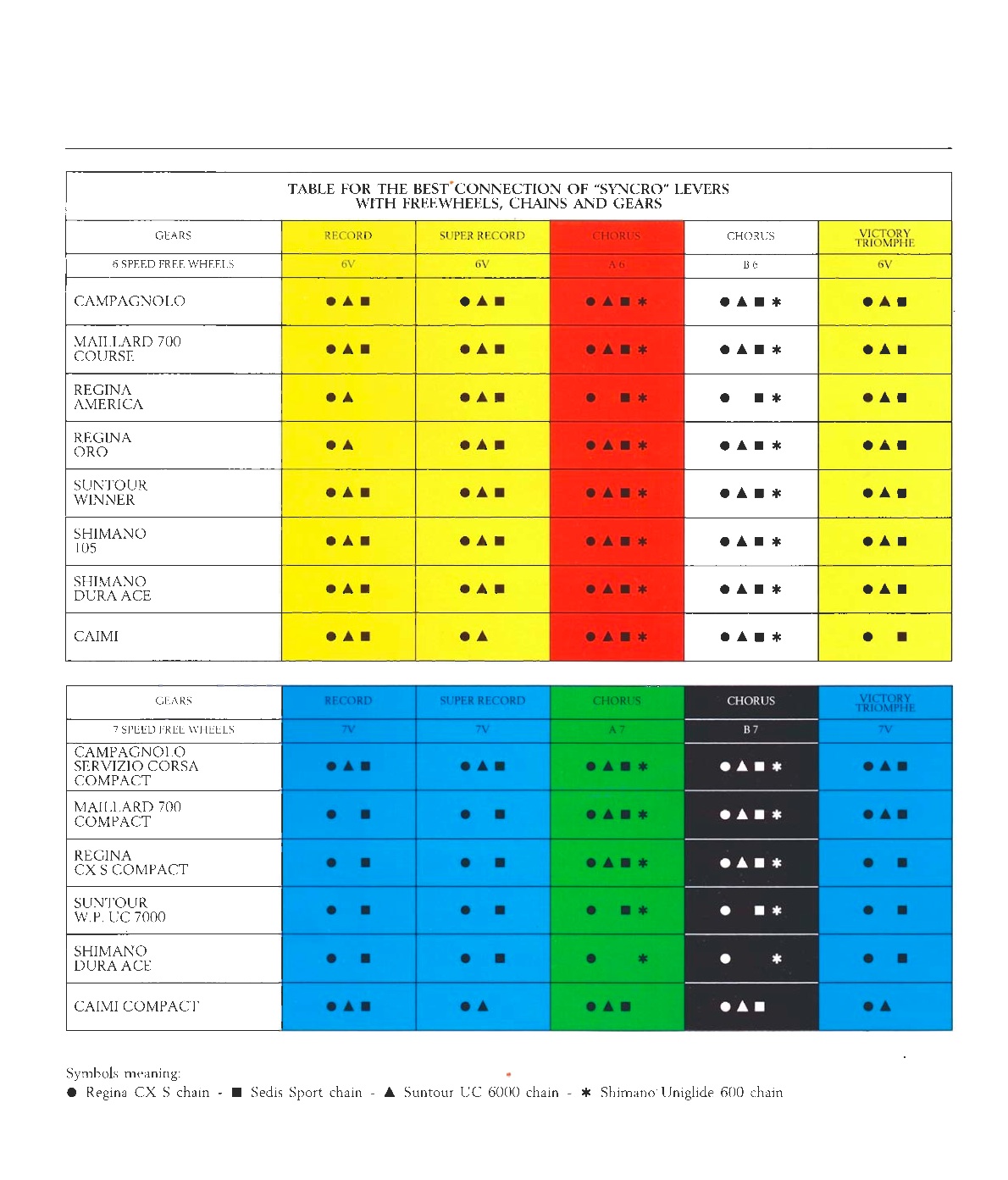
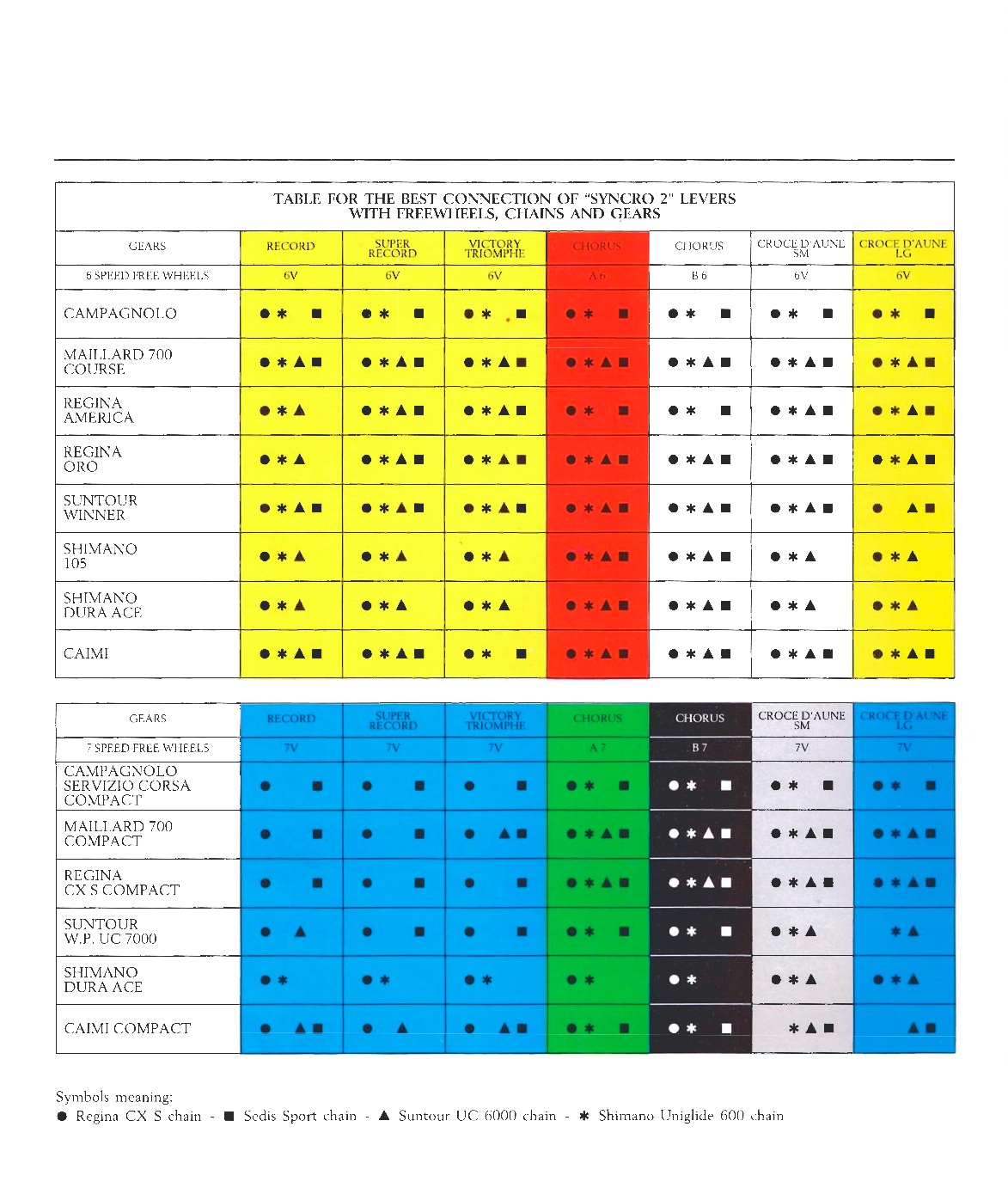
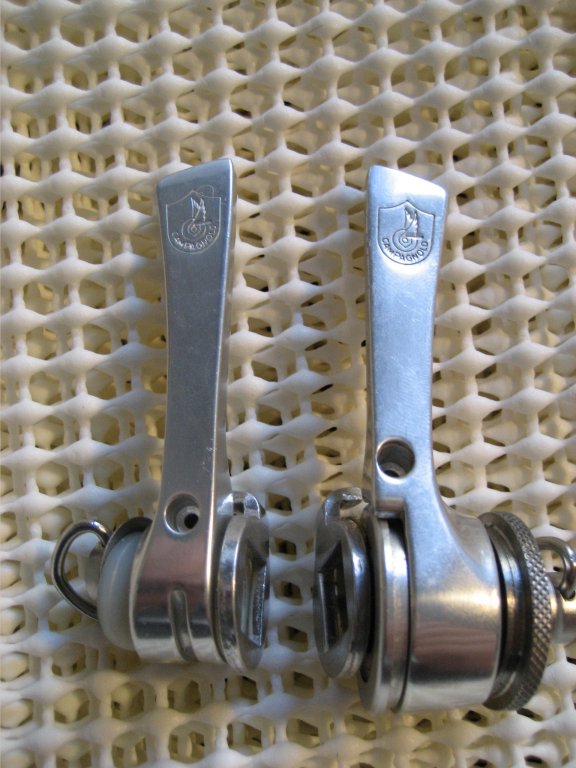
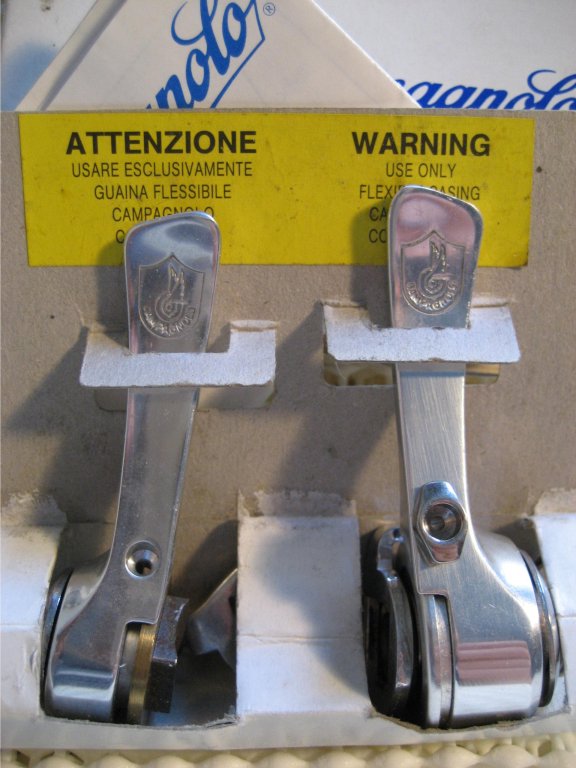
Syncro      Syncro2

First things first. The first thing you MUST do is consult the tables provided by Campagnolo with regards to what combinations of freewheel, chain, dérailleur and shift collar work together. Yes -- the different colors of collars can be hard to find. In some ways, I'd suggest selecting your derailleur, freewheel and chain based on the collars you have access to. Some substitutions will work better than others, but unless you have lots of time and lots of spares, stick with something that Campy published as working. It can be hard enough setting up Syncro with the correct equipment.


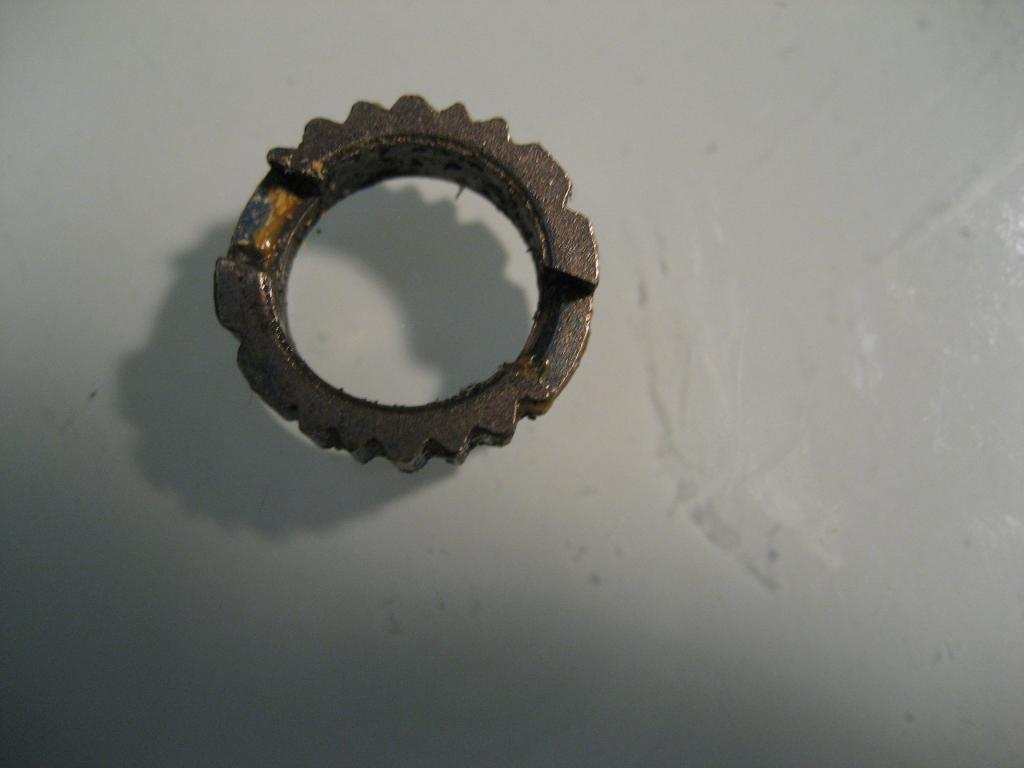
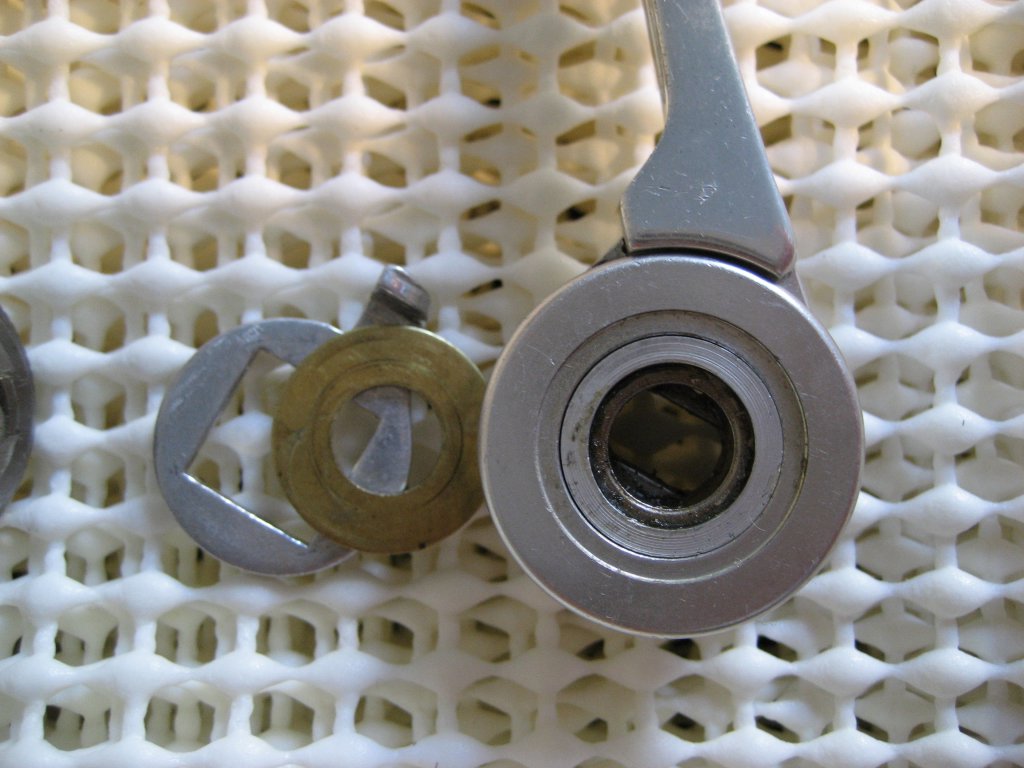
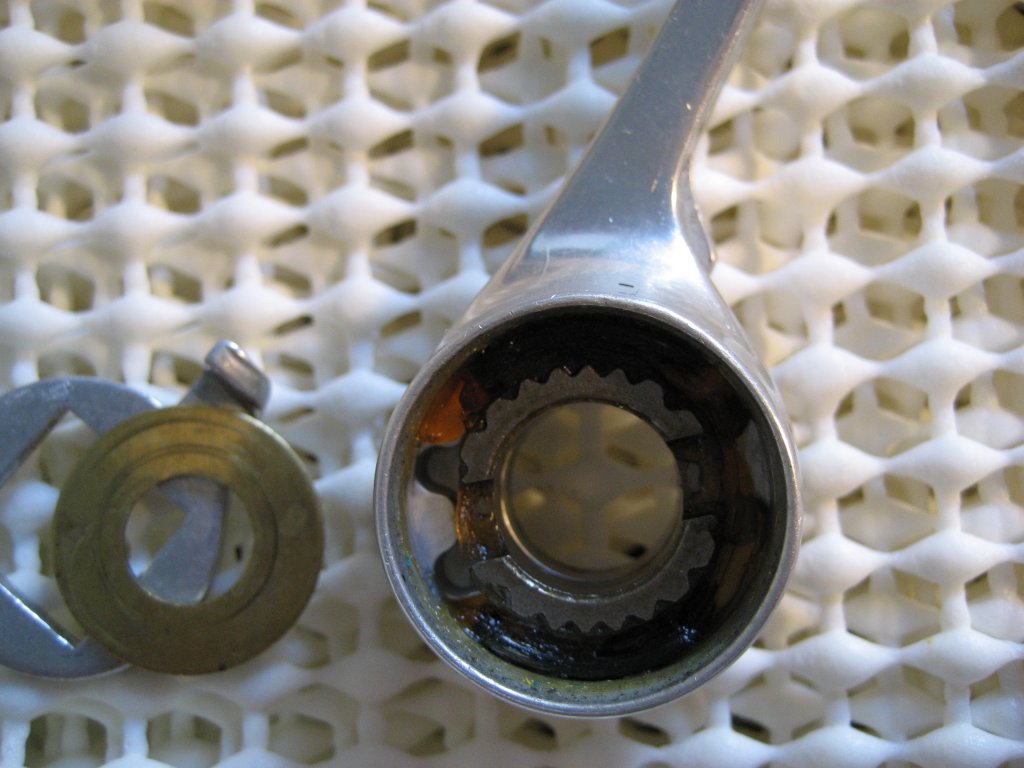
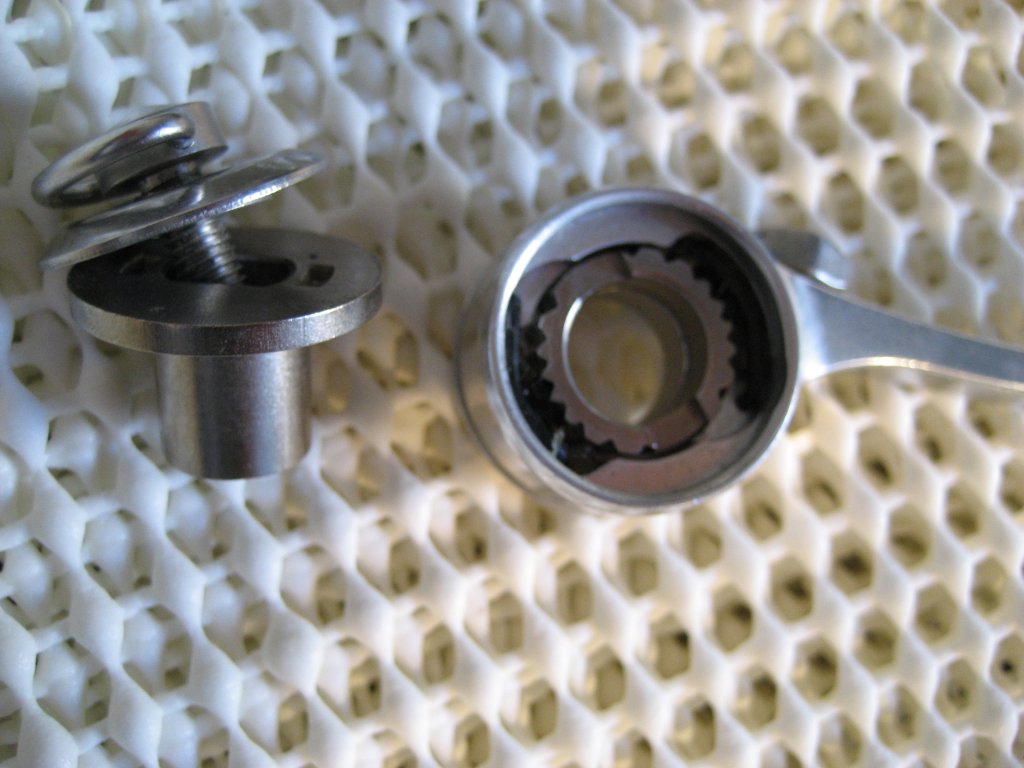
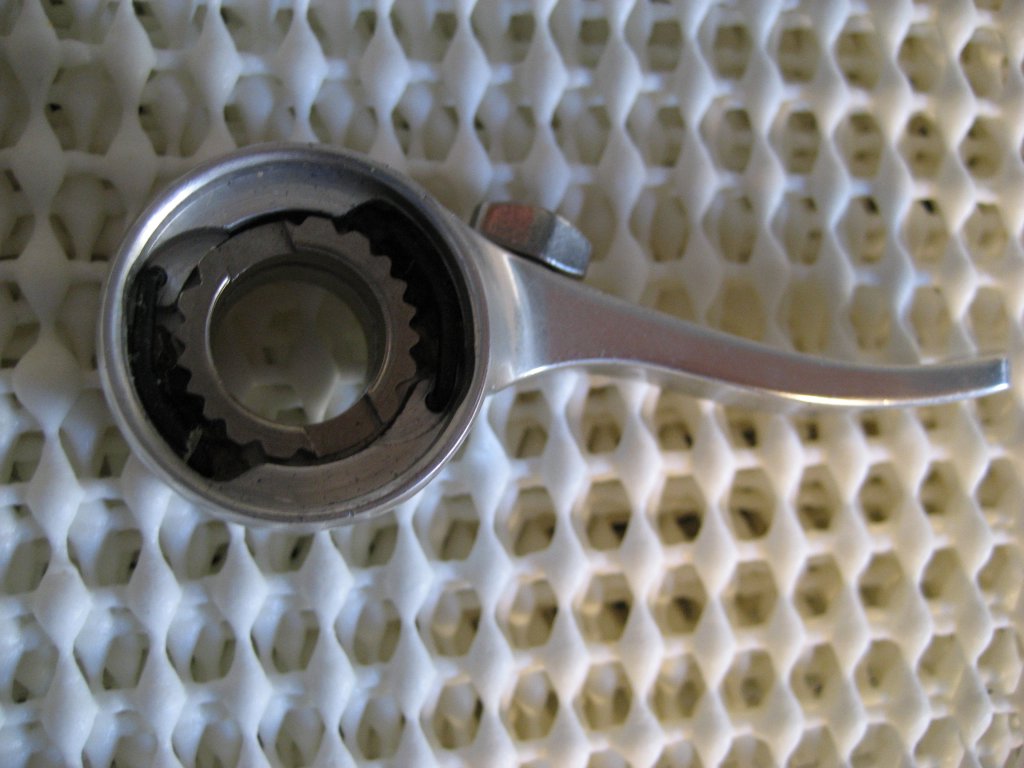
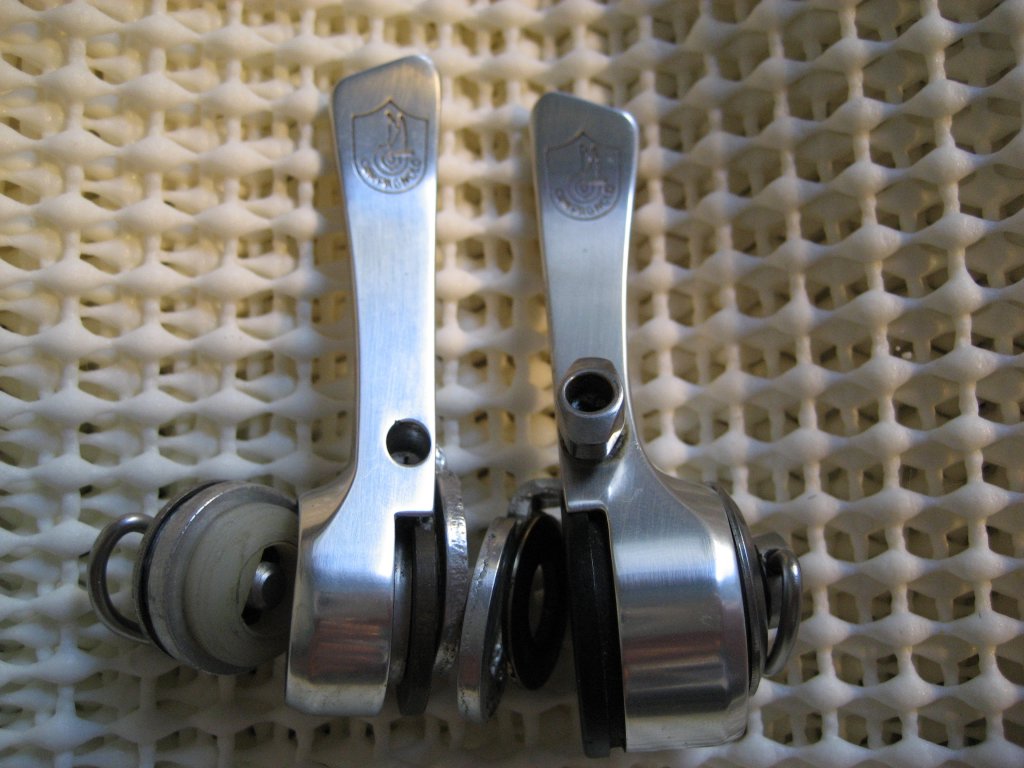
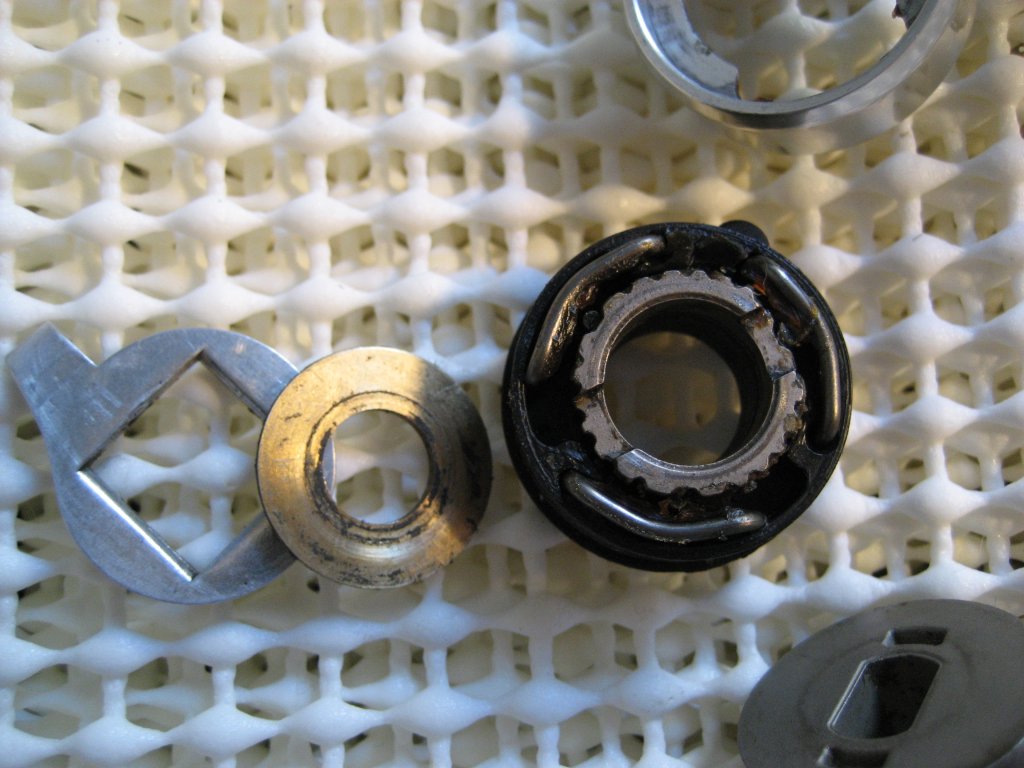
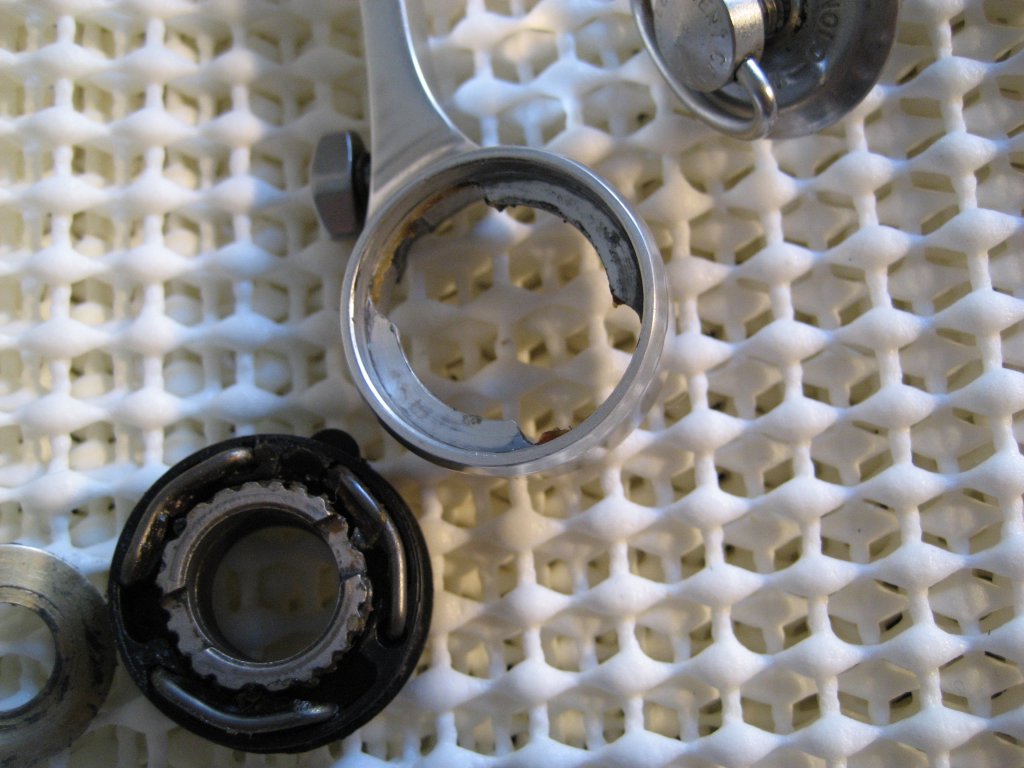
One tip I read that seems to help comes courtesy of a usenet post by Andrew Muzi over at Yellow Jersey. He advocates artificially wearing the teeth of the shifter notched insert, using a buffing wheel. I used a dremel with a little bit of buffing compound, which also works. The goal is to take some of the square edges off the teeth of the collar. This eliminates some of the harsh edges you'll encounter when shifting, and make the whole system a little more tolerant of imperfect shifts. The above shows a slightly worn blue insert. Might be hard to see in the picture, but the tops of the notches begin to round slightly when they wear. The goal is to simulate repeated shifting, and eliminate any break in time for the shifter.

There are also some who advocate using a floating upper pulley -- similar to the kind you'd find in a modern derailleur. The bearing units tend to be more precise, and indexing systems can benefit from a little wobble as they're shifting. It provides a little overshift, to get the chain up on the next cog, and then lets it sort of float back to the appropriate location. Personally, I haven't had to resort to this, but it may make the system a little less finicky.


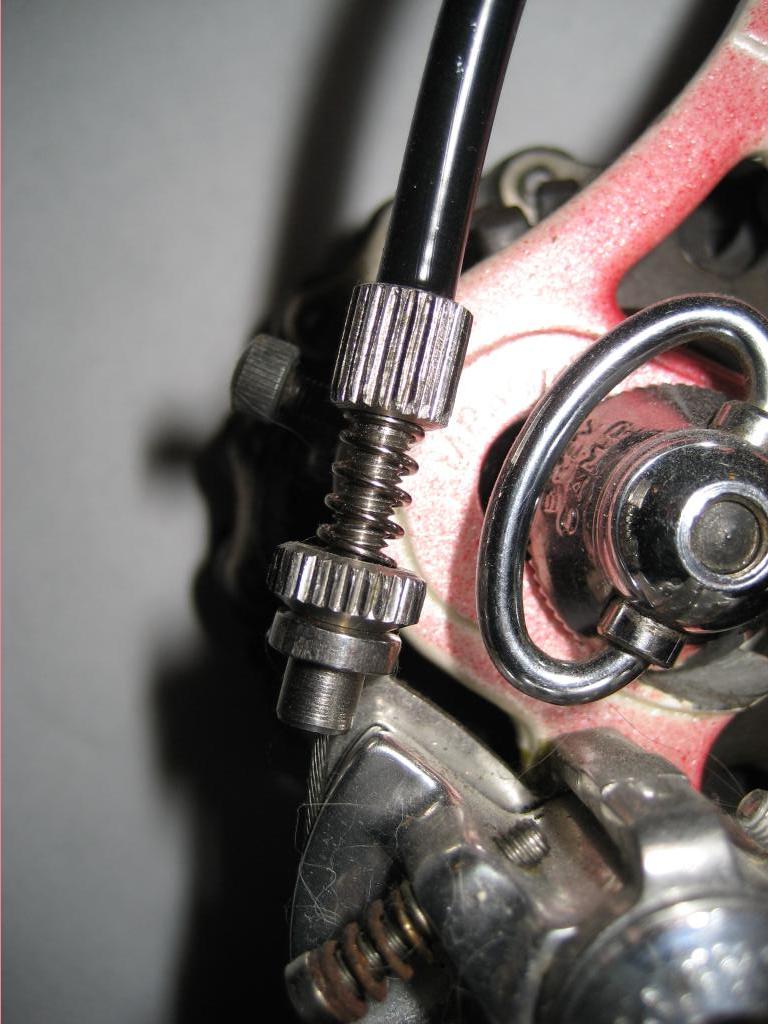
If your derailleur doesn't have a barrel adjuster, it should. Some Syncro shifter sets came with one, and once Syncro continued, derailleurs came with them. You need this for the fine-trim on your derailleur. The Campy supplied one is shown above, but you can cobble one together from your parts box.

One thing I've never read anywhere, but really seems to have a positive effect, is tightening the indexing lever more than you'd think. If you're used to modern indexing systems, you know the tension on the lever really has no impact on the quality of shifting. The tension isn't really all that adjustable. On the Syncro, however, having it snugged down further than you think seems to improve shifting accuracy immeasurably. If you hear a discreet 'click' when you shift, make them tighter! Mine make more of a thump sound when shifting...If you're used to friction levers, you will not end up tightening the indexing lever enough. Don't strip anything, but don't be shy either. I think this is related to the 2 springs not providing support for the insert when not tightened down (hence the eventual move to a much much better 3 spring version post-95). Just be careful -- I've seen cracked inserts before.

Use modern derailleur cables. They don't have as much stretch in them, and that seems to be a good thing. The use of linear cable housing may also be a wise thing, although I have to admit -- I'm using spiral housing successfully.

My setup works beautifully, if I do say so myself. I do *not* have to overshift, which was a common complaint with these. I think the wearing of the collar, in conjuction with the tight indexing lever makes all the difference. Curious about my setup? I use a Croce d'Aune derailleur, Regina Oro freewheel, CX chain and the yellow collar with Syncro 2 levers.

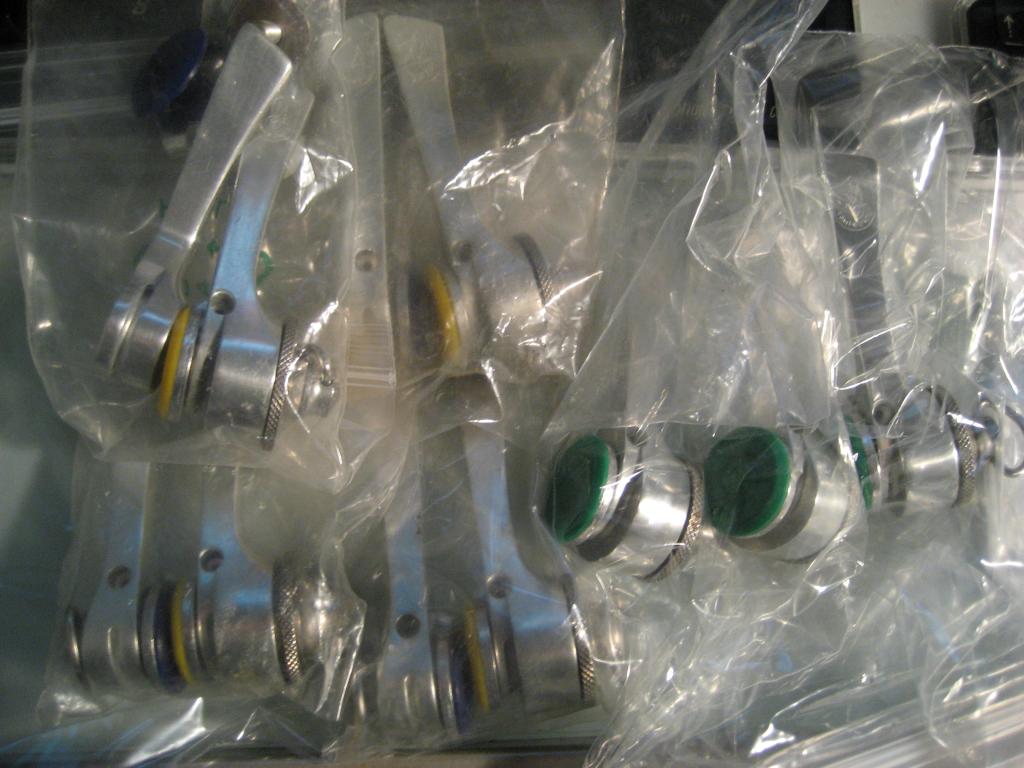
Here's a gratuitous picture -- a pile of NOS Syncro II's. Its all part of my effort to corner the market in obsolete, inferior technology.

Friday, May 11, 2007

The last gasps of Syncro

When people think of Syncro shifters, they tend to think of 2 versions. The original version, with the little lever on the side, and then Syncro 2, which I detailed in an earlier blog post. That really doesn't show the big picture -- the introduction of 8 speed cassettes and Ergopower didn't herald the end of the downtube shifter.


1991 saw the introduction of 8 speeds for us mortals. But in order to take up 8 speeds worth of shifting, without having to bend the lever past the downtube, some changes had to be made


A larger takeup barrel was added. But that was basically the only change made to the 1991 version. Flat shifter lever, and the identical innards to the Syncro 2.


1992 saw some more obvious changes to the shifter. The ability to switch between friction and indexed was done away with -- no longer could you pull out a collar and rotate it to disengage the indexing cog. The lever itself was curved, for your comfort.


The innards were also mildly changed, but the 2-spring arrangement of Syncro 2 remained. A small adjuster was added to the rear shifter to allow the "possibility of adjustment while racing" -- which is probably Campy speak for "compensate for our mediocre design while riding."

The left/front lever was also redesigned...but its still a friction shifter. Nothing too exciting there. If you're reading this with the hope of seeing it, just place a comment indicating you'd like to see it, and I'll add some pictures.


1995 saw the final redesign of the lever. Outside it looks fairly similar, but inside it saw a pretty significant change.


A insert contains all the shifting bits. A new 3-spring design was employed. The upside to this was better support around the collar, which gave improved precision to the whole mechanism.

This design still lives. Campagnolo discontinued downtube shifters altogether in 2001, but the same design is used for the 10 speed bar end shifters today. If you wanted 10 speed indexed shifters, you'd just need a set of stops, and a set of the bar end shifters, or a set of the 95+ shifters, and a 10 speed indexing collar.
Thursday, March 29, 2007

Colnago Branded Delta's

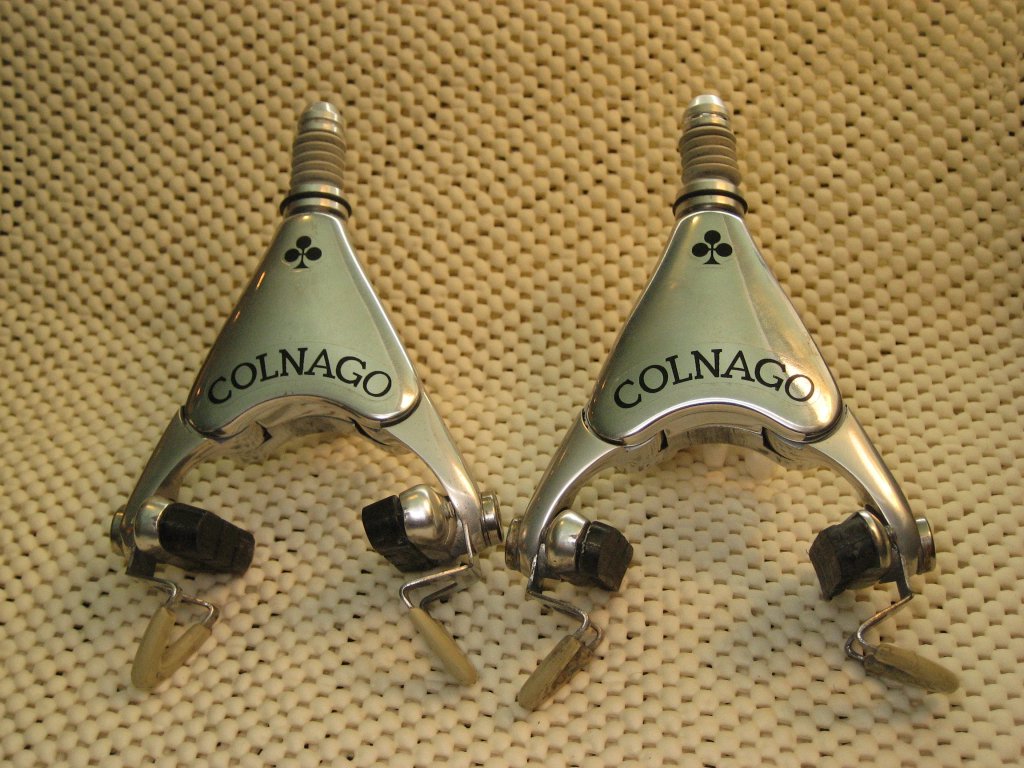
Whole lotta Campy Delta happenings around here. This set is pretty neat:


Colnago polished-and-labeled Record Delta's. Soooo pretty. Makes me want to buy a Colnago just to have a place to put them.

Tuesday, March 20, 2007

Campy Delta's

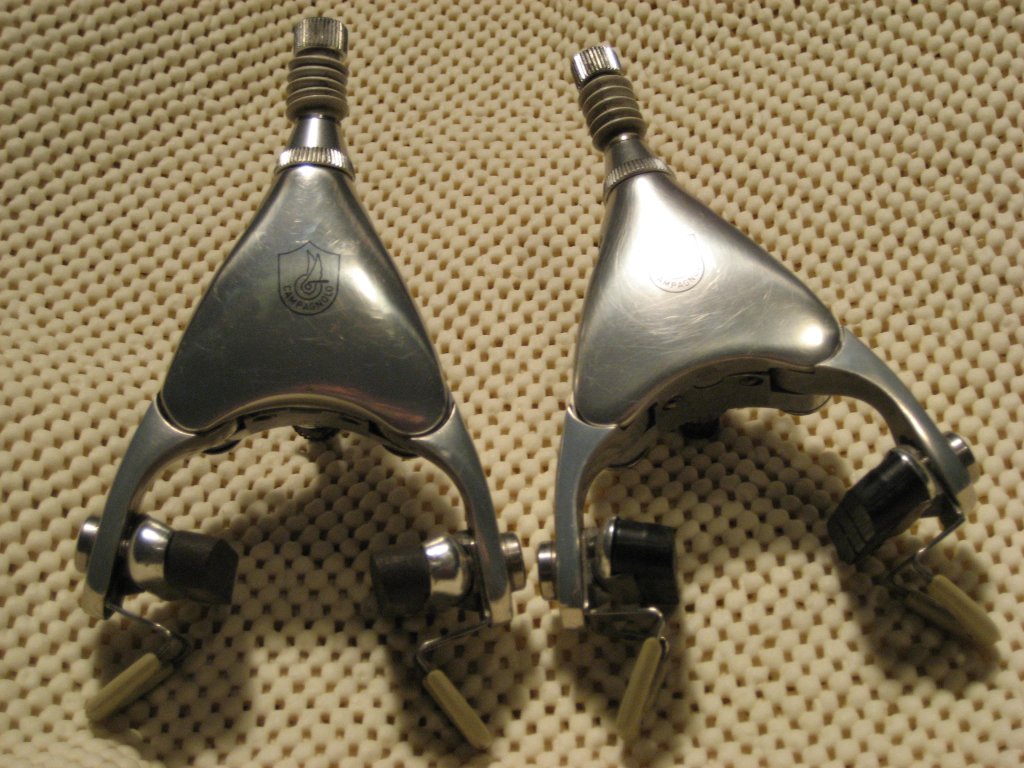
I've got a couple of sets of Campagnolo Delta brakes. Maybe I'm in the minority, but I like them. They feather well, and if I need to come to a screeching halt, they can do that too. And no brake looks as cool


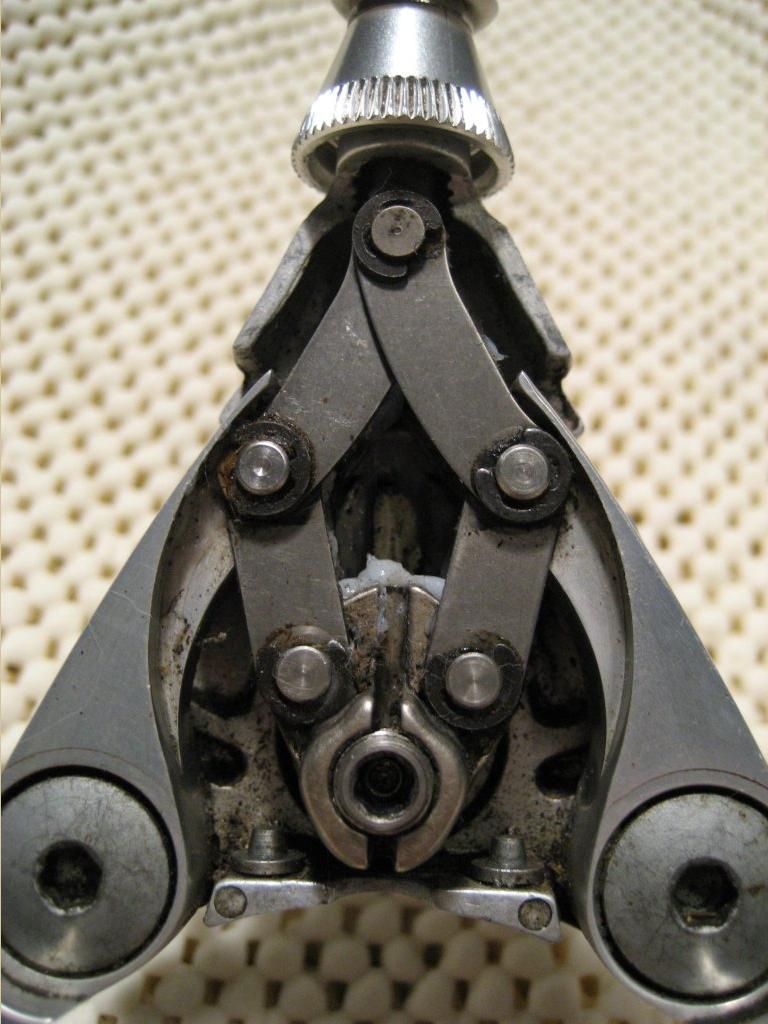
This set is the Croce d'Aune version. Whole lotta engineering going on in these. let's take a peek.


Inside the Croce d'Aune Delta. See those 2 studs at the bottom? Those hold the bottom of the front plate on. The internal is a diamond linkage -- the linkage sandwiches the arms, cable fixing bolts, and a hollow tube at the top, on which the top retention adjuster, and the knurled cable adjuster thread.

Man oh man are these dirty.


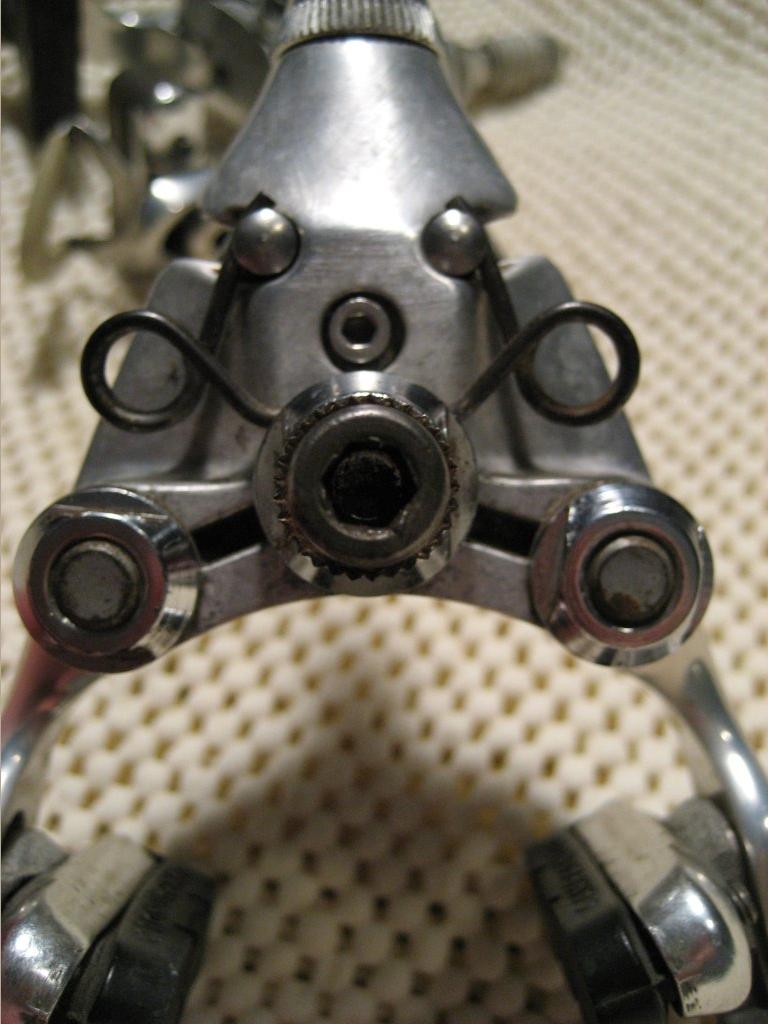
The backside. The springs force the arms inward. The studs the brakes press against are the pivots for the diamond linkage. They're C-clipped in place.

Contrary to what you may have read elsewhere, you can *not* adjust the height of the CdA delta. The mounting bolt also secures the spring, so if it moved up or down, it would impact the spring mounting and tension. Delta's are finicky enough about setup as is.

Thursday, February 22, 2007

Mavic 571/2 HG Hubset

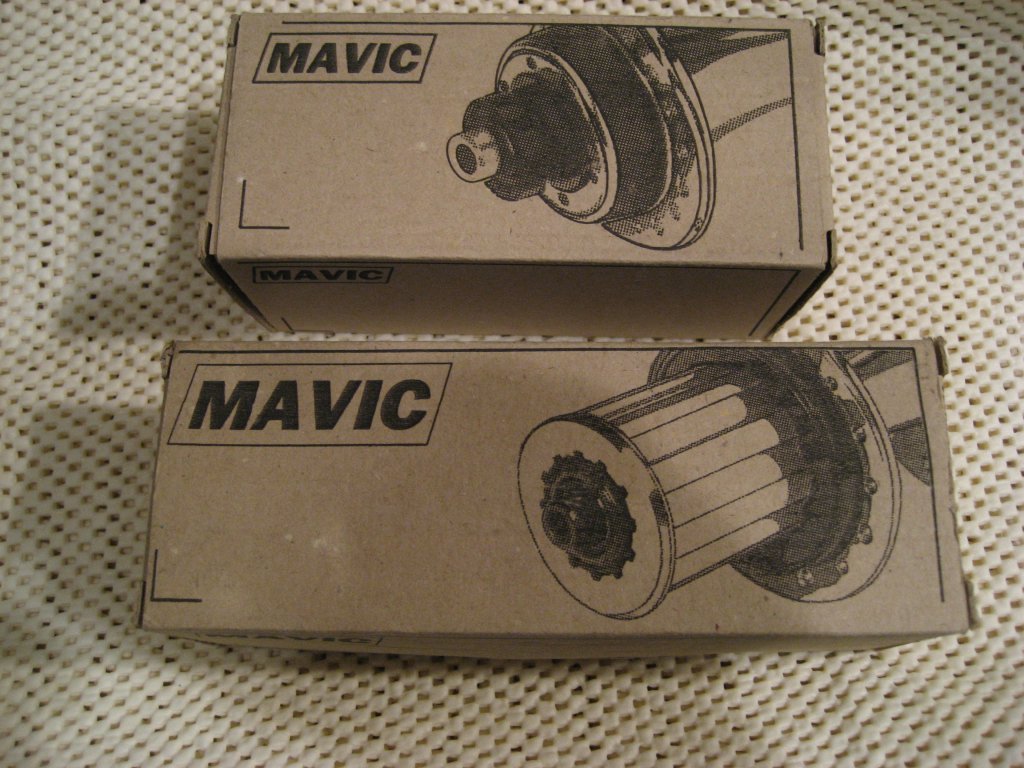
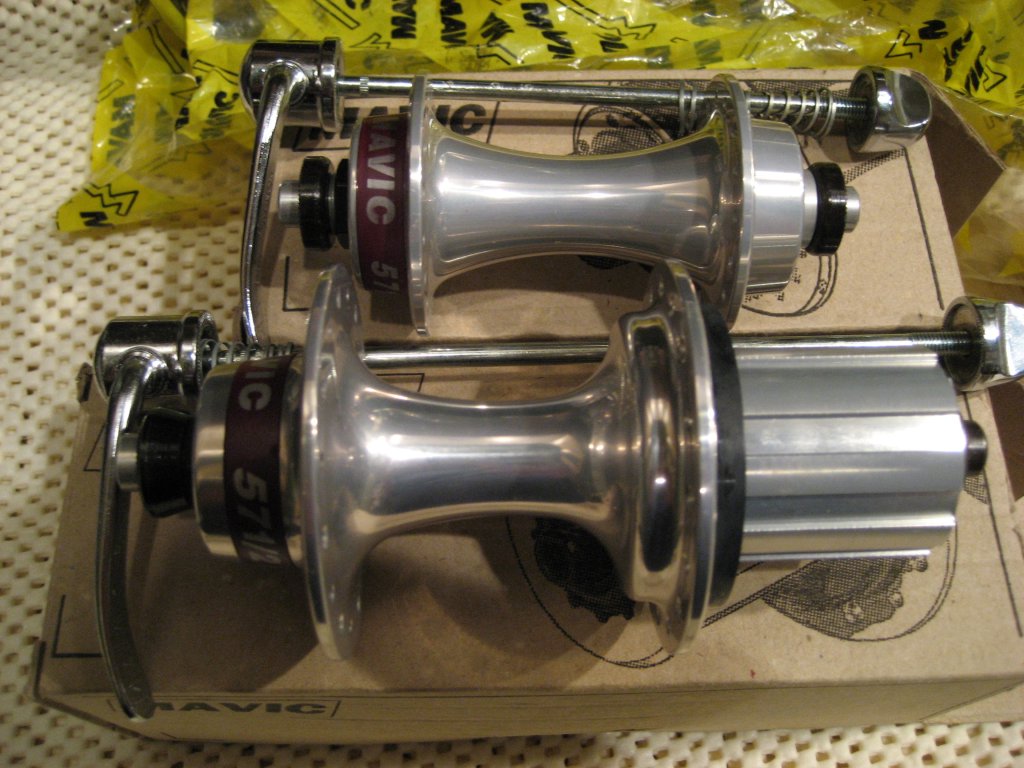
Well I certainly never thought I'd find a set, but it happened. NOS, still in the boxes 571/2 HG hubset. And they're perfect.


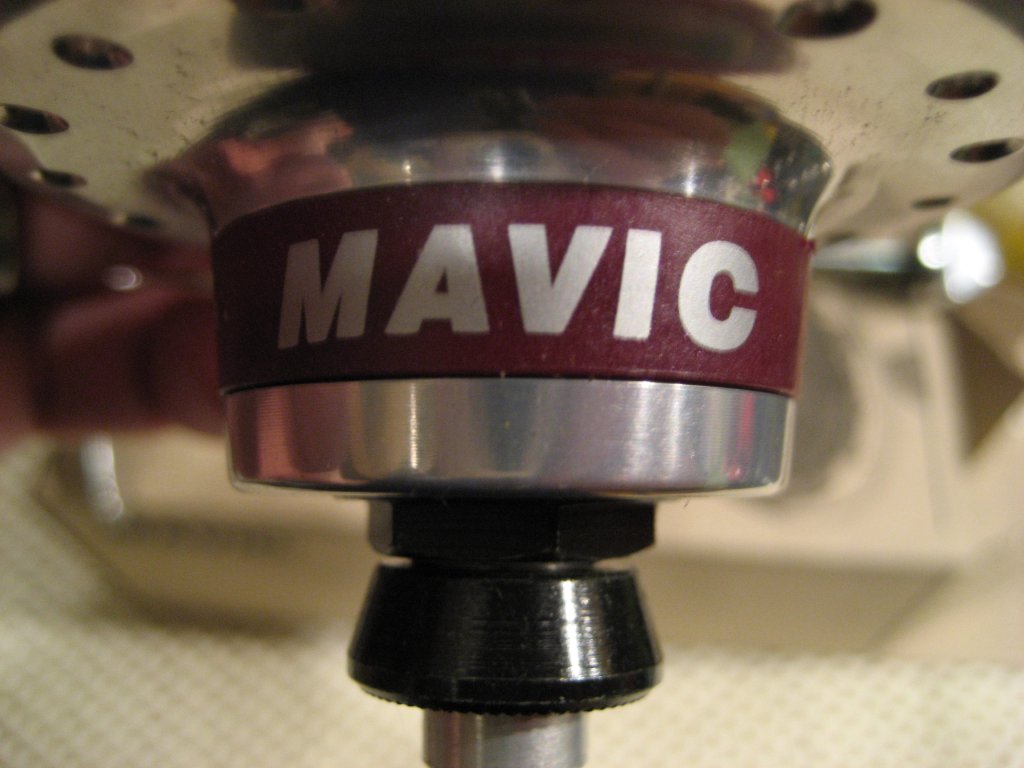
Not a scratch.


The biggest problem is, how could I ever bring myself to use these? And so the search for a gently used set continues.

Thursday, February 08, 2007

Merckx serials and dating frames

Finally made my Merckx serial list public and palatable for the world at large. Check it out at http://www.cadre.org/Merckx/.

Sunday, January 21, 2007

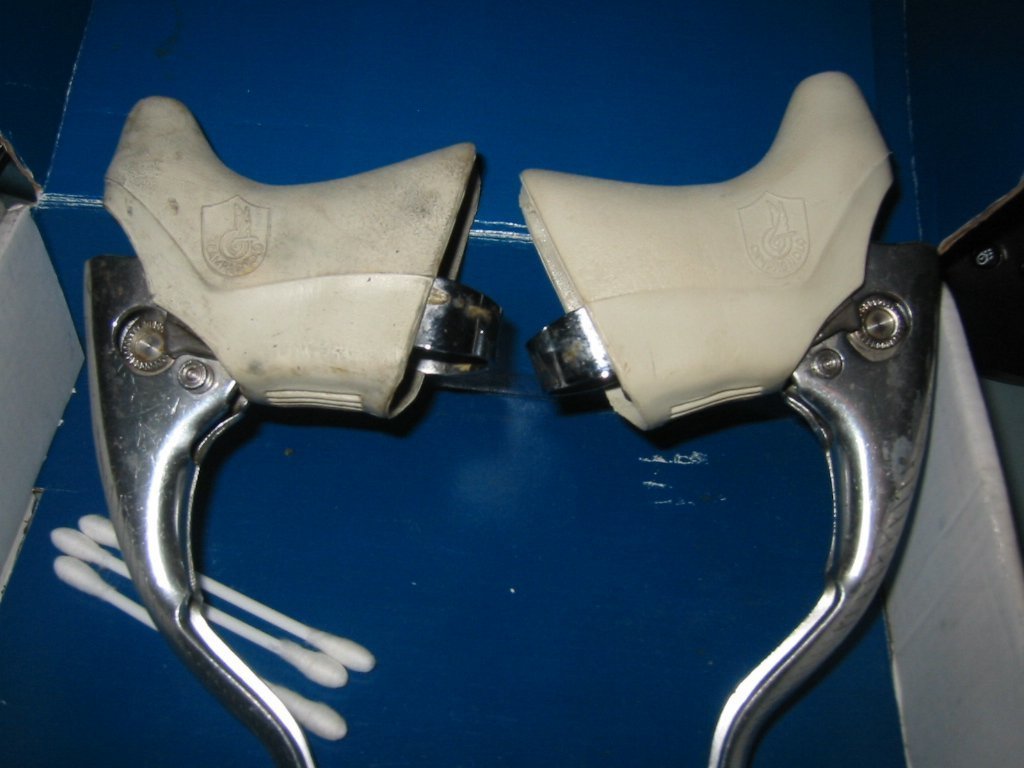
Two versions of the original Powergrade brake lever

Did you know Campagnolo partially redesigned the Powergrade brake lever used for Delta brakes? Me neither.

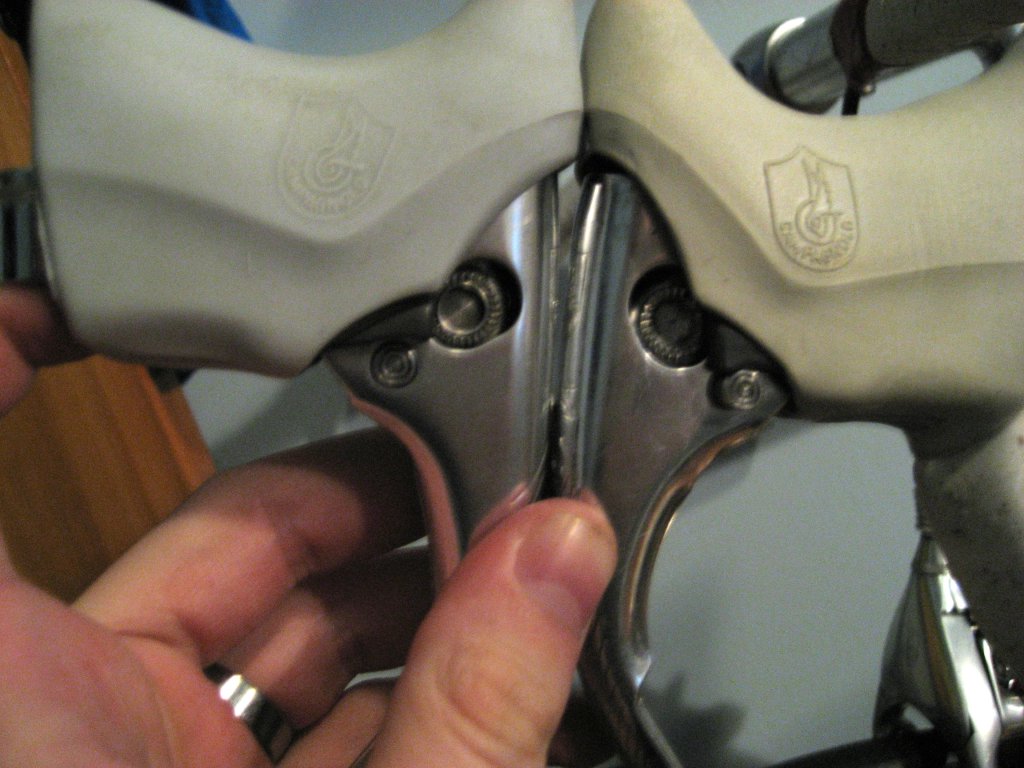
In 1988, Campy switched to the Powergrade brake lever, so one could fine tune the cable pull at the lever. In 1989, they changed the design subtly.


The angle the cable end holder thingy is adjusted at changed. The earlier lever is on the left and the later on the right. The range on the 1988 version is relatively small, and more horizonal. The later version gives a little more range. The hoods also changed at some point from the type that takes a plug (as found in the pre-powergrade version from 1987 and prior) to one that has a punch out piece molded in.

Useless info, but interesting nonetheless.

Wednesday, December 20, 2006

The Mavic 571 cassette hub

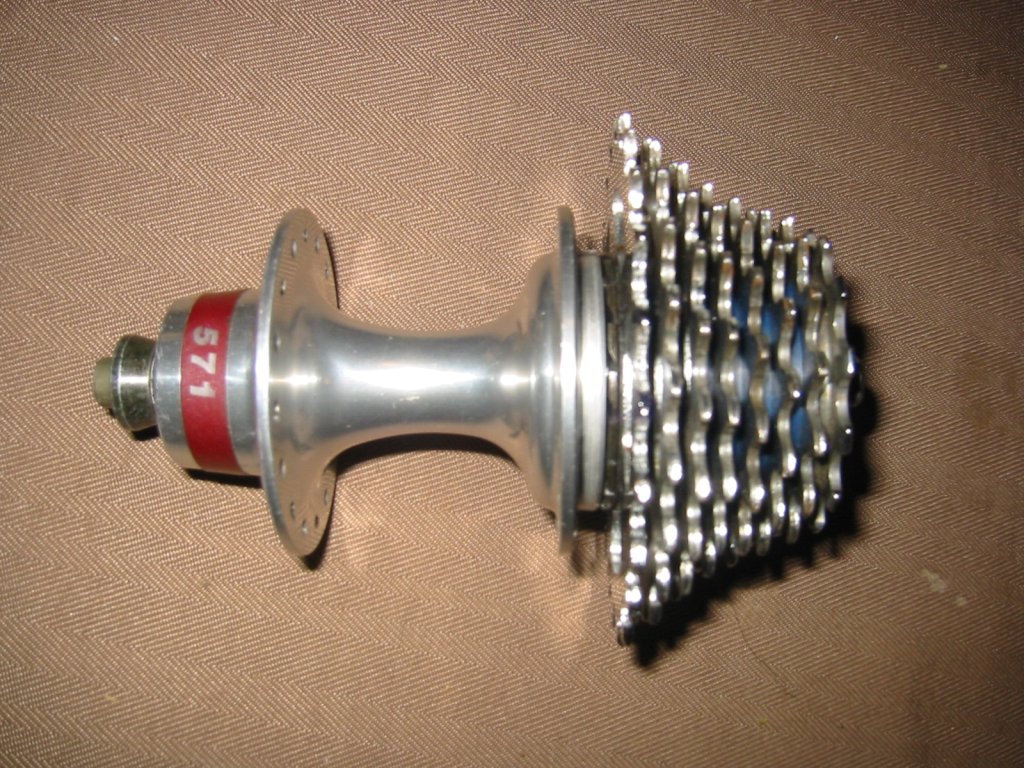
Finally managed to score a Mavic 571 rear hub.


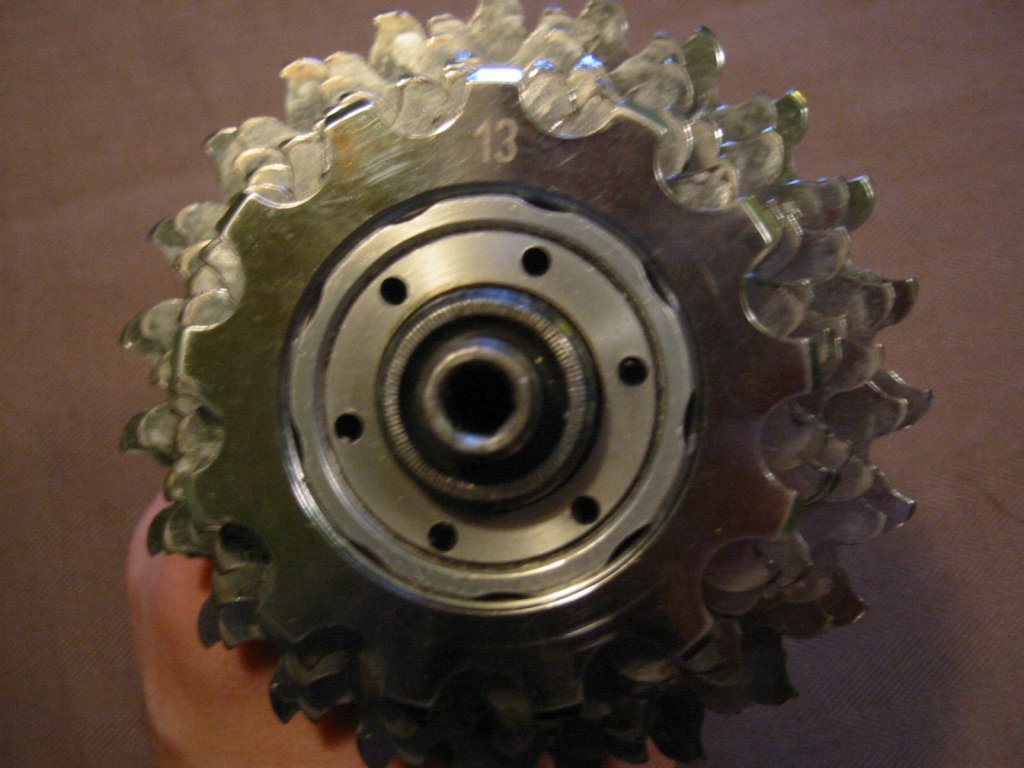
It came to me with an original, and as far as I can tell, unused, 13-23 Mavic cassette. The original skewer wasn't present; fortunately I have a correct one.


It's not the 571/2HG, so its unlikely I'll use it any time soon -- it would require actually shifting (ha!) to 821 shifters, or Shimano 8 speed brifters...neither are options I'm particularly interested in at the moment. If I stumble across a suitable rim, maybe I'll build it up. Just in case, ya know, I decide to try it out.

Sunday, November 19, 2006

How it started....

A comment in my last post got me writing a comment back. Went long enough that it might as well be a post.

It started with the fixie -- though I'd like to go on record as having bought said Pista in 2002, prior to the current ridiculousness, and I sold the thing off to a (way too short) hipster for more than I paid. The geek part started with the blue Merckx.

I had gotten a ridiculous deal on a barely used Bianchi XL Boron. Being as powerful as I am (and smooth too!), I must have flexed it too much when riding, cause the clear coat on it developed spiderweb cracks on the top tube. Not the tube itself, just the paint. It kind of freaked me out a little, though. But mostly, it made for an excellent excuse to get a new frame.

So I started looking around for a new frame on eBay, when I saw the blue Merckx. "It must be mine!" I thought. Or possibly said to myself, the cat, or my wife, who at the time was just my new girlfriend, and infinitely less likely to opine "its nice, but where are you going to put it?"

Anyhow, it ended up selling on eBay to someone else, for more than I was willing to pay. I was sad. So I started doing some research. Merckx Grand Prix are rare, as I began to learn. Depression set it. I'd never have that bike!

Then suddenly it happened. Apparently, the guy who outbid me had a wife or something who did ask where he was going to put it, and the frame was being put back up on the block. For 7 tense days I watched + waited. 10 seconds left, I submitted my bid. My browser spun the little loading arrow. Was the Internet going to conspire against me? Would my bid go through?

As you probably guessed, it did. i ended up getting it for less than I had been willing to pay originally, and less than the guy had got it for. That was almost exactly 3 years ago now. It's morphed in to a mostly-Mavic equipped ride, but its still rocking the Ultegra 600 brakes my friend Jeremy (who spurred this post) gave me so I wouldn't kill myself riding a brakeless fixie. Thanks man!


The Merckx, just arrived, 2004.


I just got another Merckx -- the older one seen in the recent posts. My wife hasn't given me the "where are you going to put it" look yet, but I've already torn down my soon to be old commuter bike, in preparation for getting rid of the frame + pieces I won't be using on this bike. I figure being proactive buys me something, right?

Monday, November 06, 2006

Mavic 821 Shifters

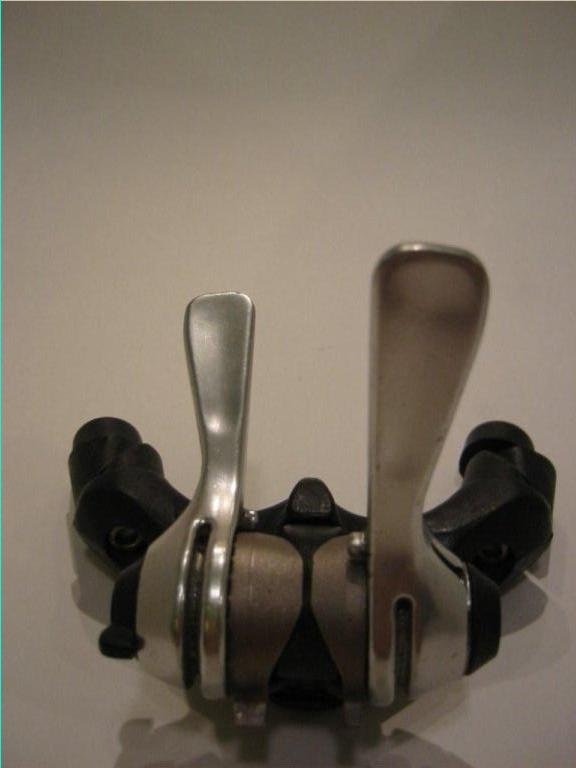
Mavic's 821 shifters were their only non-electronic foray in to indexed shifting***. They're ultra simple, and in some ways fairly crude. I'll do a teardown of them with pictures at some point.


Really, this posting is just an excuse to post a picture shot in my home made lightbox. Makes for a nice, smooth background with no flash reflections. Still needs some work, and I need to get used to shooting in it, but it should make the quality of my pictures at least tolerable.


*** Their MTB Wishbone shifters were the same basic design, using a notched disc. Same general idea, but different. My mistake.

Saturday, October 28, 2006

C-Record Brake Levers

Just got a nice set of C-Record/Croce d'Aune brake levers. These are going to be paired up with a set of CdA Delta's, to be used on the new Merckx. Still not sure of the date on the Merckx, but I'm not all that concerned. Its just an excuse to build up a fullish CdA bike. Even going to try using a set of Syncro's in indexing mode.


The levers arrived in pretty dirty condition. I spent 30 or so minutes cleaning them up, and they look fantastic.


Left is before, right is after. Hot soap and water can really work miracles when it comes to brake hoods.

Thursday, September 28, 2006

A new bike in the family

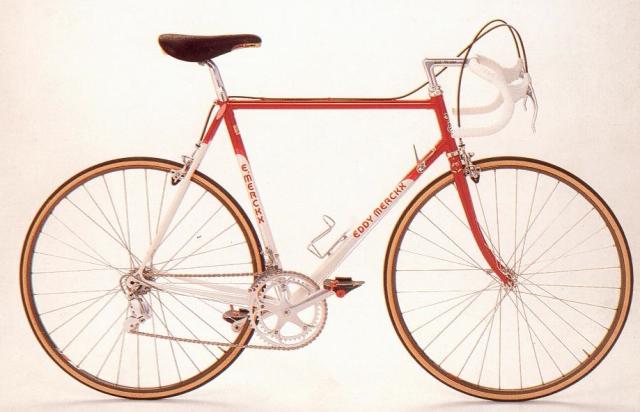
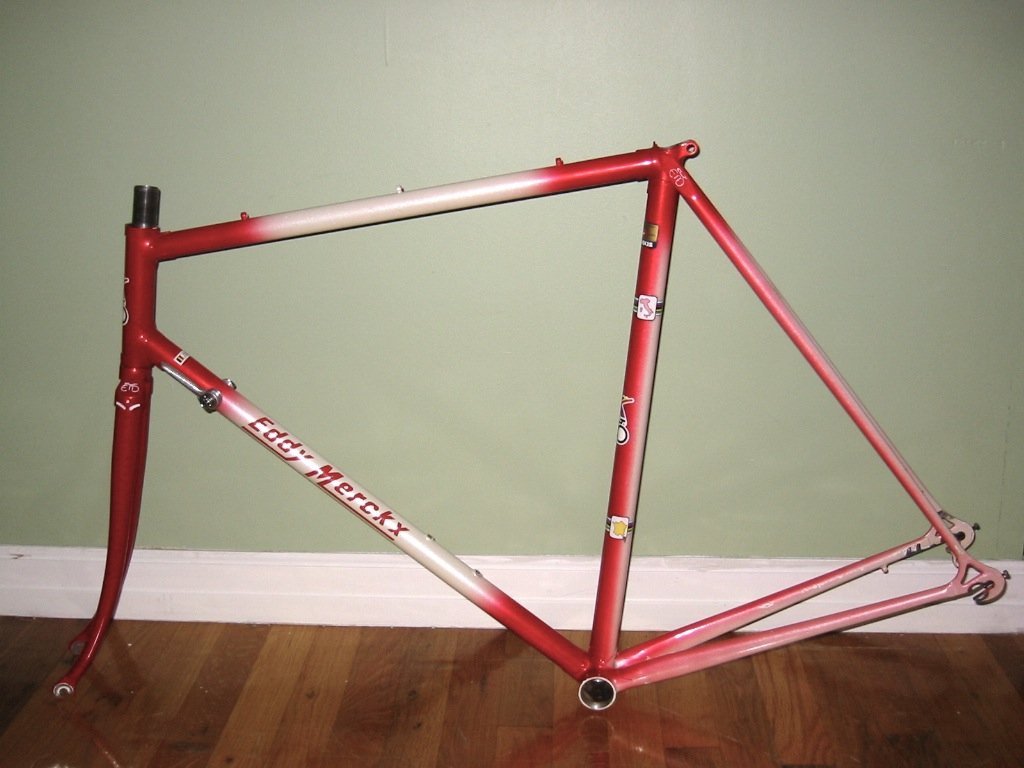
I recently stumbled on an early Merckx frame while perusing ebay. Not the earliest, but sort of a transitional frame between the first generation and second generation of Merckx frames. On a whim, I threw what I thought was a low bid on it, and won. It was in Belgium, so I expected to wait quite some time to receive it, but to my surprise, it arrived less than a week later.


Its an SL road frame. My guess is 84 or 85 -- I'll be mailing the folks at Gita, the importer of Merckx bikes in to the US to see if they can give me a date. No idea if they have a list of all bikes made, or if there's a serial scheme they haven't told anyone, but they might be able to give me more info. It has under-the-bottom-bracket gear cable routing -- so not early 80's, on top of the top tube brake routing, so not late 80s, and a single set of bottle bosses, which would be abnormal by the mid-to-late 80's.


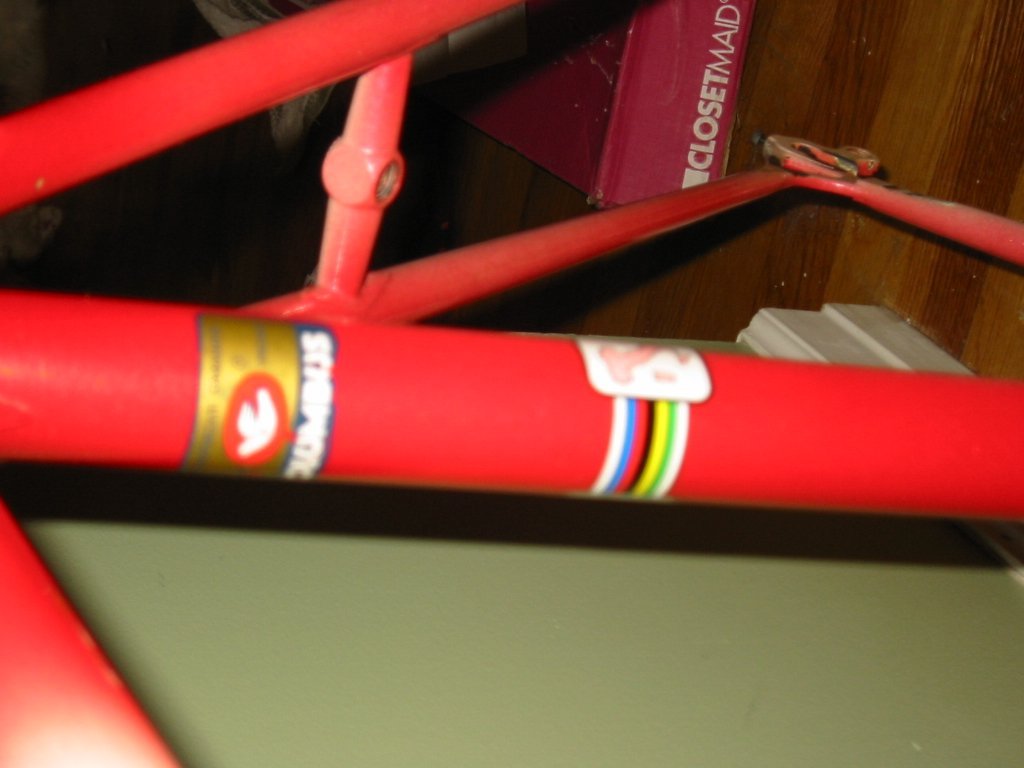
Early-to-Mid 80's SL decal.


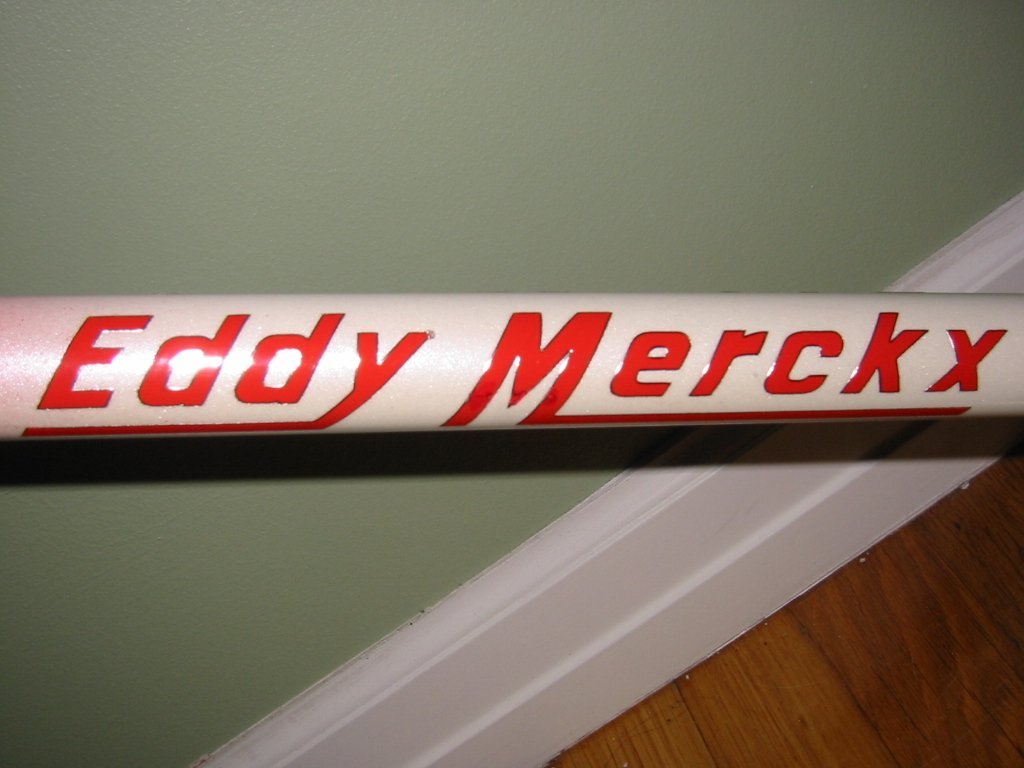
Early style side-slant lettering on the downtube


The modern EM logo caps on the seatstays.


All of which says to me, 84/85. I'll update when/if I hear from Gitabike.