Showing posts with label Campagnolo. Show all posts

Friday, May 31, 2013

Patent Searching

Patent searches are tons of fun. Here are a couple of patents I found that I wanted to share:

Online patent searches provide a wealth of information about the workings of some of our favorite equipment - as well as the innovations, successful and otherwise, that preceded them. The slight variations and changes that happened from patent submission to real world implementation (note the spring setup on the Syncro patent, for instance) are really cool. Even cooler are the abortive attempts - take for instance this patent from Campagnolo, which was issued around the same time - it seems to be a slip-proof shift lever where the hinged part sort of acts as a brake on the spring (???), the need for which was probably negated by their "success" with Syncro. WTF indeed.

The pictures are truly worth the thousands of words that comprise the patents. If you come across anything cool, leave it in a comment below.

The picture-linked patents above are for the Mavic 571 face-pawl cassette hub, the Campagnolo Delta Brake, the Campagnolo Syncro 1 shifter and the original Shimano STI shifters

Sunday, February 17, 2013

Syncro 2 Insert Tool

Ever notice how bike maintenance goes much, much smoother when you have the correct tools? And how horribly awry things can go when you don't? I'm not proud to admit I've marred the edges of a headset top nut by trying to use an adjustable wrench instead of taking literally 2 steps to the right to grab a proper headset wrench. Or rounded off the small bolt that attaches the cable to the front derailleur. We've all done these sorts of things, felt a little sheepish about being lazy, and learned our lesson. Mostly.

One question I've gotten on occasion, given my somewhat suspect reputation as a Campagnolo Syncro shifter expert, is how to install shift inserts in to the levers. I've always just used a pick or small hex wrench to push back the G spring on one side, and tried to push the insert in. Giant pain to do, and an excellent way to stab yourself with a pick. Given how infrequently one would ever actually change an insert, I didn't spend too much time figuring out a good way to do it.

As you'd expect, there's actually a proper tool to install the shift inserts - with the somewhat non-descriptive name of Syncro 2 Quick Mount. I made a little video to show how the tool works.

It's definitely one of those tools no one should really need - who works on that many Syncro levers, especially in 2013? But for the workshop that needs to have the correct tool for every weird, esoteric bike bit...here's another one to watch eBay for!

Wednesday, April 18, 2012

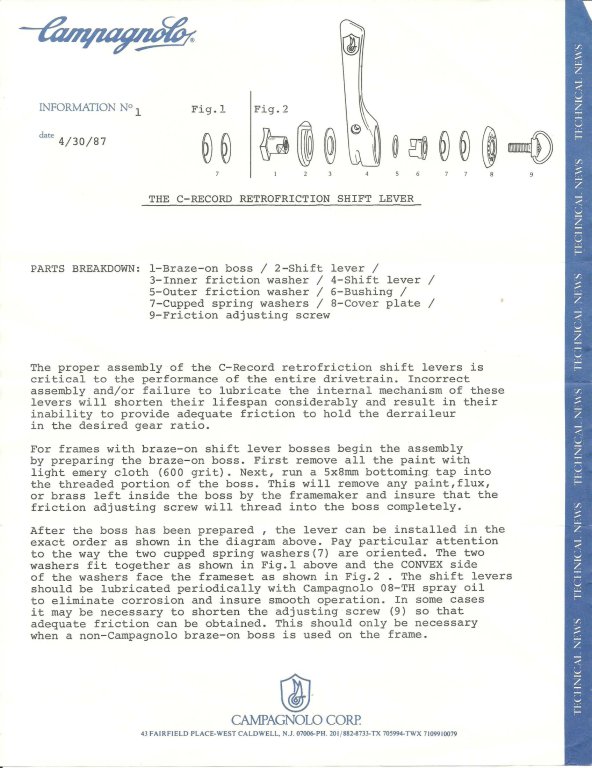
Campagnolo Doppler Tech Notice

They say a picture is worth a thousand words. Less spoken about is the value of a drawing.

Often the source of head scratching is the orientation of the dished spring washers for the Campagnolo Doppler retrofriction shifters. Do the two washers nest in to one another, or are they opposing? Do they face inward or outward?

The above information notice, dated April 30, 1987, should answer those questions once and for all - they nest in each other, with the convex side facing the frame boss.

Friday, April 09, 2010

2 days! Who's ready for Paris-Roubaix? This guy right here

Just in case you hadn't noticed, I have a couple of topics I seem to write about. I'm clearly a Mavic junkie, a super-fan of late 80's/early 90's racing, and a pave obsessive. Most roadies cringe when you say Rock Shox, but I get all excited at the thought of suspension on cobbles.

So when an insane opportunity arose to merge all of those in to one project emerged, I couldn't say no.


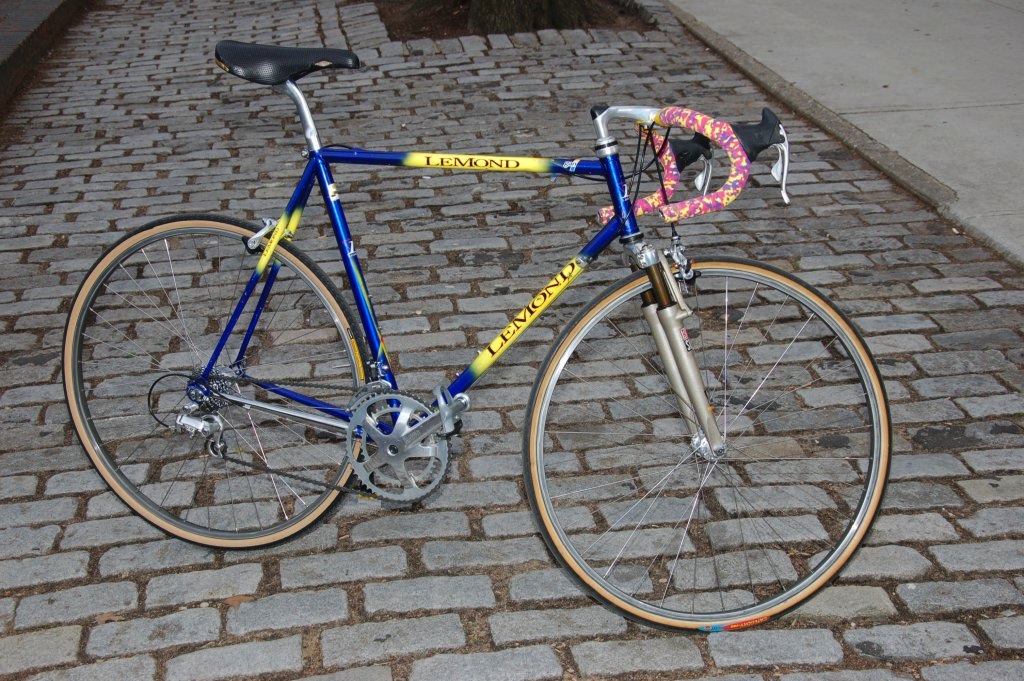
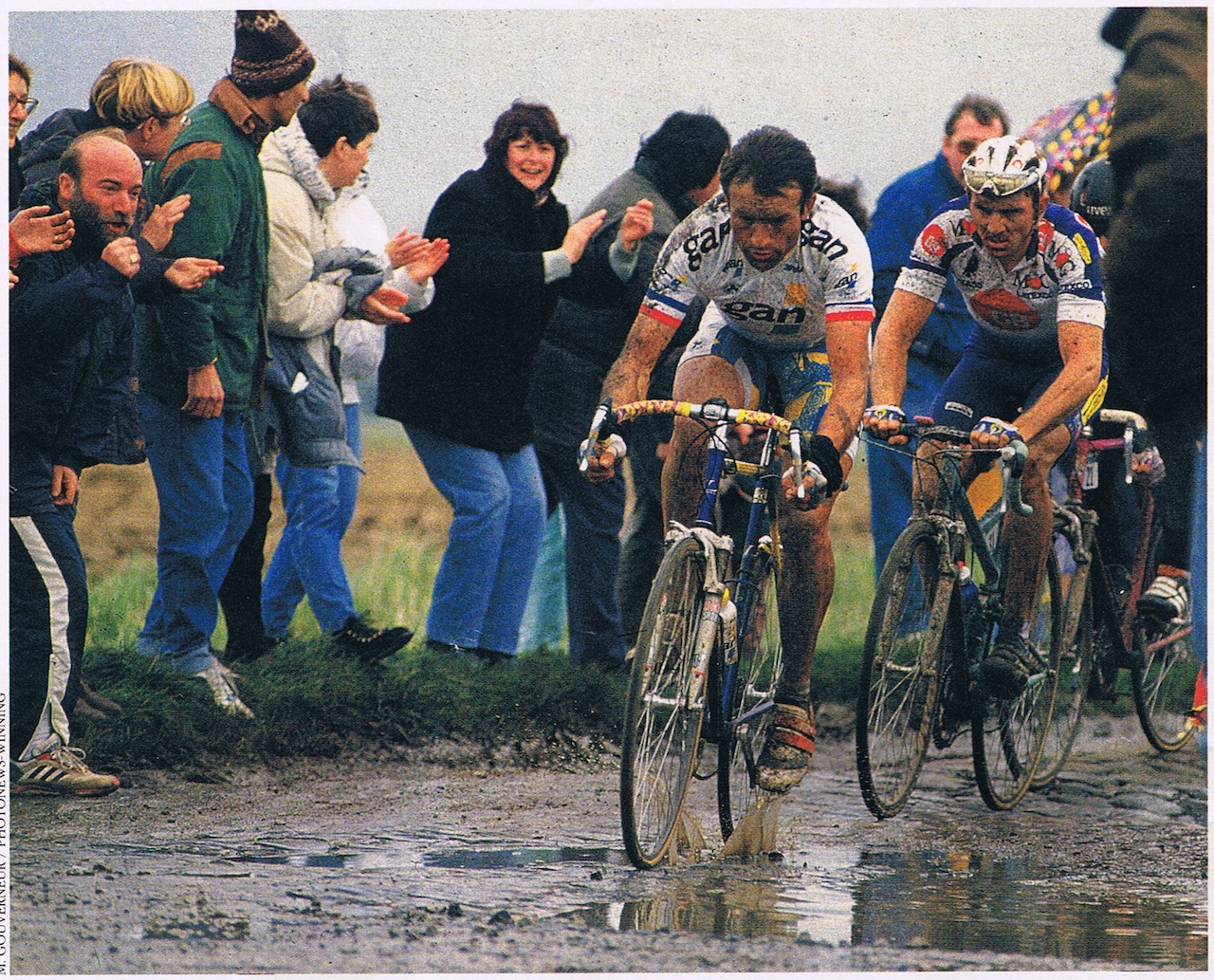
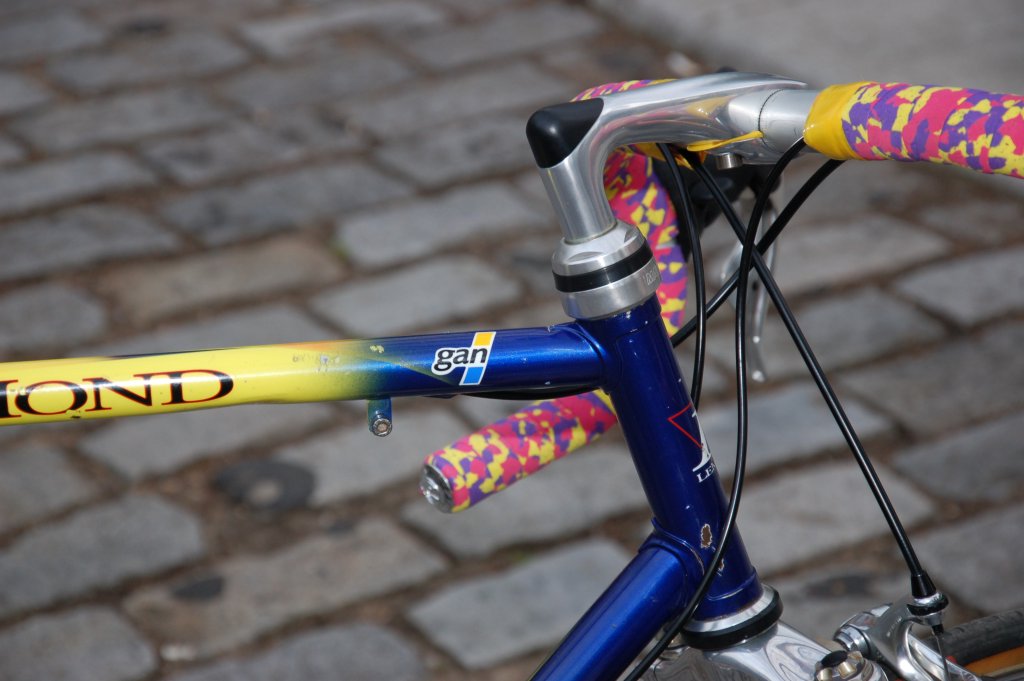
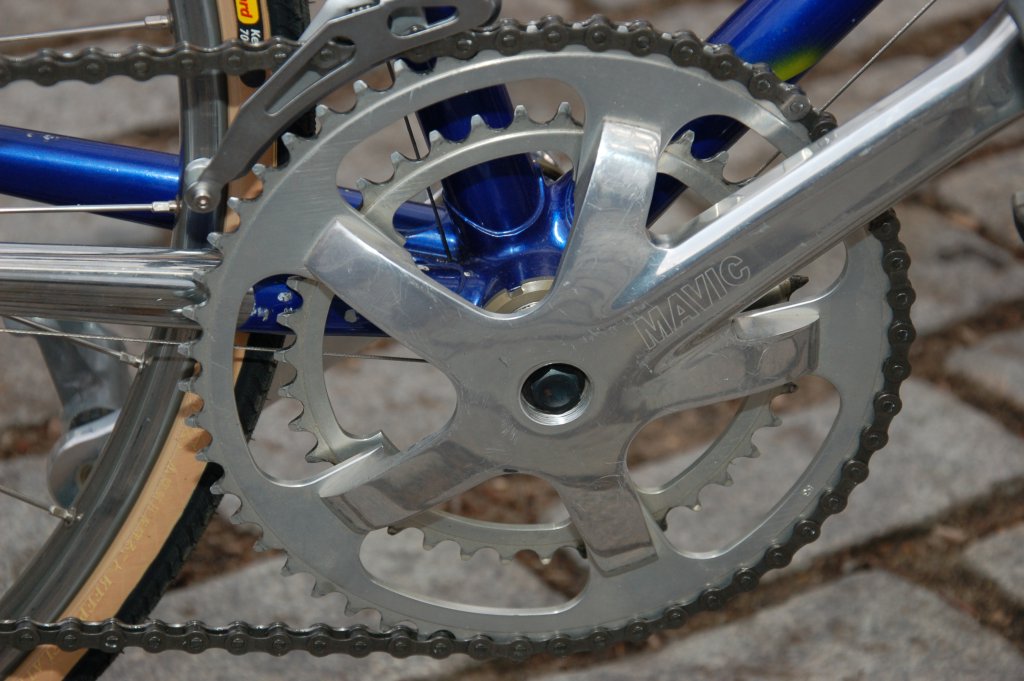
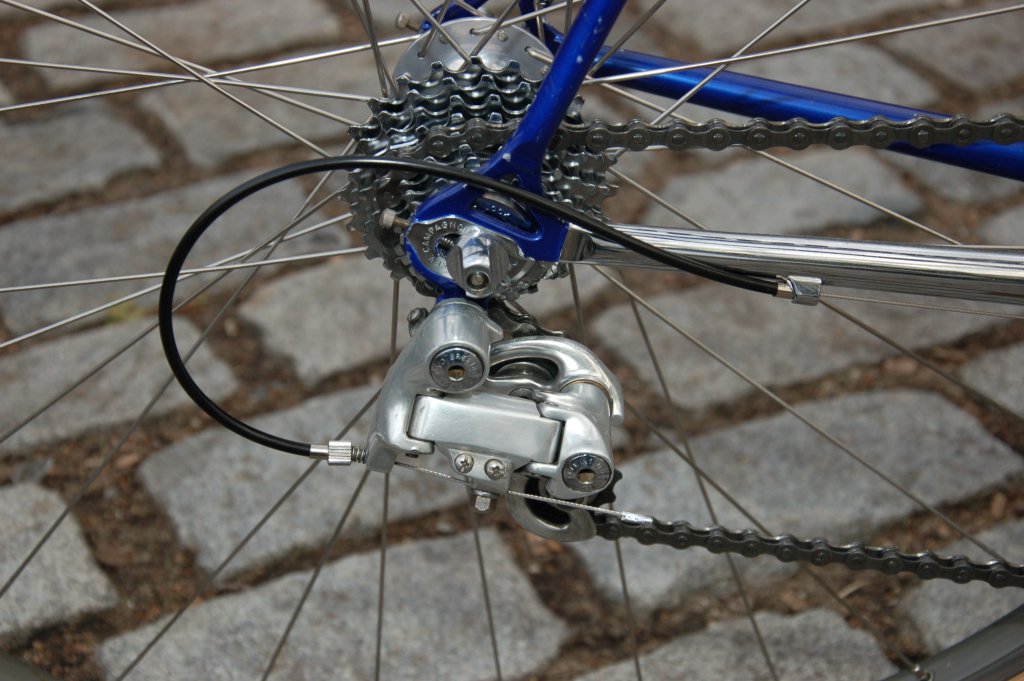
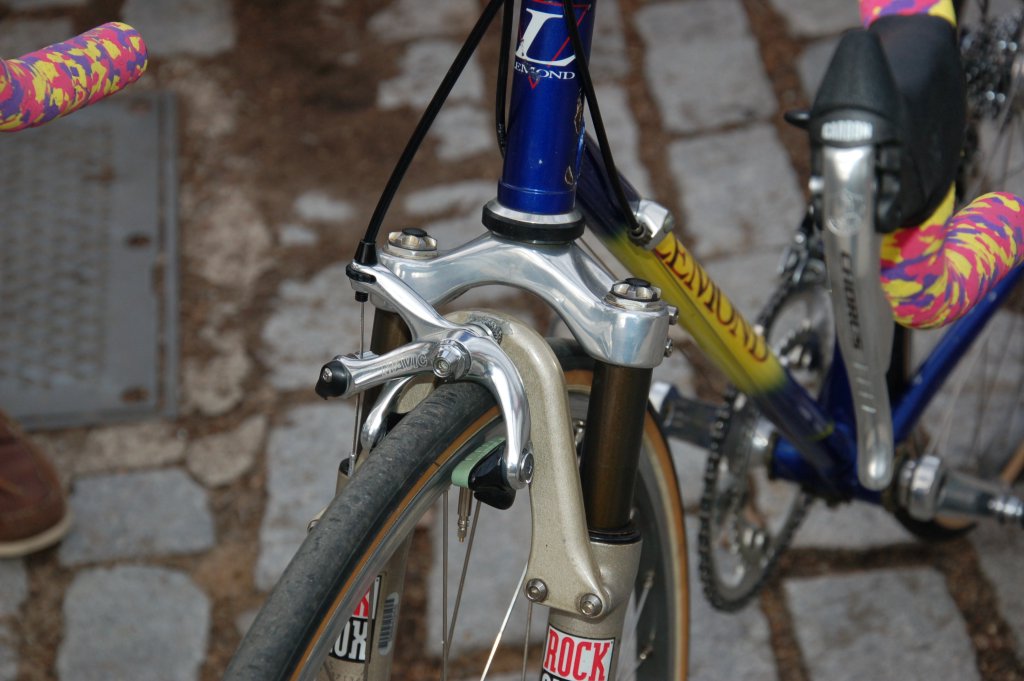
What we have here is the nexus of all the things that get me excited in a bike. Lemond Team GAN, decked out about as close as possible to the bike Gilbert Duclos-Lassalle rode the latter portion of 1994's edition of Paris-Roubaix.


In 1994, GAN was sponsored by Mavic, and rode the Zap electronic shifters in some events - or at least, tried to. As you can see here, Lemond was riding Zap at least a little during the spring classics.


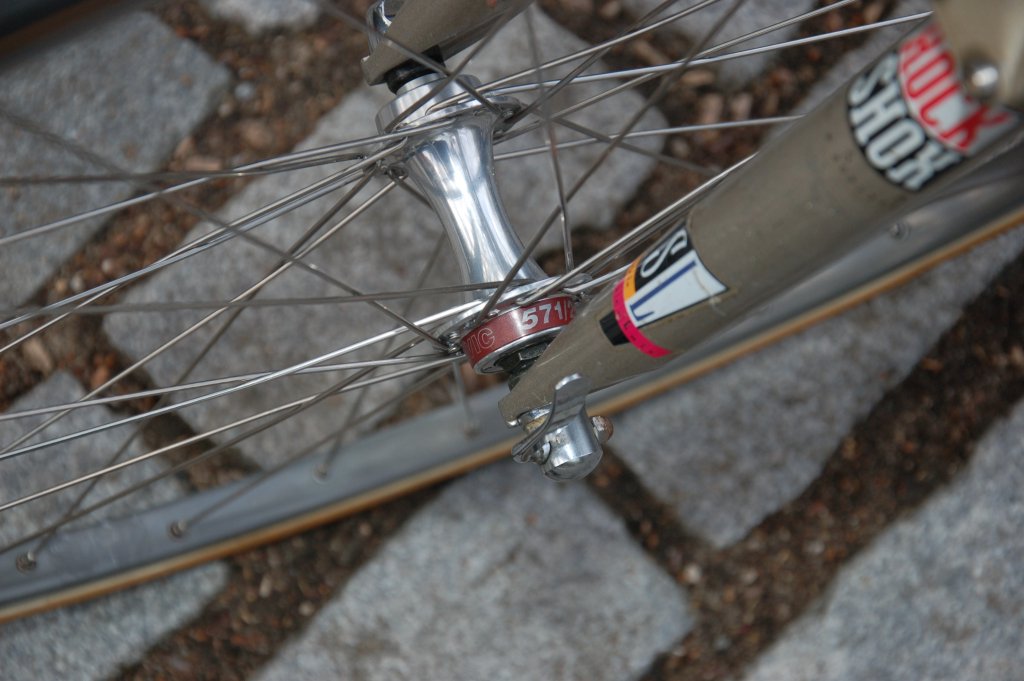
I'm not going to make any assumptions about why, but they did NOT ride Zap in Paris-Roubaix (and, in fact, in a lot of other races as well...but thats a different topic). Instead they rode a mixed drivetrain - the crank was a Mavic 631/2, the 862 front derailleur, and 571/2 front and rear hubs. For shifters, they used Campagnolo's Record Ergopower shifters, along with a Record rear derailleur. The 571/2 would likely have had a Campagnolo Exa Drive body on it, though it could also have been a custom spaced Mavic proprietary cassette.


Up front, they were riding Rock Shox Paris-Roubaix SL forks. Mavic 451 brakes. Cinelli bars and stems - Duclos-Lassalle rode Criterium bars (yes, with Ergopower). They used a variety of stems on the bikes, including the Oyster and the 101.


Selle San Marco saddles - some Rolls, some Regals, and some Titanios. Selcof posts.

Obviously, a few liberties were taken in building the bike. I'm in no way scared of tubulars, but I AM scared of the price tag associated with Mavic Paris-Roubaix rims. Tracking down the 1994 version of the Record Ergopowers proved something of a pain, so I acquiesced and went with a set of 1995 Chorus levers - identical to the Records of the prior year, save some cutouts in the lever. There are a few other things I know are wrong, but I'll leave it to the astute - and annoying - reader to nitpick on my project.

I'll be riding this bike Sunday, April 11 in the Brooklyn Pavé ride. It's a ride around Brooklyn, hitting some of the handful of cobbled streets that still remain. It starts at the Old Stone House in Park Slope (4th St. + 5th Ave) at 1pm - we roll out at 2. Please note - this is a friendly little ride not affiliated with any responsible entity. If the rider has a flat or breaks a fork or gets socked by Bernard Hinault, we'll help out but we're not culpable. Moderate pace over some pretty bumpy roads - you'll feel 'em way more than I will, what with my suspension fork - so nerves, or at least an ass of steel recommended. Email me (upper right corner of this page!) for additional info.

Friday, February 05, 2010

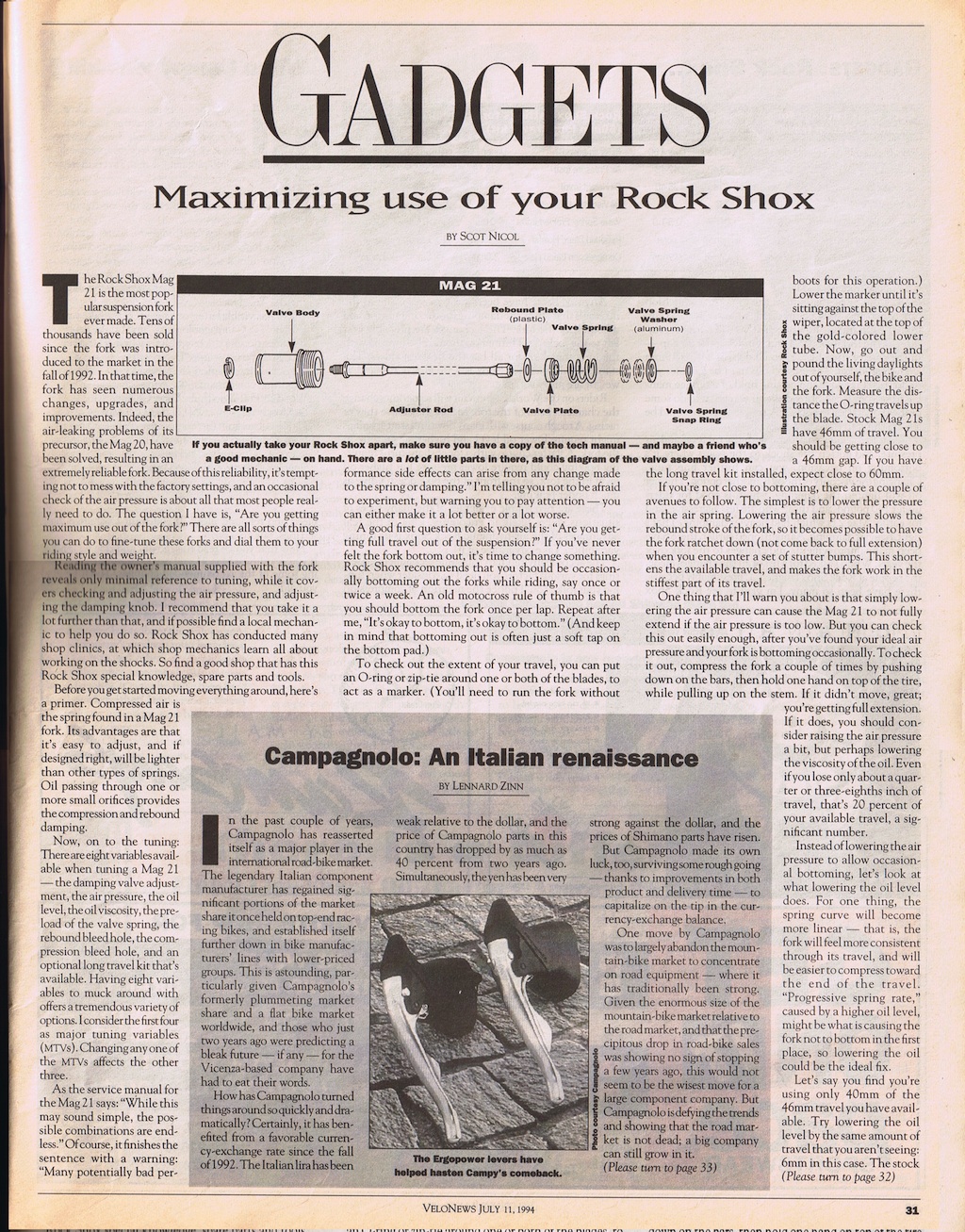
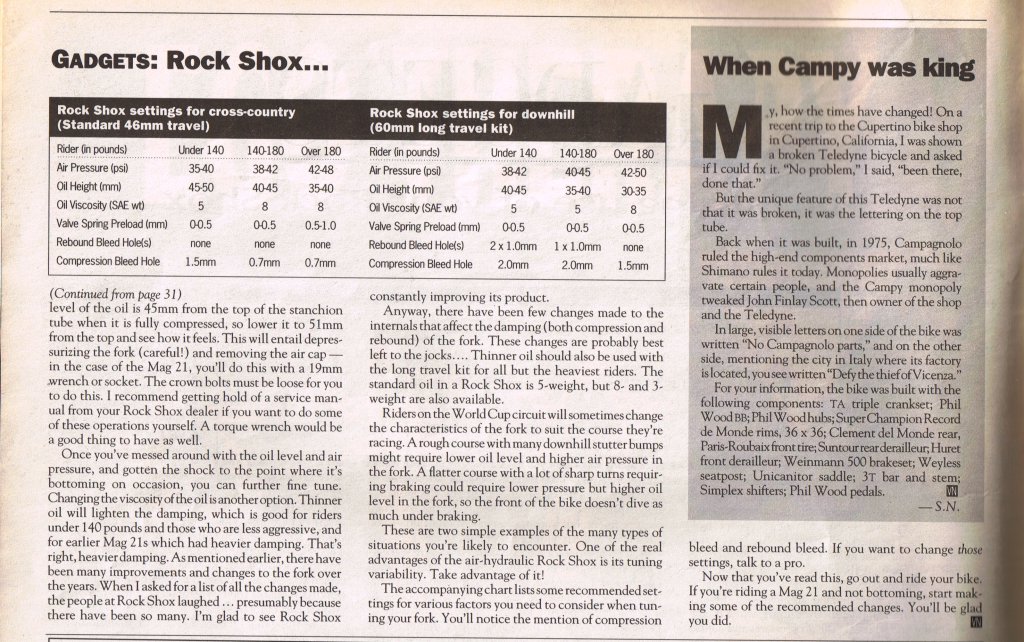
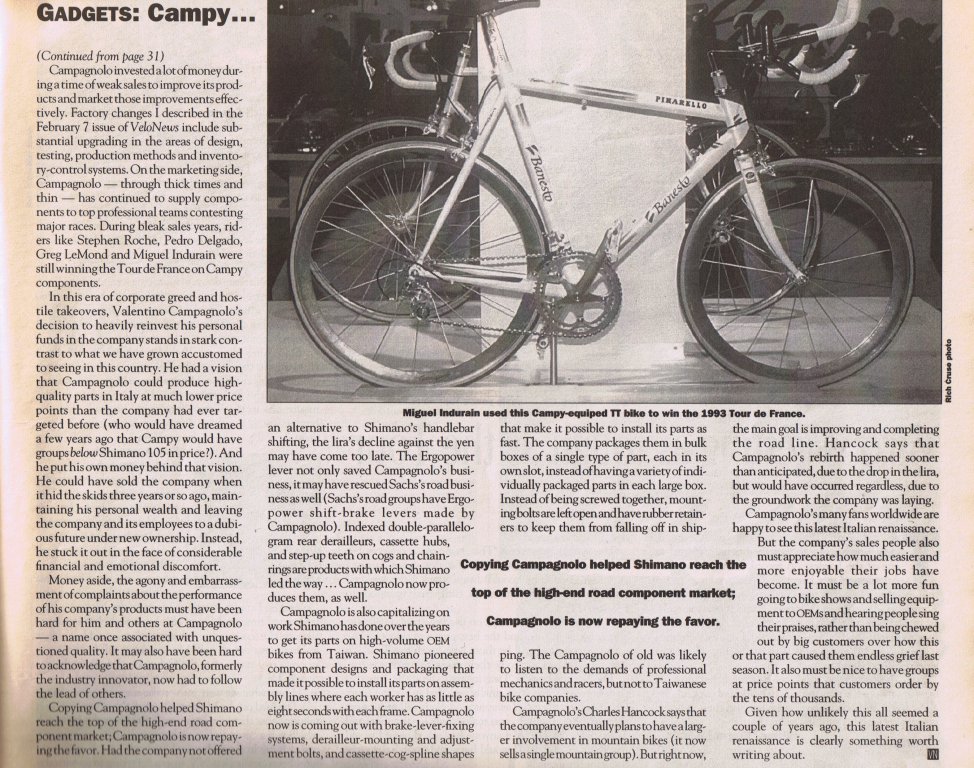
VeloNews July 1994 - Rock Shox and Campagnolo

My scanner is really terrible at handling large format documents. It only fits up to legal size, so that made it a little hard to scan in this latest batch of stuff. I apologize for the crude re-piecing of the first page - hopefully everything is still readable without inducing a migraine.

It's pretty obvious I'm on an early 90's tech kick at the moment (and, I suppose, the last 4+ years of this blog). Some stuff survived this transitional period, some didn't. The scans below cover 2 items, one of which fizzled out, and one that talks about the comeback of Campagnolo. From the July 11, 1994 VeloNews, Maximizing use of your Rock Shox and Campagnolo: An Italian renaissance. Read on!


No, no, I'm not going to start talking about vintage MTB stuff. The Mag-21 IS almost identical internally to the Paris-Roubaix, however, and tuning is a pretty similar experience.

Little article on Campy's comeback as well...


Ready to tune your Paris-Roubaix now? Whaddya mean you don't have one?!


Sorry, the crappy scanner necessitated chopping the very top of Indurain's TT bike.

Saturday, January 16, 2010

A table, a chair, a bowl of fruit and a violin; what else does a man need to be happy?

Trade the violin for a nice bike, and I'll agree to that. I may not NEED anything else to be happy, but there are definitely a couple of items I really really WANT, that'll make me just a little happier. If you find yourself with any of the following items, and think you might want to sell or trade them, please let me know. Email address is in the about me box on the upper right!

Mavic 631/2 crank: Did you know there are two versions of the 631 crank? It's true! In 1994, the 631 was redesigned. It was relieved on the backside, to lighten it. The arms are boxier, and it'll take a smaller chainring in the outermost position. AWesomeness, and I can't find one! Whatever size, I am not a picky man.

1994 Campagnolo Ergopower shifters: Record OR Chorus. 1992 and 1993 brifters have metal bodies. 1994 is the year they switched to a plastic "carbon" body. The brake levers have no cutouts, and the area directly above the lever is screened 'CARBON' on the Records. Chorus have no marking. Yes, in this case, I am being stupidly picky.

Those are the two more difficult items. I'm always on the lookout for more 571 hubs or parts - can't have enough spare pawls, and I have a little project that requires some 36h shells...a silver Cinelli 101 stem in 100mm would also be nice, as would a nice set of Criterium bars. A single Mavic 451 brake, front or rear too!

Thanks for reading!

Post title is an Einstein quote. Pretty sharp guy! ;)

Sunday, January 10, 2010

Full suspension at Paris-Roubaix

The last couple of years have seen some vendors slowly introducing shock-absorbing materials in to road bikes available to the public. It seems like quite often, these bikes are first seen in public during Paris-Roubaix. A big deal was made of Hincapie's 2005 soft tail Trek, even though that bike design never was made available to the public. Far more successful are some of the dampening technologies, like Specialized's Zertz inserts, which are available in all sorts of bikes in their lineup. Every article that mentions these bikes, without fail, mentions the widespread adoption of Rock Shox forks by riders in Paris-Roubaix in the early 90's, and how Museeuw used a full suspension Bianchi in 1994.

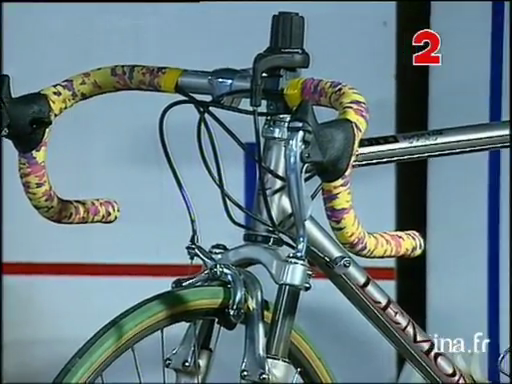
There were actually a few others that were tried as well. An interview for France 2, with Gilbert Duclos-Lassalle and Greg Lemond gave us some interesting glimpses at a full suspension rig they both used for at least part of PR in 1994.


Full suspension Lemond front-end. Note the Grip Shift adjustment knob for the rear shock...

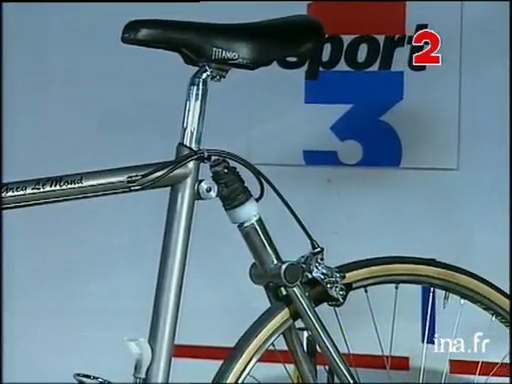
According to the information in the bottome part of the article here, these bikes were built by Clark-Kent, in Denver CO out of Titanium. The recollections in the article are, unfortunately, a little flawed - Duclos-Lassalle finished first in 1992 and 1993, and came in 7th in 1994.

Duclos-Lassalle was off this bike, and on to a Excell tubed Lemond within the first 1/3 of the race that day. Why, we don't know. I think its fair to assume something as simple as a flat that early in the race wouldn't necessitate a bike change - and given that watching 1994 footage closely suggests he changed bikes again in the latter half of the race, to another Excell tubed frame, makes it unlikely whatever went wrong was easily fixed.


Check out that crazy rear suspension system - reminds me of the Moots YBB soft tail.

This scanned clipping over at the Mombat site gives a closeup of a Lemond that looks very similar to the one shown in the interview - it doesn't appear to be the same frame, but its probably fairly similar. Air/Oil shock? Or maybe the white thing in the picture above is some sort of elastomer?


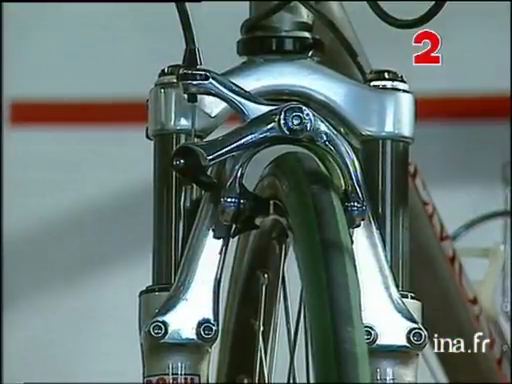
Requisite Rock Shox Paris-Roubaix. Mavic 451 brake.

Potential technical issues aside, looks like a very cool ride, and I'd certainly like to know where any of these ended up after the race.

Friday, December 18, 2009

1993's prices...

Ever wonder what the stuff you collect now cost back in the day? It's not too terribly difficult to find vendor catalog scans with a Google search, but finding catalogs from bike stores is a little harder.

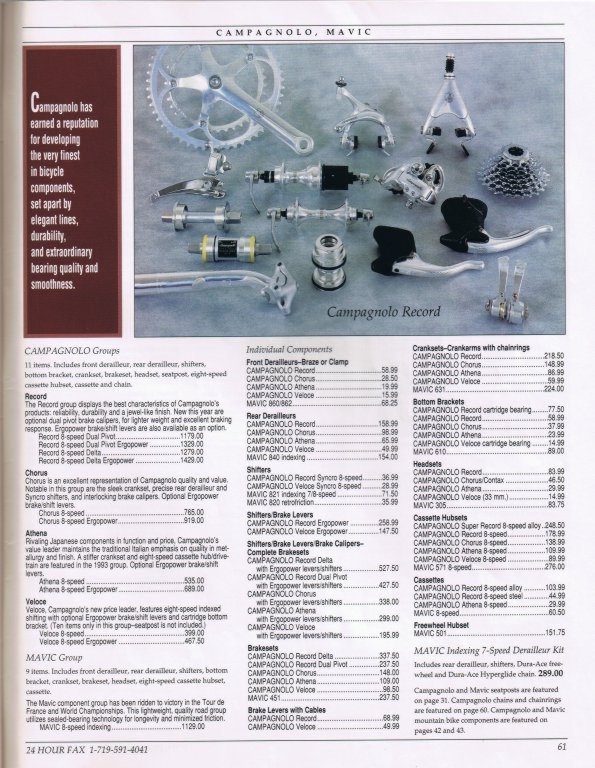
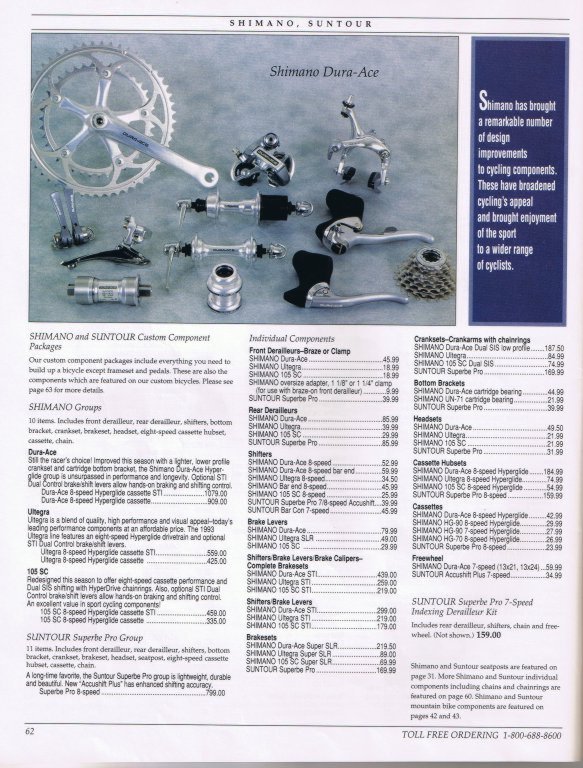
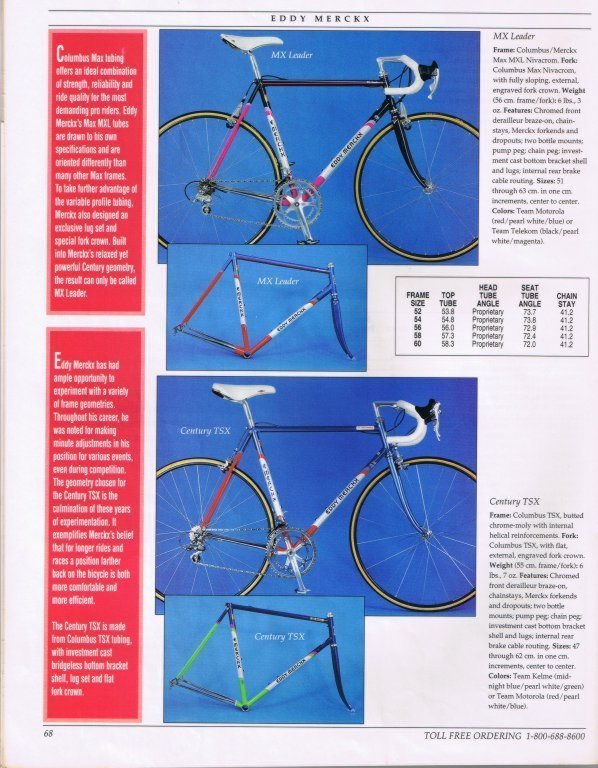
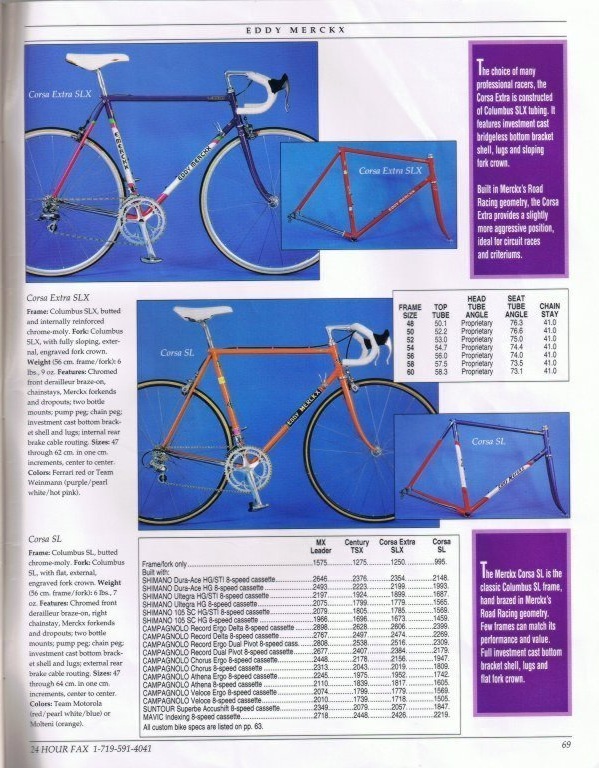
Fortunately for us, Harry is a pack rat like no other, and gave me a 16 year old Colorado Cyclist catalog. Here are a couple of scans - 2 pages of Merckx bikes, and their Campagnolo Record, Suntour Superbe Pro, Shimano Dura Ace and Mavic component pages. I think its safe to say that the lamentation of "if I knew then what I know now, I would have bought 100 Mavic headsets" is bunk; very few of the items sell now for as much as they sold for then.


Campagnolo Record, Chorus, Athena, Veloce and Mavic


Shimano Dura Ace, Ultegra, 105 and Suntour Superbe


Merckx MX Leader and Century


Corsa Extra and Corsa

Thursday, December 03, 2009

Urban legends, and things I was right to believe in...

If you ever hear an urban legend about a kid who cut off his nose with garden shears, that is categorically true - I went to junior high with that kid. At the time I thought it was hilarious. Still sorta do...

And much like the garden shears kid, every once in a while something that people thought was an urban legend turns out to be true.

A month or so ago, I saw this on eBay:

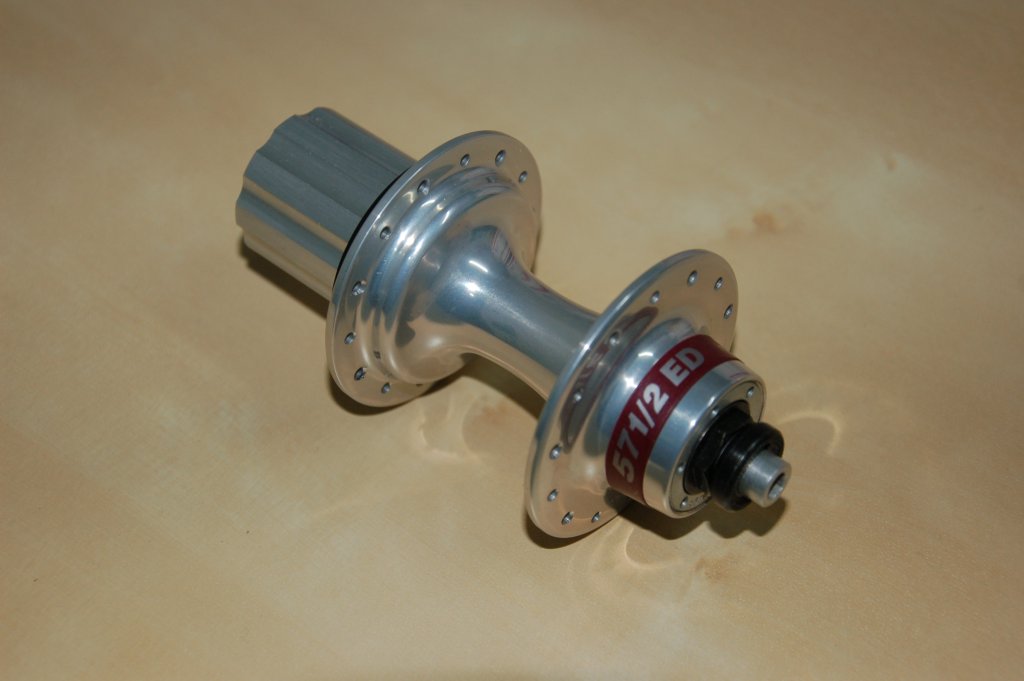
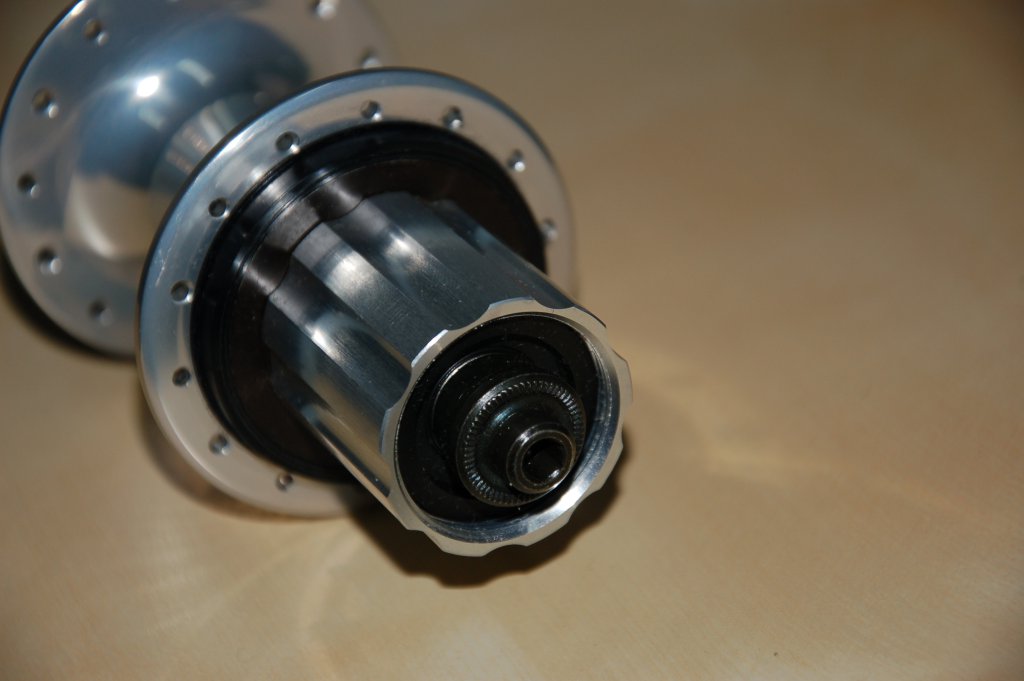
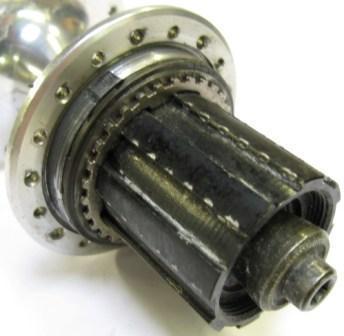
It's a 571/2 hub...ED? I had previously seen hubs marked 571/2, and 571/2 HG - HG being, of course, hubs with Shimano's cassette splines, instead of the Mavic proprietary type. This particular hub has a serial indicating its from 1995.

Through a roundabout series of purchases and ultimately a trade with Harry, I ended up with the 571/2 ED. When I got it out of the box and took a look, though, I was dismayed to see the Mavic spline pattern on the cassette body.

It's worth noting that the Mavic proprietary cassette came in 2 flavors. With the 571 hub, the outermost cog was threaded, much like Shimano's Ultraglide (UG) cassette. With the 571/2, Mavic went to a lockring setup, like Hyperglide (HG). If you're ever looking for Mavic cassettes, be aware of the difference. The spline patterns are the same, however, so you can adapt a 571 cassette to work on a 571/2 if you can source a correct 8th cog and lockring

For a long time, I had believed that Mavic made an Exa Drive version of the 571/2. So once I saw the hub marked ED, I decided to consult my primary materials to see if it was true. Turns out, I couldn't find any evidence that it existed. Chuck Schmidt over at Velo-Retro sells a phenomenal collection of Mavic catalog reprints, and it wasn't in there. I checked magazines that had information about the 571/2. I read about ZMS. I read about Mektronic. They all mentioned that HG was available, but no mention of ED. Maybe the early Cosmic wheel set, that used the same cassette mechanism as the 571? No dice.

Moving right along. I thought I had captured my Moby Dick, but it turned out I had a normal Mavic splined 571/2 hub, with a weird ED marking on the model band. Facing facts, I came to the conclusion that I was wrong - no Exa Drive 571. Just what was this ED marking though? Electronic Drive, marking it as part of the Mektronic group? That didn't sit well with me, especially since Mektronic was designed to work with Shimano (and Mavic) cassette spacing.

So it stood. Until I spied something weird in an eBay listing from France.

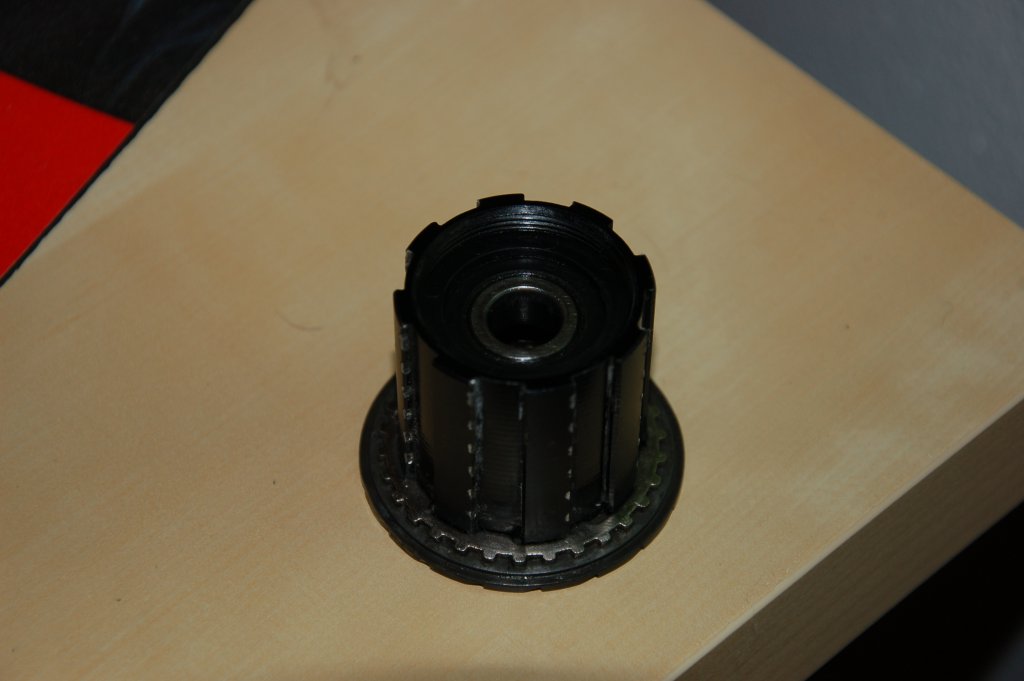
The thing that piqued my curiosity was that, based on what I would see, the splines looked weird for Shimano. They had a trapezoidal quality to them, and based on wishful thinking, I counted 8 splines. Shimano HG has 9.

Sure enough, when I received it, my suspicions were proven correct. 8 splines, undercut a little. EXA DRIVE.


Seperated at birth?

The Mavic sponsored GAN team sometimes rode an odd combination of components in 1993 and 1994. Mavic brakes, cranks, front derailleurs and wheels, with Ergopower brifters and a Record rear derailleur. Were they using the 571 or 571/2 rear hub when they rode that setup? There are a few ways to pull that off - respacing a Mavic or Shimano cassette being the easiest other than just using a Record rear hub. Is it possible they were using an Exa-Drive body like the one I now have?

I can't say for sure this is de facto evidence that Mavic produced an Exa-Drive 571/2 for the public, and marked it as a 571/2 ED - though I certainly think they did. But if anyone tells you that either the pruning shears story OR the existence of a Campagnolo body for the 571/2 is total bullshit, send them my way.

Tuesday, December 01, 2009

Ergopower 1992 (in italiano)

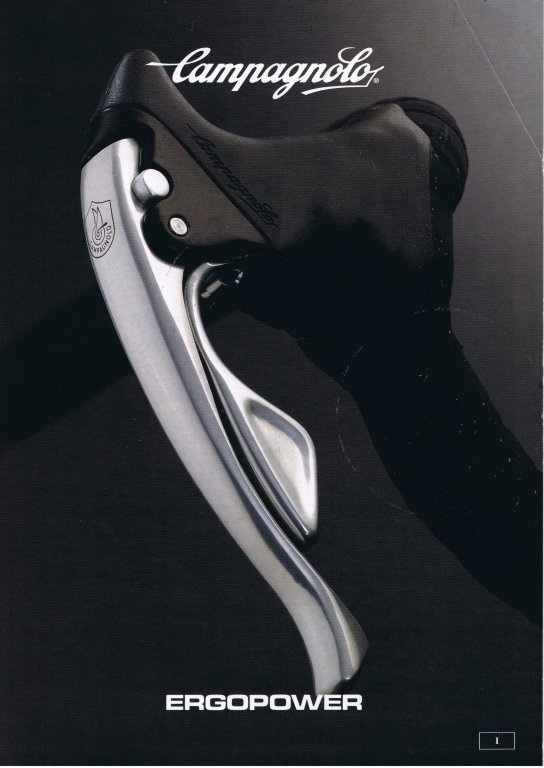
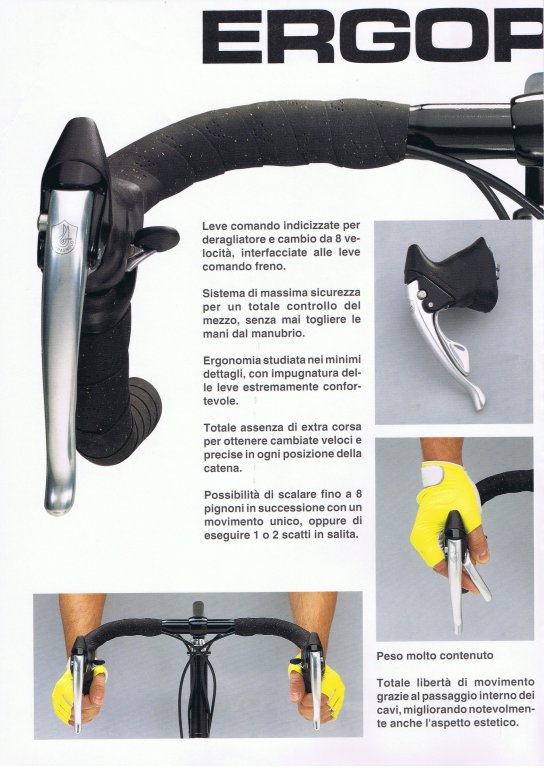
Ergopower was introduced by Campagnolo in 1992. For the 2 prior years, Campagnolo was without an answer to the rising popularity of Shimano's STI. The benefits of being able to shift without removing your hands from your bars were undeniable.

People always talk about how poorly Campagnolo was executing in the late 80's and early 90's. Ergopower helped bring them in to the modern era, and really helped them get out of the funk they were in.

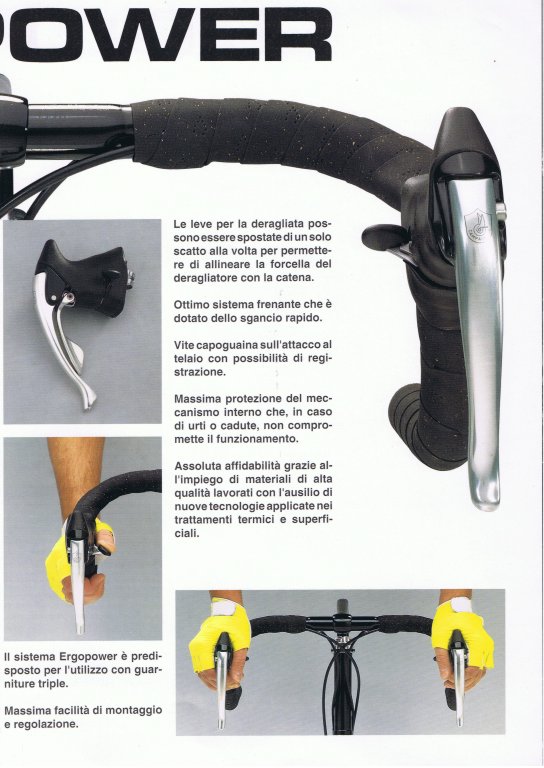
Below is the Italian version of the 1992 Ergopower catalog. I've added the english catalog's text below each of the pages, so those of us who can't read italian can follow along.


Indexed control levers for front and 8-speed rear derailleur, interfaced with the brake levers.

Maximum safety system for total control of the bike without removing the hands from the handlebar.

Ergonomically designed down to the smallest details, with extremely comfortable lever grip.

Total absence of over shift to obtain fast and precise shifting in every gear position.

Possibility to shift down 8 gears in succession in a single movement or to shift up one or two speeds.

Very reduced weight.

Complete freedom of movement due to the internal passage of cables, considerably enhancing appearance as well.


The front derailleur levers can be shifted one position at a time so as to align the front derailleur cage with the chain.

Optimum braking system with incorporated quick release opening system.

Adjusting barrel on frame boss allows fine tuning while riding the bicycle.

Maximum protection of internal mechanism so that operation is unaffected by blows or falls.

Absolute reliability due to the use of high-quality materials developed through new technologies for heat and surface treatments

The Ergopower System is set up for the use of triple cranksets.

Maximum ease of installation and adjustment.


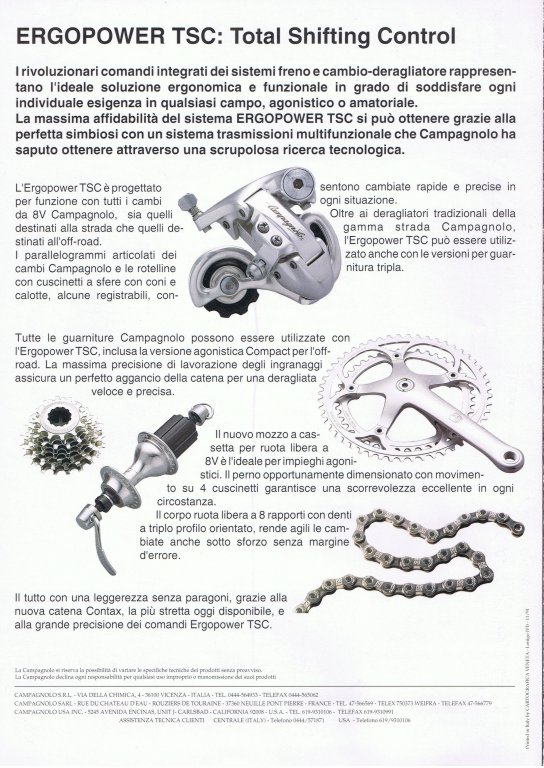
ERGOPOWER TSC: Total Shifting Control
These revolutionary integrated controls for the braking and derailleur systems provide the ideal ergonomic and functional solution for meeting every individual requirement in any field, athletic or amateur.

Maximum reliability of the ERGOPOWER TSC system is obtained thanks to the perfect symbiosis of the multi-functional transmission systems which Campagnolo has developed thanks to scrupulous technological research.

Ergopower TSC has been designed to work with all Campagnolo 8-speed rear derailleurs, whether for the road or off-road. THe articulated parallelograms of Campagnolo rear derailleurs both with pulleys using adjustable bearings and pulleys using bushings, permit fast precise shifting in every situation. Along with the traditional front derailleurs in Campagnolo's road range, Ergopower TSC can also be used with triple crankset versions.

All Campagnolo cranksets can be used with Ergopower TSC, including the Compact sports version for off-road.
The maximum precision in machining the chainrings ensures perfect engagement with the chain for fast precise derailleur operation.

The new cassette hub for 8 speed freewheel is ideal for sports uses. The appropriately dimensioned axle moving on 4 bearings ensures superior performance in all circumstances.

The 8 sprockets with triple-profile teeth make shifting easy, even under stress, without any margin of error.

All of this is obtained with unequalled lightness thanks to the new Contax chain, the narrowest available today, and to the high precision of the Ergopower TSC control levers.

Tuesday, March 24, 2009

Campagnolo's Century Finish

Sometime in late 80's or early 90's, Campagnolo introduced the "century" and "graphite" finishes to their product lines. Century was strictly for Record, and was a sort of smokey chrome. Graphite was available in the "lesser" component groups, and was a darker, opaque grey/black.


Graphite finish items show up relatively infrequently. Even less common are items in century finish, like these beauties that followed me home recently:


If you check out the Campagnolo catalogs, you won't see either finish pop up until the 1991 catalog. I have a hard time using catalogs as cannon in these situations - you'll also note that the last generation criss-cross style (often called the 5 pivot style) was available by then, and all delta's in the catalog sport black accordians and wheel guides.


Not so with my brakes. The Chorus cranks above have a '51' in a box for a date code, which I've been led to believe indicates 1989. Who knows when they really appeared? 1989? Possibly for the 1990 catalog year?

Tuesday, November 06, 2007

The Syncro Rainbow

Its no secret that I have an unhealthy love of quirky, late 80's/early 90's bike stuff. In my drive to corner the market in obsolete shifters, I've amassed a pretty scary amount of Campy Syncro equipment. Shifters, unlike frames, are small and easily hidden from the prying eyes of those who'd question my strange obsession. Good thing too.

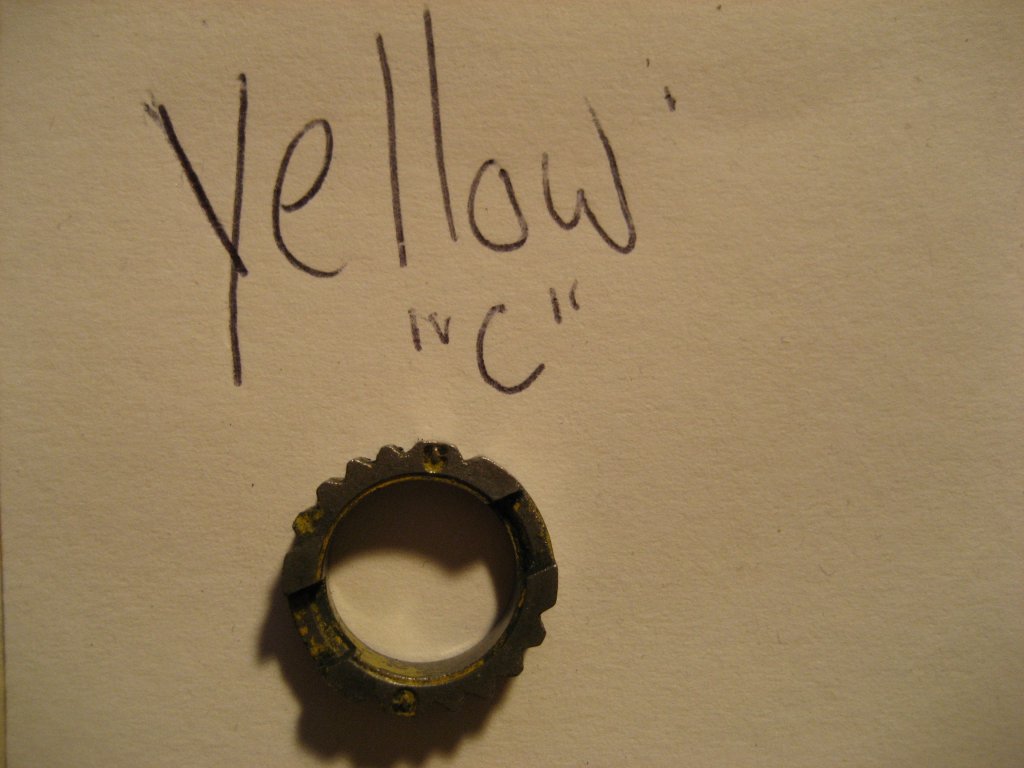
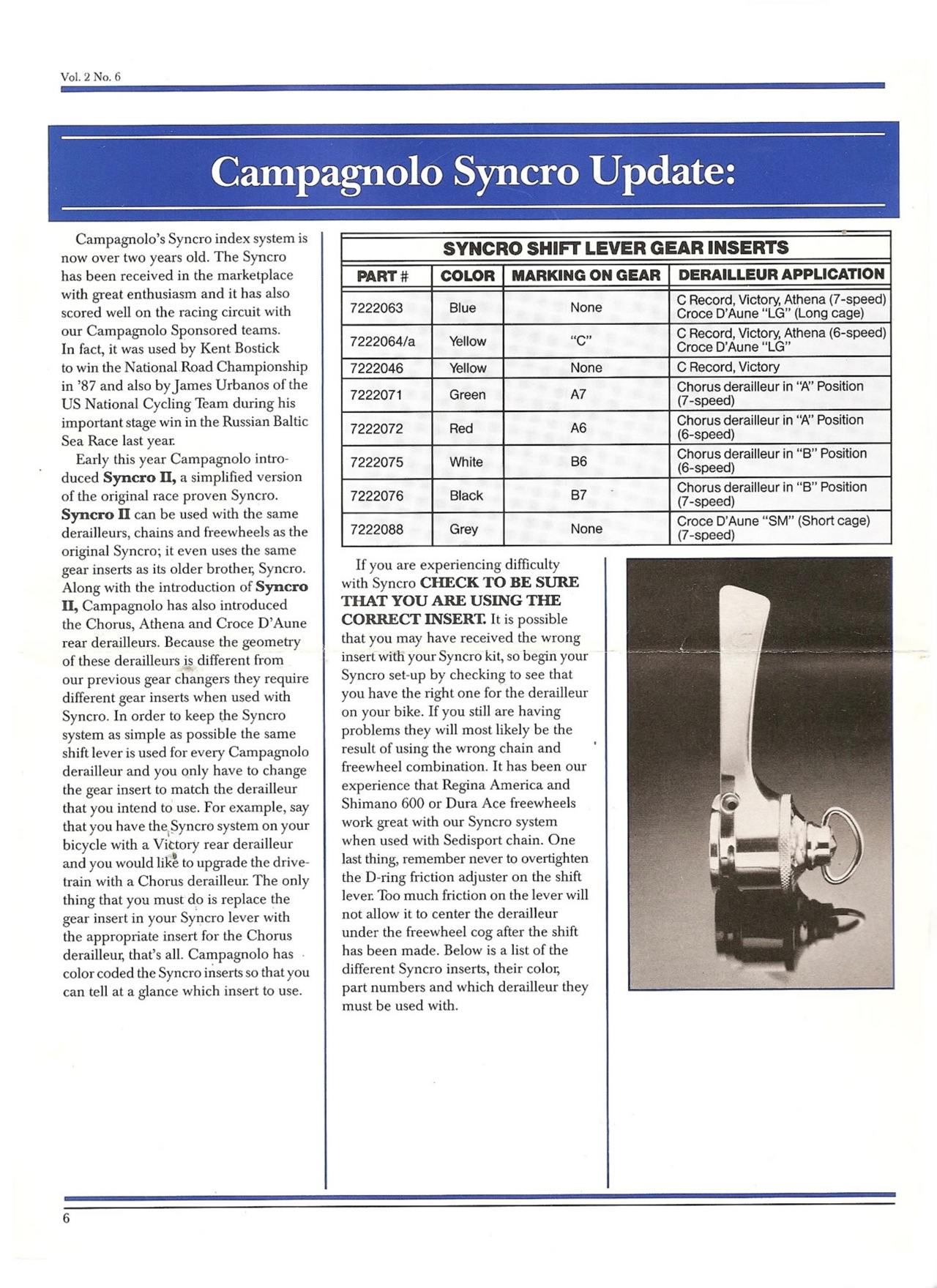
I recently came across a Syncro article in the Summer 1988 Record News, a news letter put out by Campagnolo USA in the 80's. Some interesting information in there. It confirmed the existence of 2 yellow insert variants, and maybe gave a little more clarity on what inserts work with what. Maybe. Still no listing for the Croce d'Aune small cage with 6 speeds that makes any sense. Good job guys!

Here's a little pictorial of the Syncro inserts.


The yellow "6V" insert.


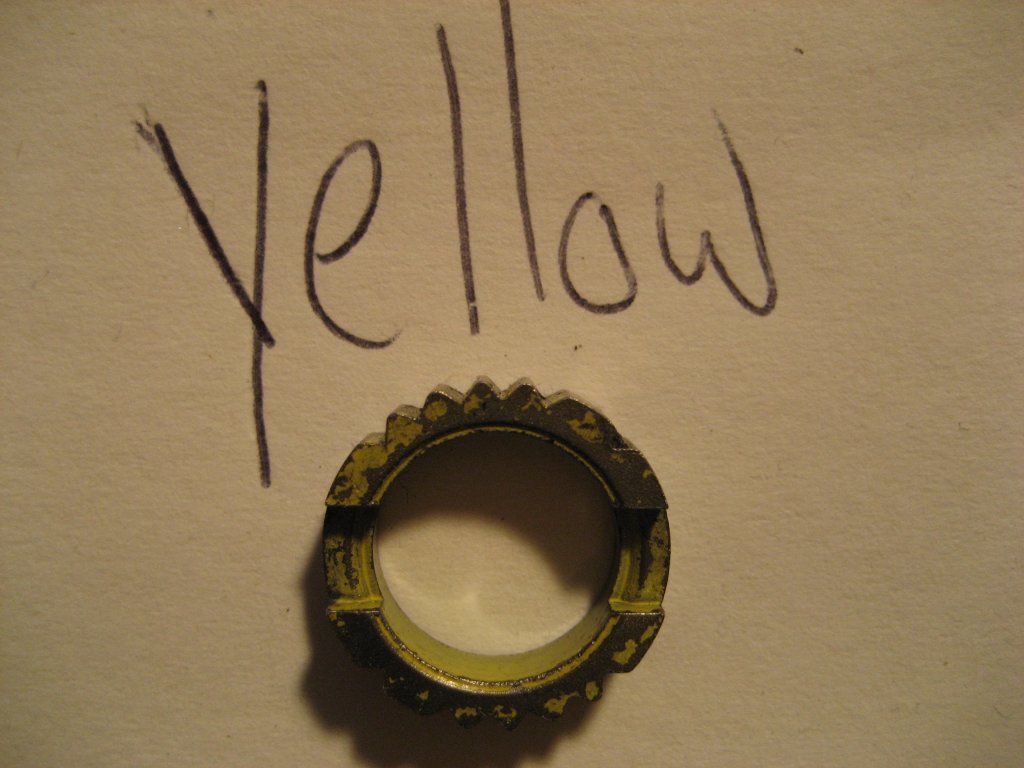
The yellow "C" insert.


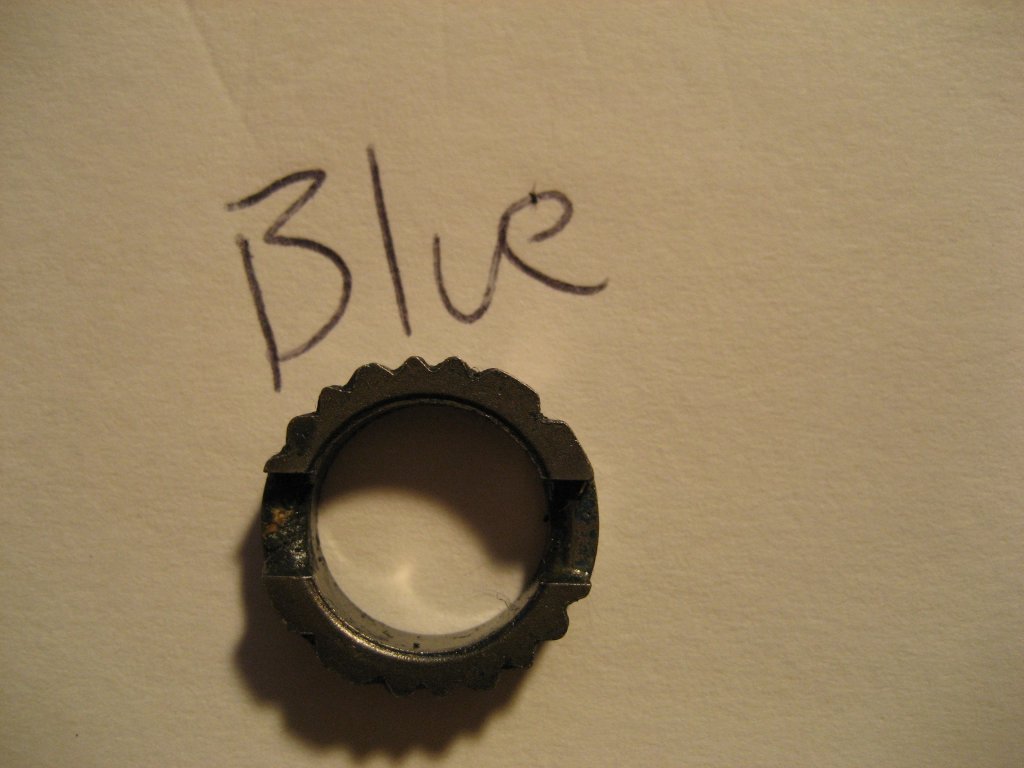
The blue "7V" insert.


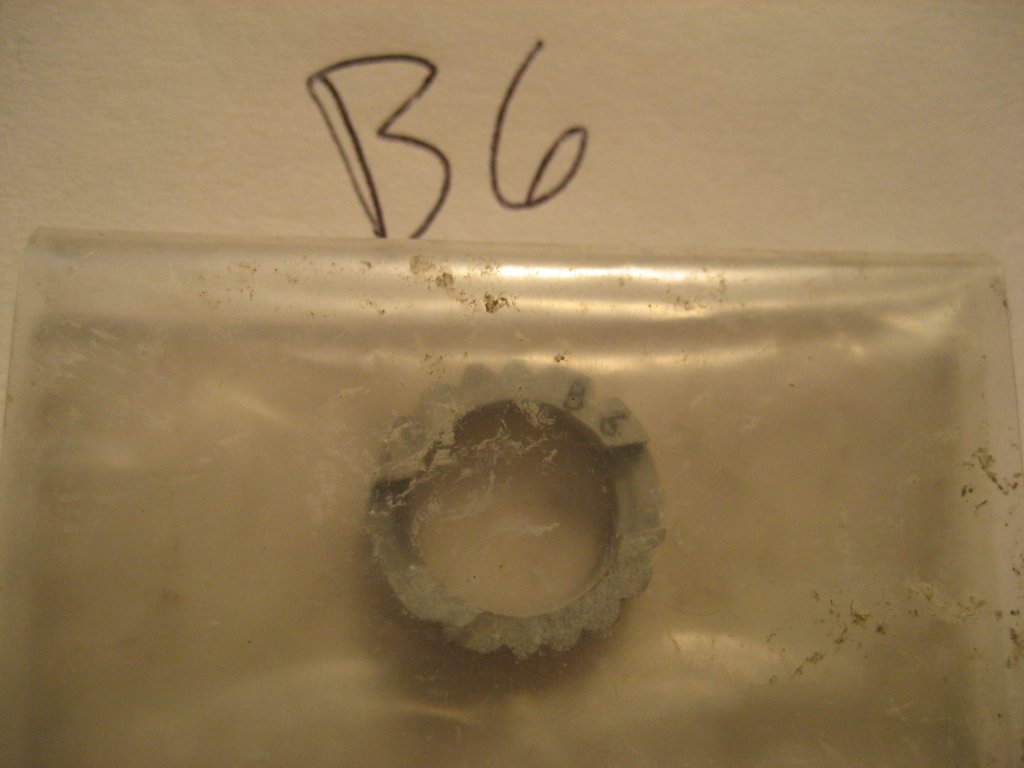
The white "B6" insert. Sorry about the plastic.


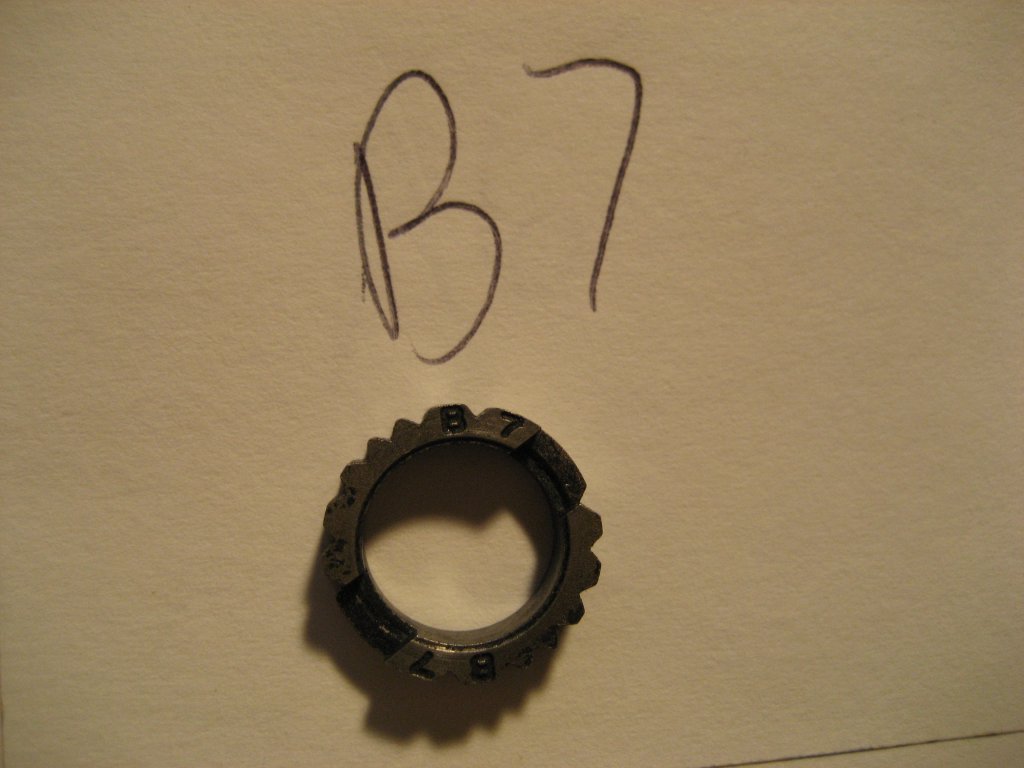
The black "B7" insert.


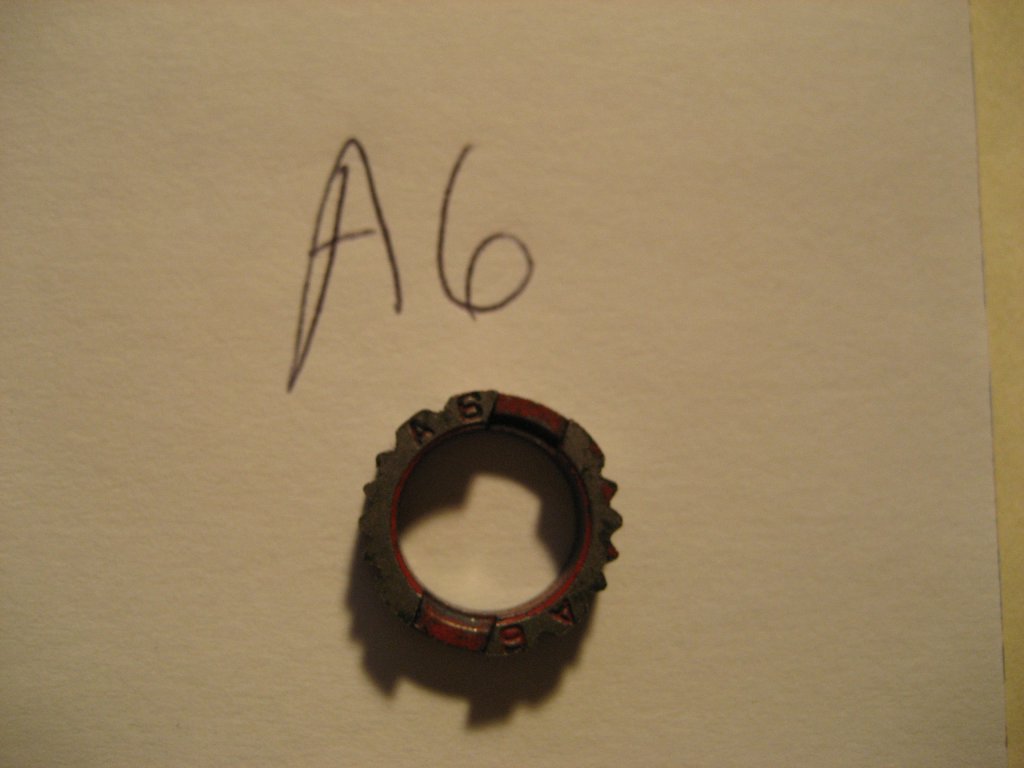
The red "A6" insert.


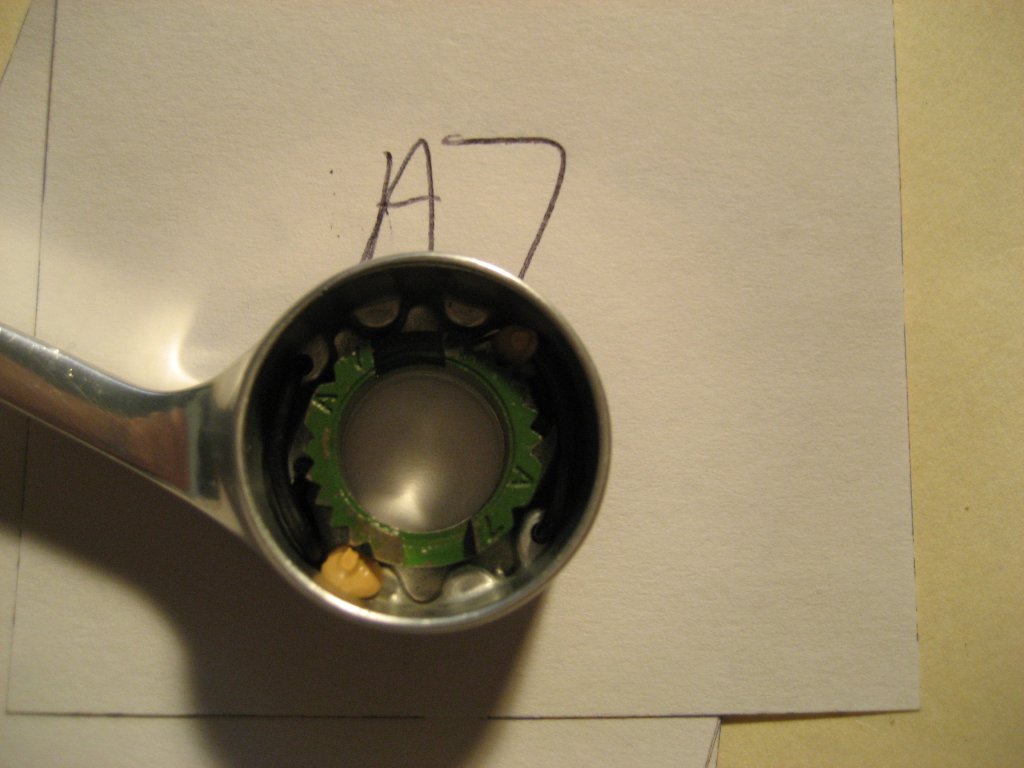
The green "A7" insert.


Thats all of the 6/7 speed inserts, except the grey "7V" one thats used for Croce d'Aune in 7 speed. That seems to be the only one thats ridiculously hard to find. If you have one, you really ought to send it to me - I promise to give it a good home.


The yellow inserts are pretty close to being the same, except for a very subtle difference in the 5th gear, and a more pronounced one in the sixth. I suspect the differences become more apparent in freewheels that aren't tight-ratio'd.

Thursday, June 21, 2007

Syncro Tips and Tricks


I've had a few people email me looking for some insight on setting up Syncro shifters. I don't claim to be all knowing on the subject, but I have had some success based on info I've read, as well as a couple of tricks I've picked up.
 
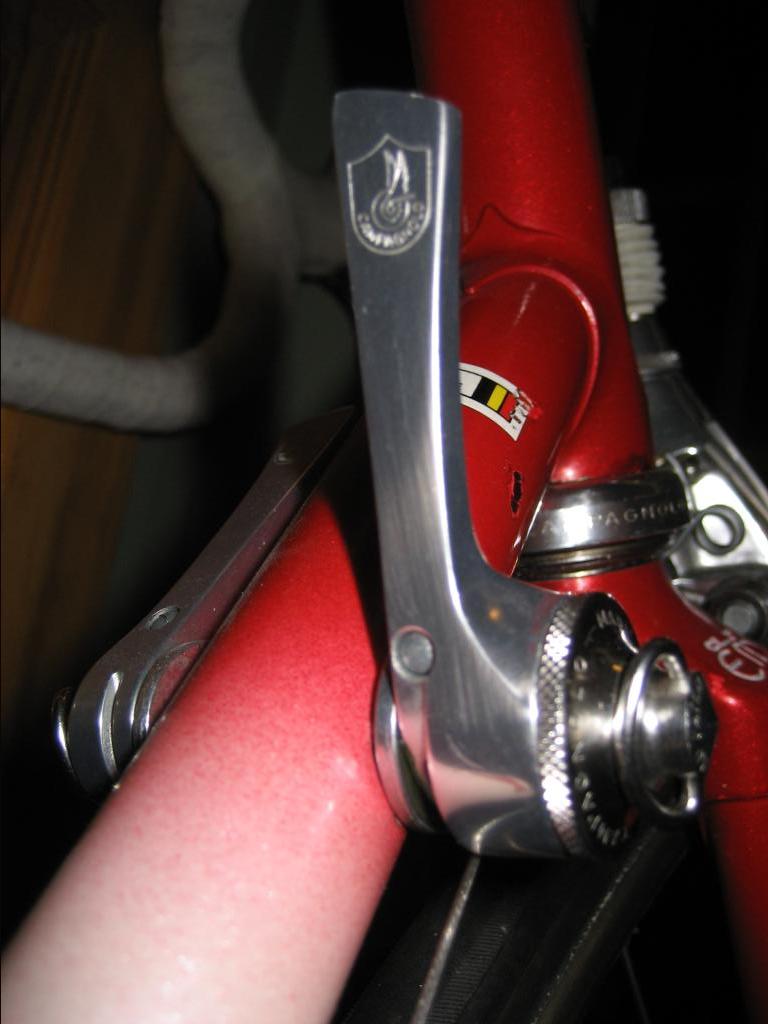
Syncro      Syncro2

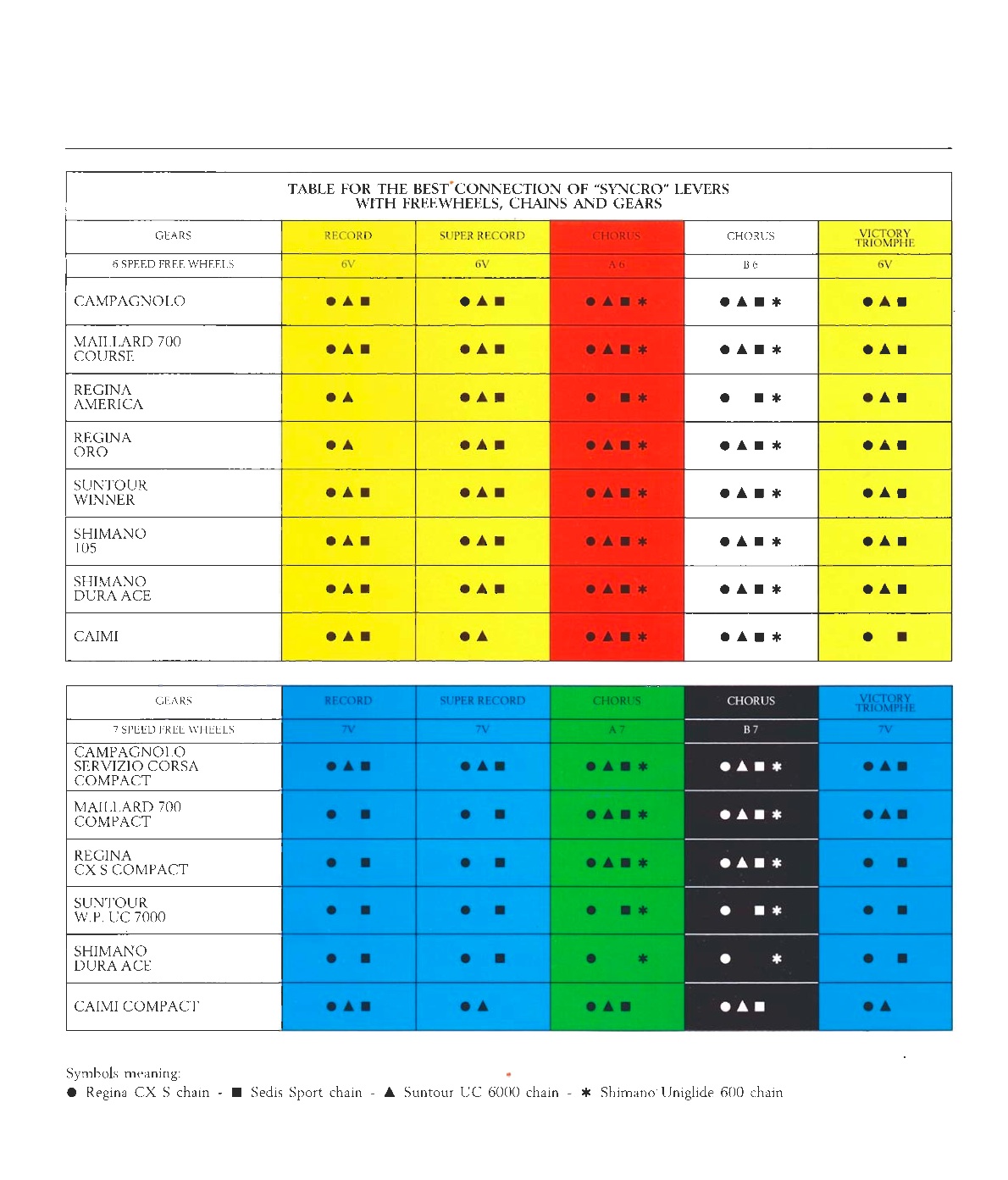
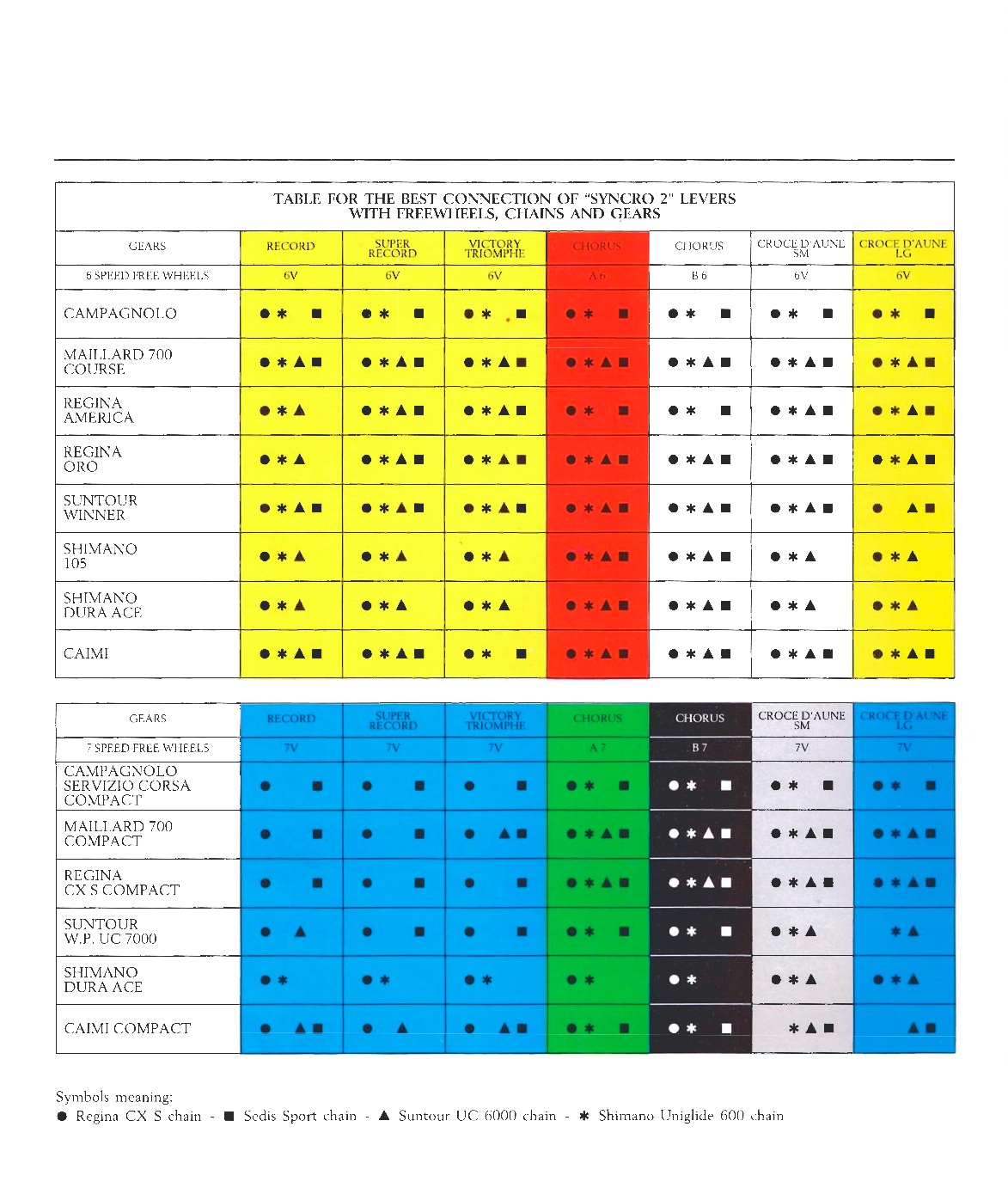
First things first. The first thing you MUST do is consult the tables provided by Campagnolo with regards to what combinations of freewheel, chain, dérailleur and shift collar work together. Yes -- the different colors of collars can be hard to find. In some ways, I'd suggest selecting your derailleur, freewheel and chain based on the collars you have access to. Some substitutions will work better than others, but unless you have lots of time and lots of spares, stick with something that Campy published as working. It can be hard enough setting up Syncro with the correct equipment.


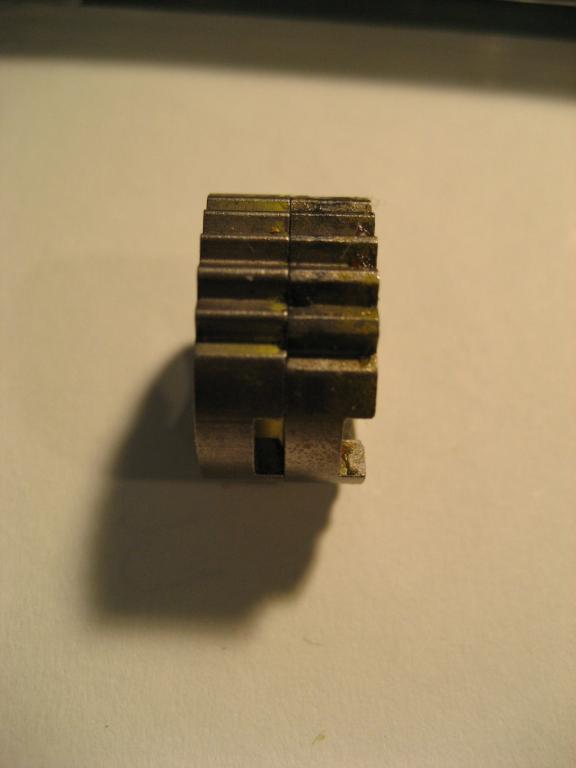
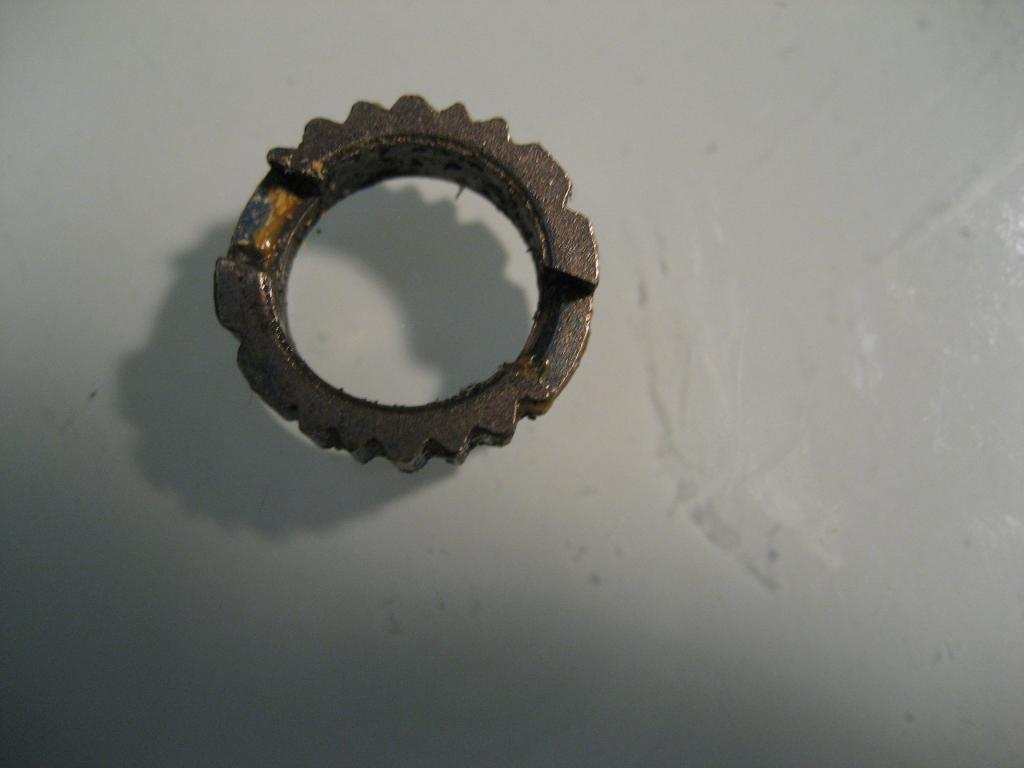
One tip I read that seems to help comes courtesy of a usenet post by Andrew Muzi over at Yellow Jersey. He advocates artificially wearing the teeth of the shifter notched insert, using a buffing wheel. I used a dremel with a little bit of buffing compound, which also works. The goal is to take some of the square edges off the teeth of the collar. This eliminates some of the harsh edges you'll encounter when shifting, and make the whole system a little more tolerant of imperfect shifts. The above shows a slightly worn blue insert. Might be hard to see in the picture, but the tops of the notches begin to round slightly when they wear. The goal is to simulate repeated shifting, and eliminate any break in time for the shifter.

There are also some who advocate using a floating upper pulley -- similar to the kind you'd find in a modern derailleur. The bearing units tend to be more precise, and indexing systems can benefit from a little wobble as they're shifting. It provides a little overshift, to get the chain up on the next cog, and then lets it sort of float back to the appropriate location. Personally, I haven't had to resort to this, but it may make the system a little less finicky.


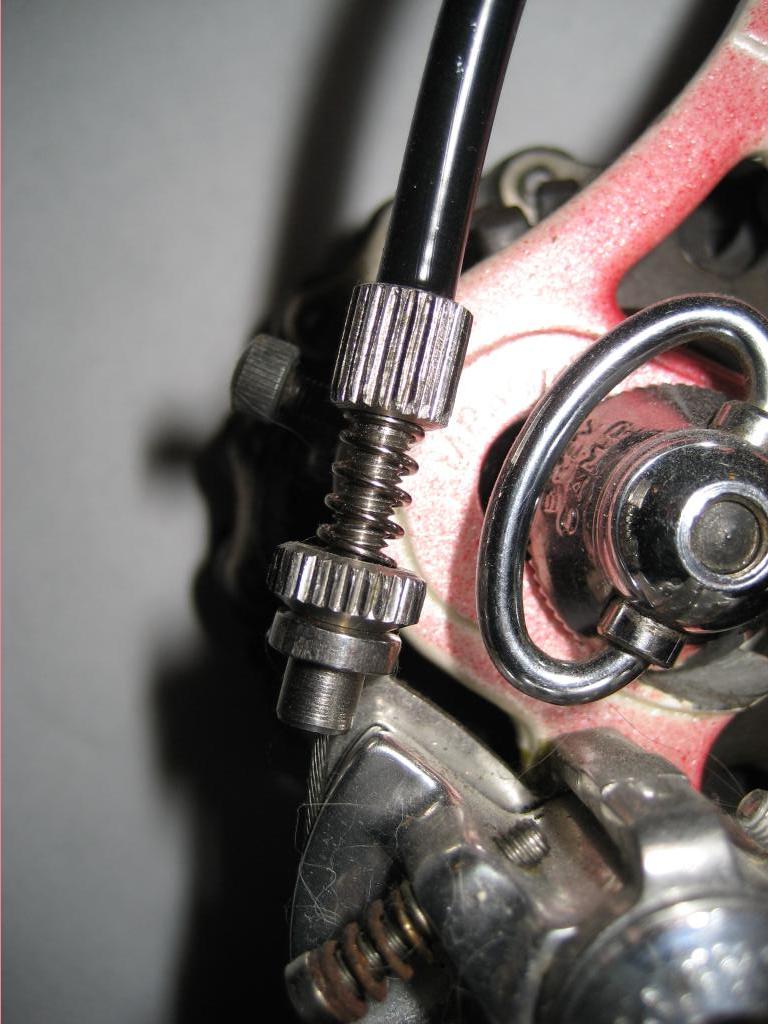
If your derailleur doesn't have a barrel adjuster, it should. Some Syncro shifter sets came with one, and once Syncro continued, derailleurs came with them. You need this for the fine-trim on your derailleur. The Campy supplied one is shown above, but you can cobble one together from your parts box.

One thing I've never read anywhere, but really seems to have a positive effect, is tightening the indexing lever more than you'd think. If you're used to modern indexing systems, you know the tension on the lever really has no impact on the quality of shifting. The tension isn't really all that adjustable. On the Syncro, however, having it snugged down further than you think seems to improve shifting accuracy immeasurably. If you hear a discreet 'click' when you shift, make them tighter! Mine make more of a thump sound when shifting...If you're used to friction levers, you will not end up tightening the indexing lever enough. Don't strip anything, but don't be shy either. I think this is related to the 2 springs not providing support for the insert when not tightened down (hence the eventual move to a much much better 3 spring version post-95). Just be careful -- I've seen cracked inserts before.

Use modern derailleur cables. They don't have as much stretch in them, and that seems to be a good thing. The use of linear cable housing may also be a wise thing, although I have to admit -- I'm using spiral housing successfully.

My setup works beautifully, if I do say so myself. I do *not* have to overshift, which was a common complaint with these. I think the wearing of the collar, in conjuction with the tight indexing lever makes all the difference. Curious about my setup? I use a Croce d'Aune derailleur, Regina Oro freewheel, CX chain and the yellow collar with Syncro 2 levers.

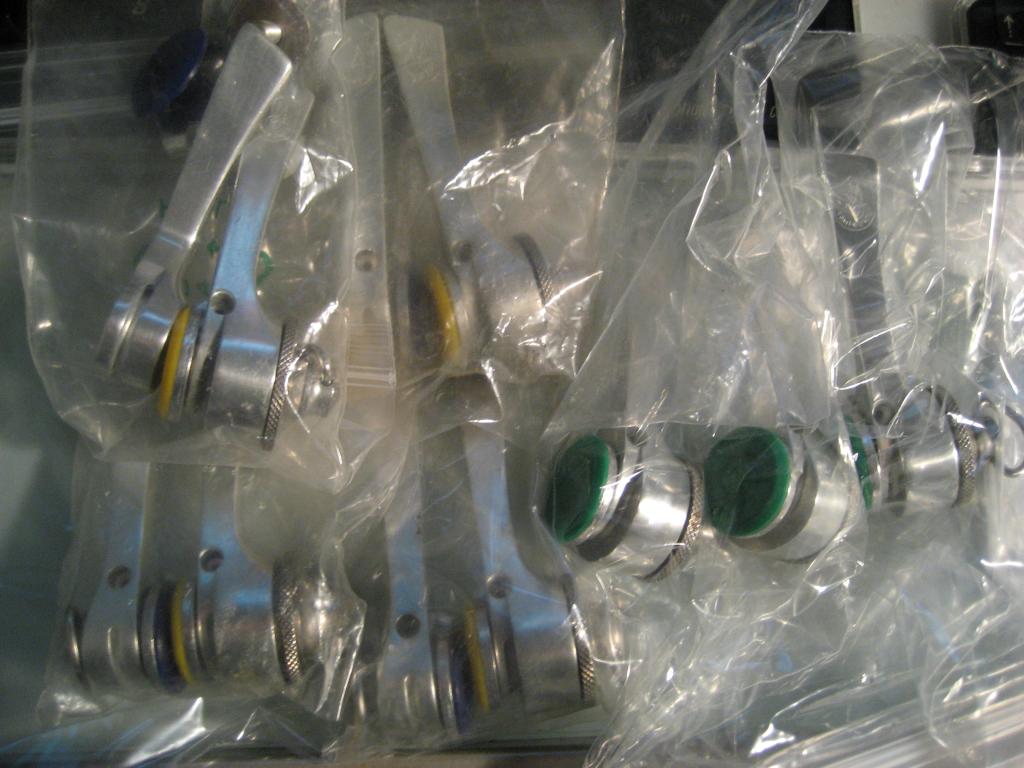
Here's a gratuitous picture -- a pile of NOS Syncro II's. Its all part of my effort to corner the market in obsolete, inferior technology.