Tuesday, March 25, 2008

More Mavic stuff? Who woulda guessed...

If there's one thing you can count on, its that I always have Mavic stuff to show off. These are the most recent additions.


Mavic 860 front derailleur, in the later, brown cardboard packaging. Earlier versions were in a yellow box with a mylar window. There's a ton of new in box Mavic stuff on the market these days. I'll post a yellow box pic once I dig one out of storage.


This is sort of a neat item. It's an early Mavic rebuild kit for the 500 RD front hub. The high tech packaging differentiates the different rebuild kits with a marker crossing out the 5 and 6 speed rear kits.


The contents are all the pieces required for a rebuild, including the bearings, adjuster shields, caps, spacers and c-clips.

If there's one Mavic item thats proved elusive, its a seat post. I have one, but it looks like someone sought out the most burred, undersized seat tube they could find, inserted it, raised and lowered it repeatedly, and then chucked it in a corner. In other words, if you have one that you're looking to sell, feel free to contact me. Thanks!

Monday, February 25, 2008

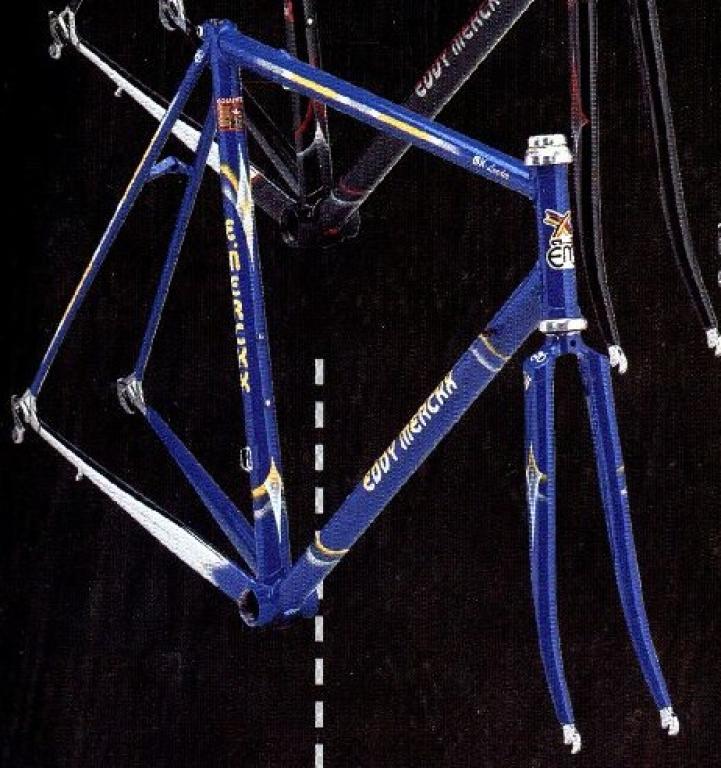
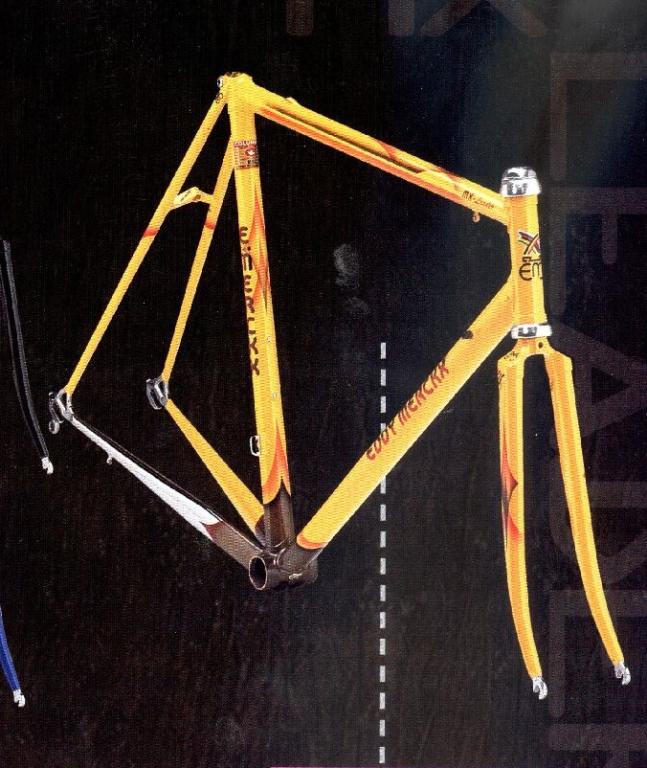
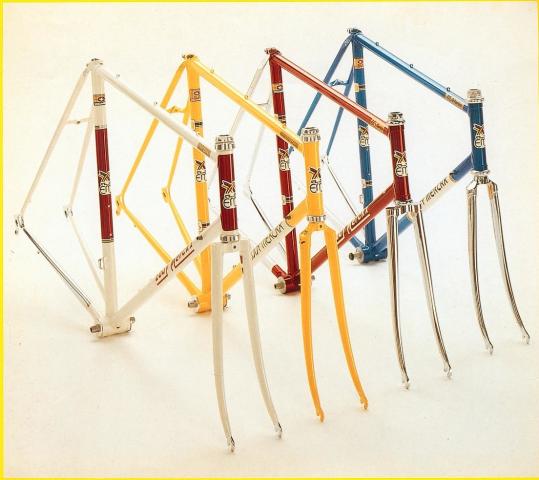
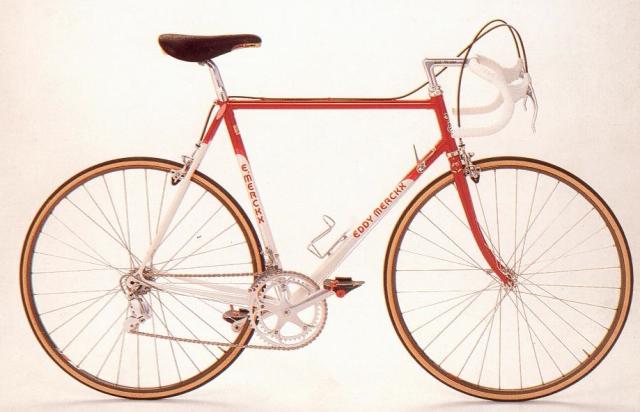
Eddy Merckx 1990 Catalog

I'm always on the hunt for primary sources for information about the bike stuff I'm interested in. Pictures, catalogs and the like. Words may lie, but pictures...well, they can lie too, but I'd rather be fooled by a period picture thats been retouched than by the recollections of a guy who worked in a store with a guy who worked for a manufacturer who's founder was a mechanic of another guy who's cousin rode with Eddy Merckx. Sure, I'd still like to hear their story, but I'd take whatever I heard with a grain of salt.


I recently picked up a 1990 Merckx catalog, that isn't (yet) in the enormous bike catalog archive that Mark Bulgier has. I've seen this catalog a few times on eBay, and loathed the fact that it wasn't scanned and available online.

It's up on bulgier.net in full resolution now. Get it here.

If you have this catalog, and never made it available to me and other Merckx addicts, I'm very dissapointed in you.


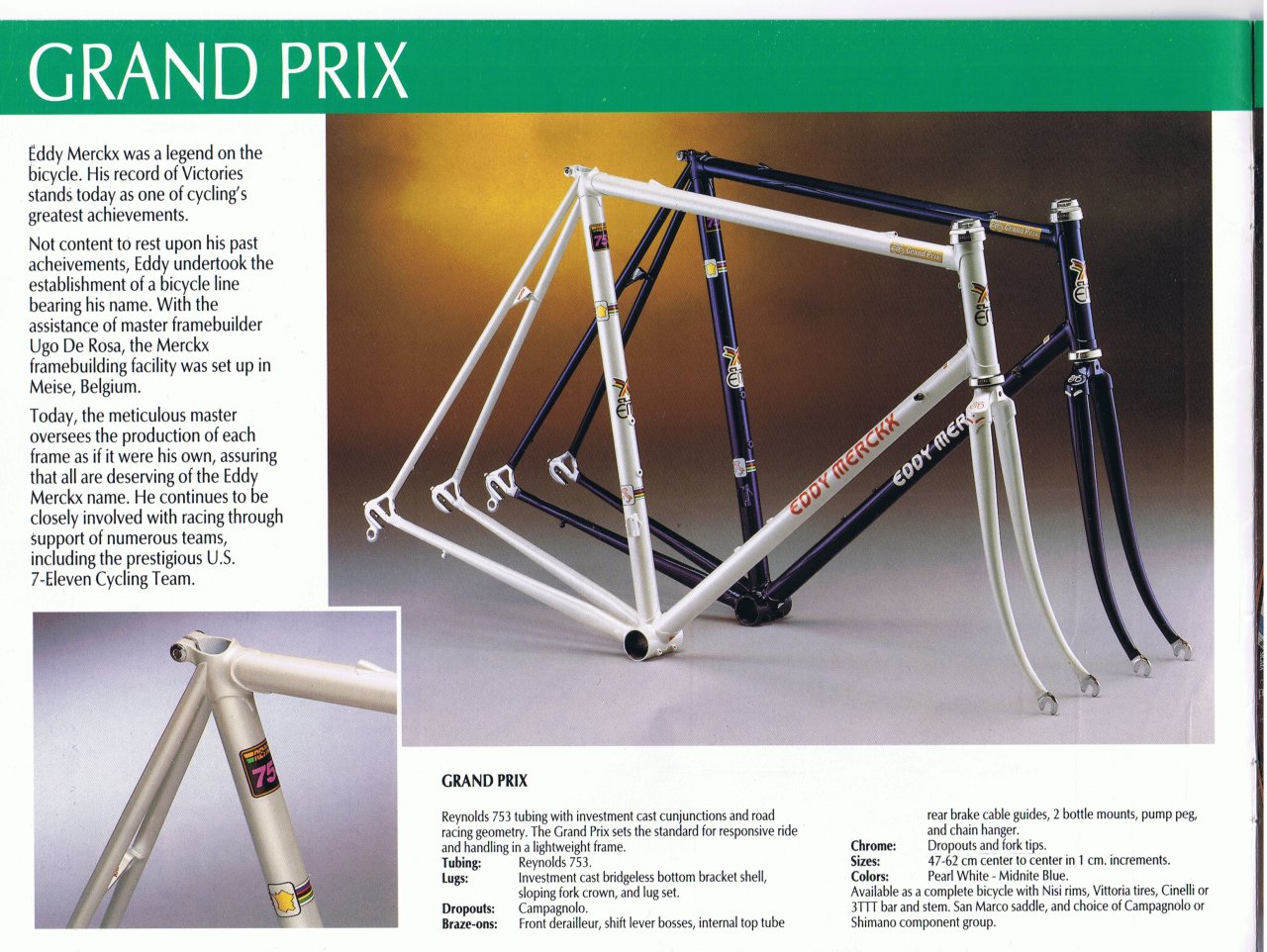
Anyone who's read this blog knows it was a Grand Prix that got me all excited about Merckx bikes. Mine is an 88/89, so it predates the above, but its very, very similar. My current thought is this catalog is from early 1990, as I believe they switched the way they did internal routing in 1990, from both cables on the top of the top tube, to the entrance tunnel being on the lower side of the top tube. I guess 1990 was when they decided non-aero brakes were dead.


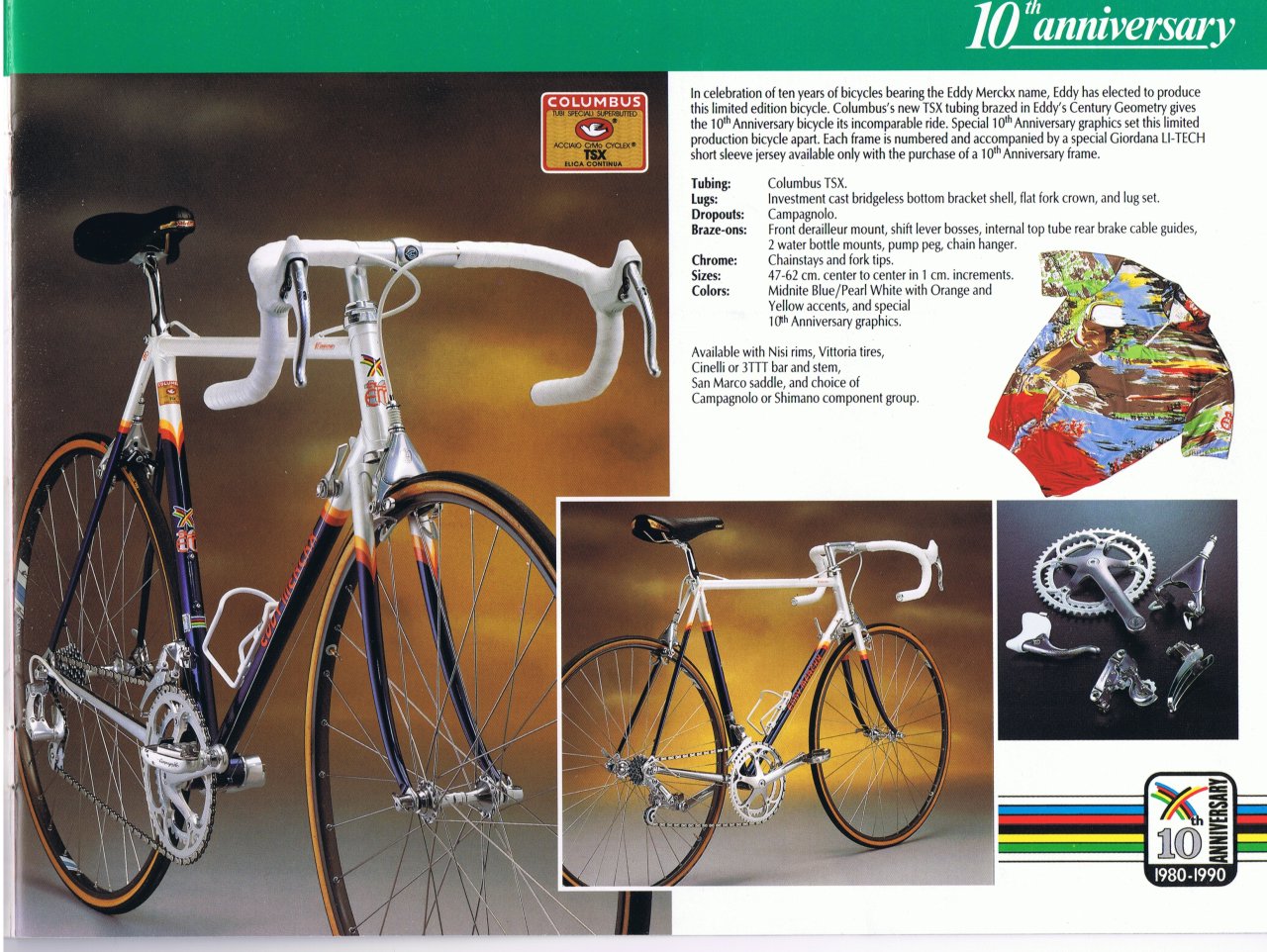
10th anniversary frame. Whats interesting about these is a large percentage of them bear a B date code, which indicates they were actually built in 1988/89. I'm guessing late 1989 is more accurate, which makes sense -- model year 1990 frames are usually available prior to the end of the previous year.


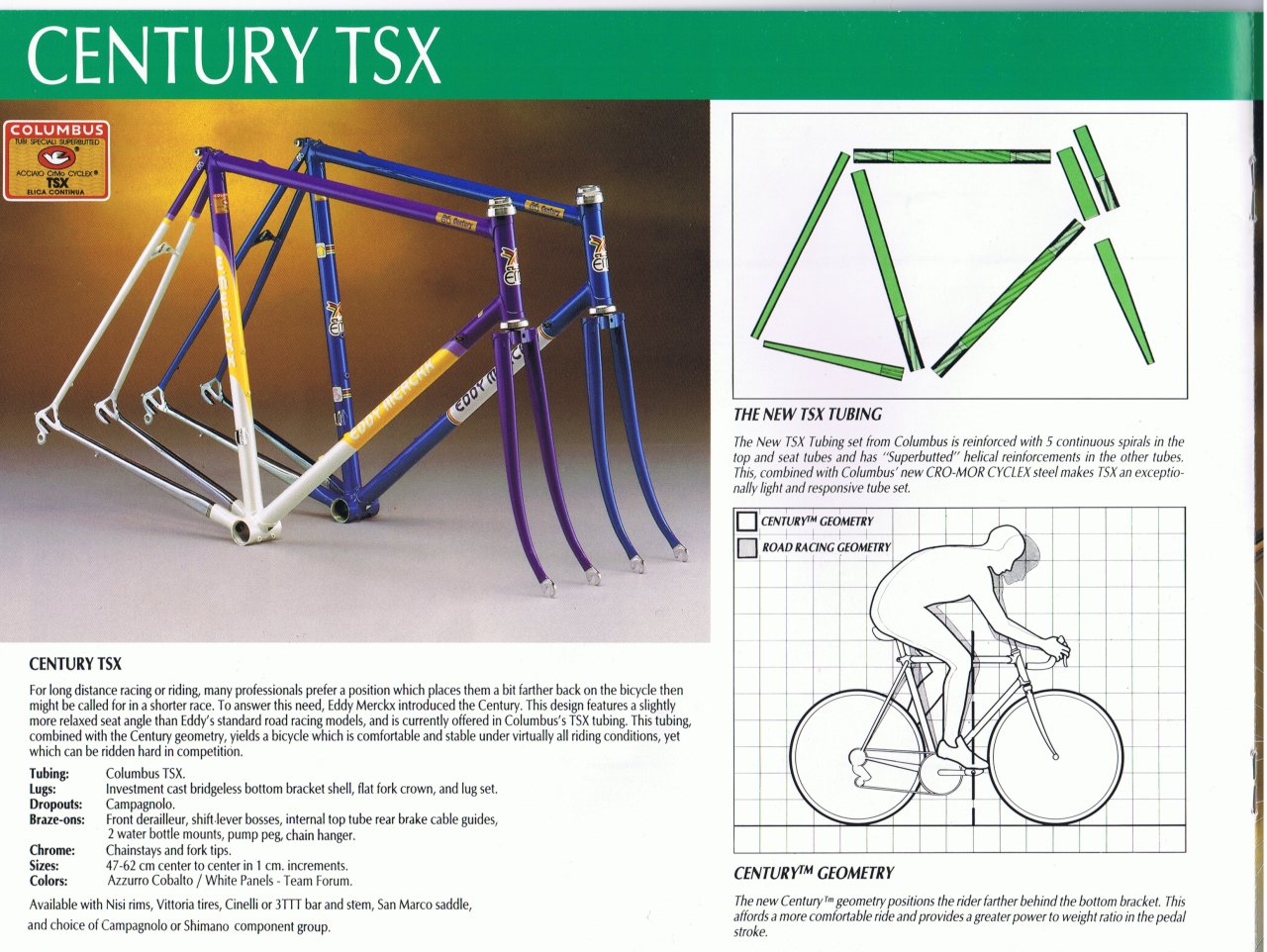
Century TSX. Note the different internal routing. The entrance tunnel is out of sight, on the under side of the top tube.

New team color scheme too? Team Forum? Never heard of them -- can anyone tell me more?


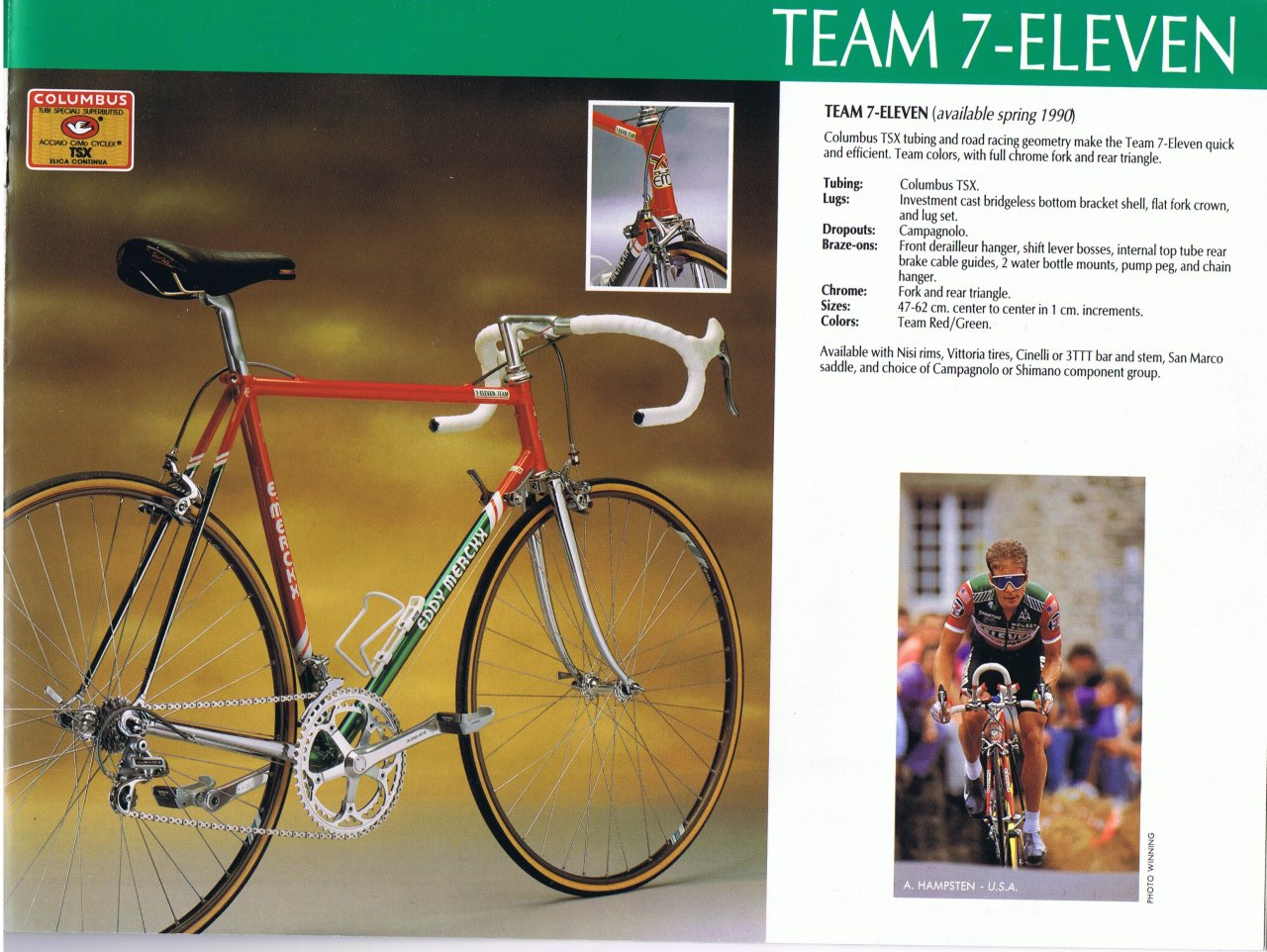
The Team 7-11 frame. I think this is effectively a Century in 7-Eleven colors. Note the presence of a 7-Eleven Team decal on the top tube.


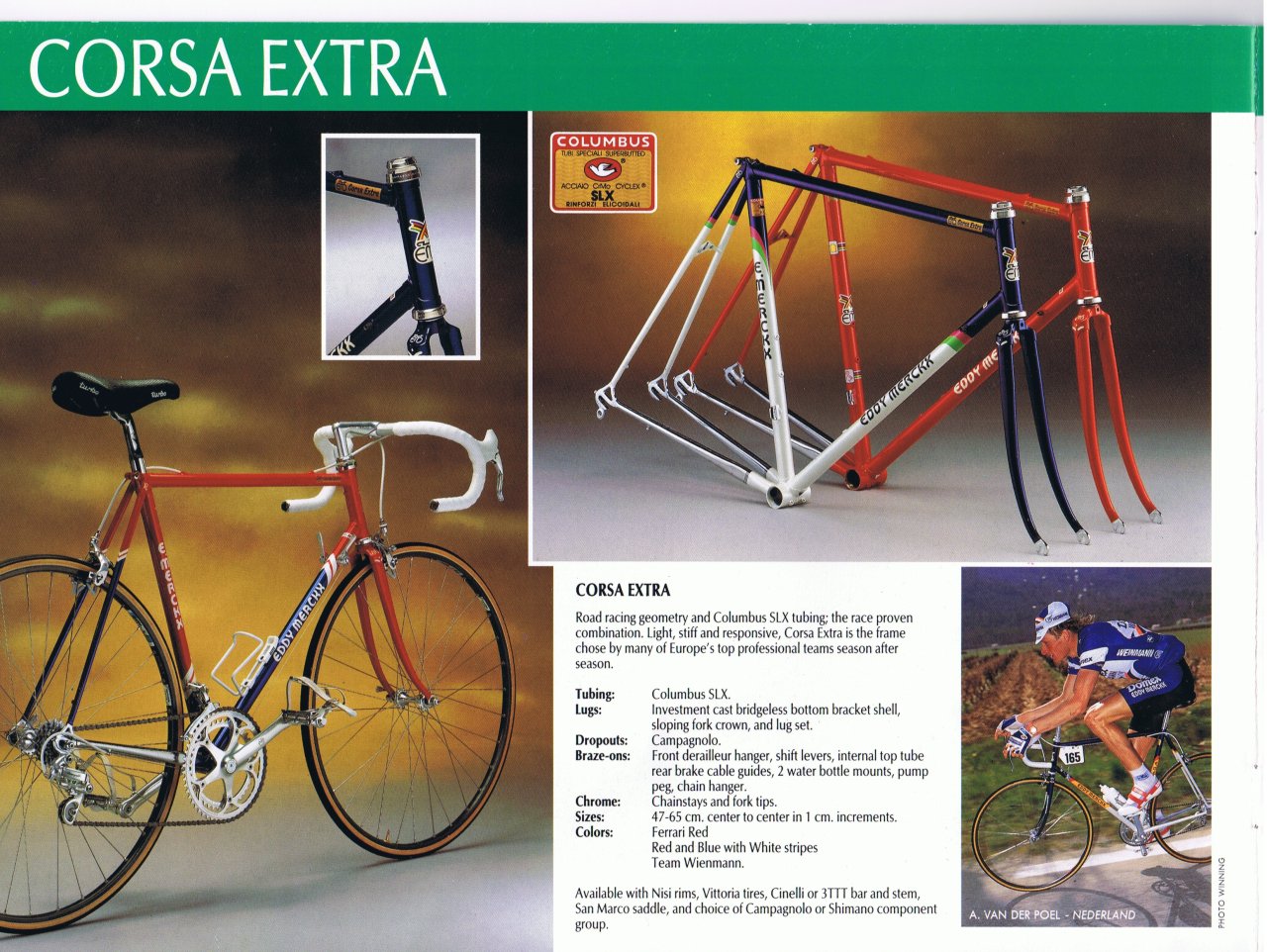
Corsa Extra, in the 1990 Weinmann color scheme -- perhaps my favorite of all the color schemes. Someday one will be mine. Also present is a color scheme I assumed was a team one which just appears to be a stock color scheme.


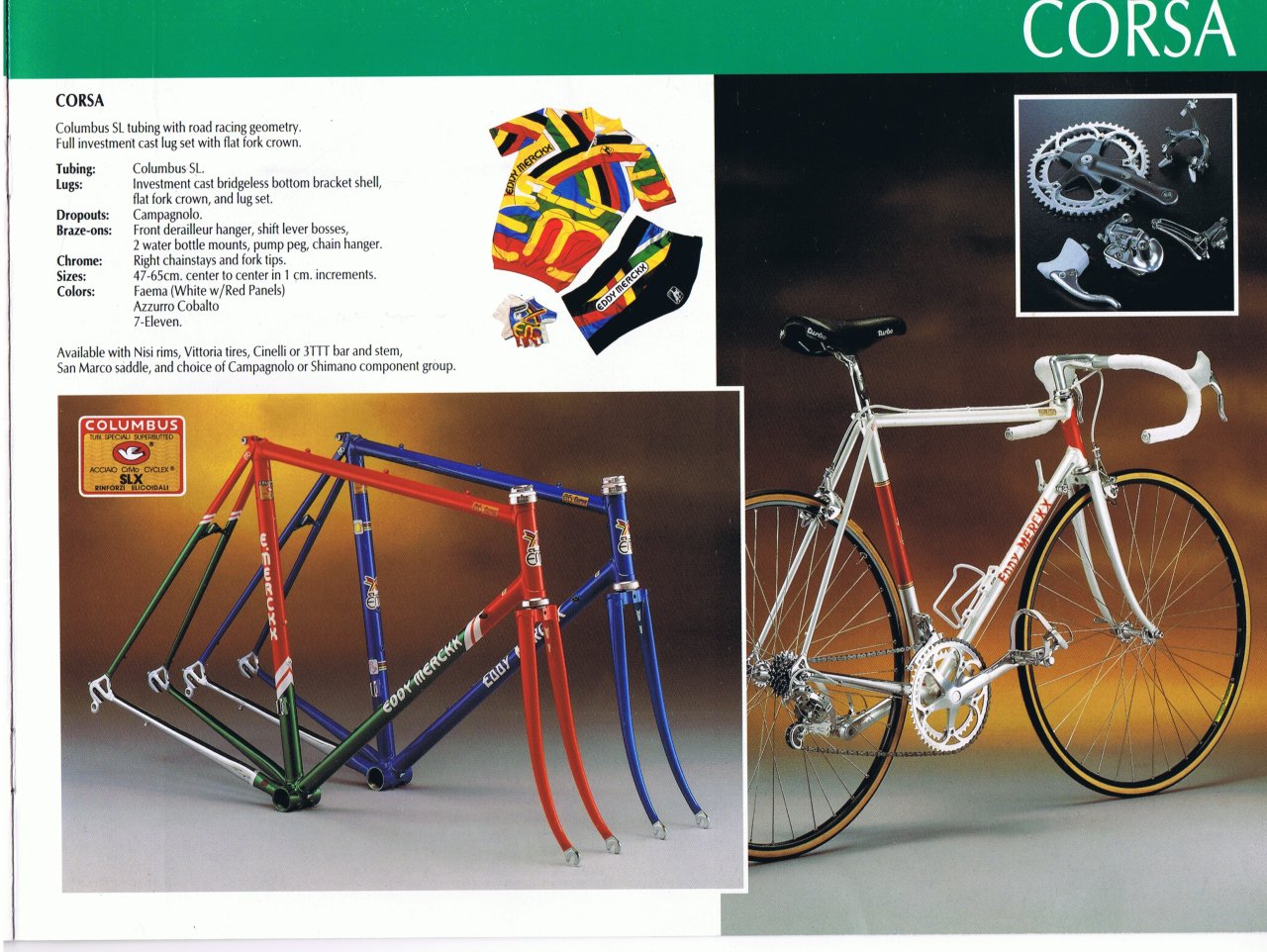
Corsa. The Faema reproduction is a beauty, and you can't go wrong with either the 7-Eleven color scheme or the blue. No 7-Eleven Team sticker here.


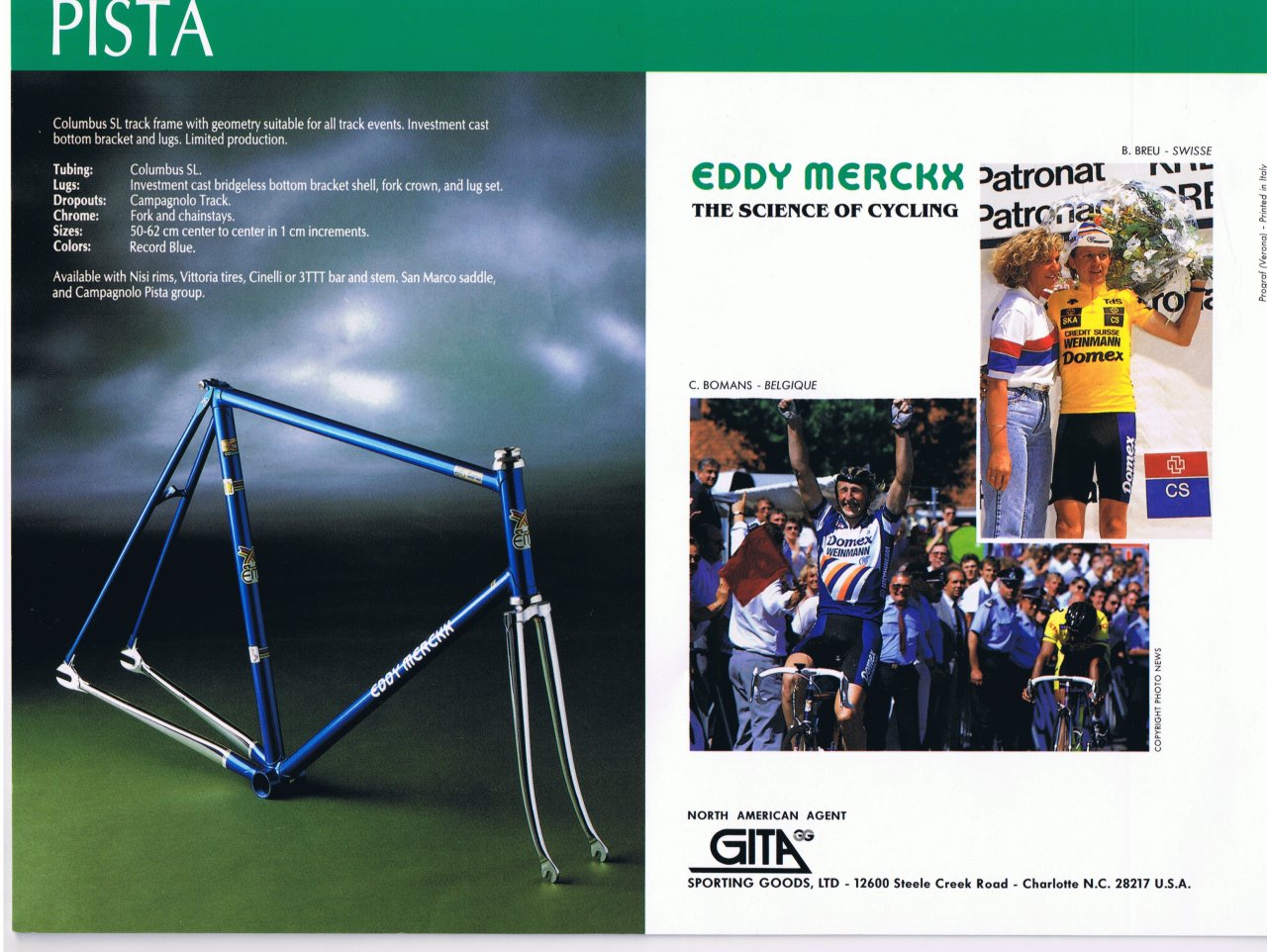
Pista in SL, sporting a Corsa decal. Simple + attractive in blue.

Have any Merckx catalogs that aren't at the Bulgier archive? If you don't have a scanner, I'm more than happy to scan for you. There's no good reason for people to pay ridiculous amounts of money for an 8 page catalog, when its so easy to scan and make them available to others.

Friday, February 22, 2008

Somewhat hard to find Mavic piece

I love buying from the French sellers on eBay. They've got all sorts of NOS Mavic bits, and while shipping isn't cheap, they're usually happy to combine shipping, and stuff gets to me FAST -- from the Paris area to NYC seems to take less time than from California. Being an impatient type, its always great to receive a package before I expect it.


This is an 821 shifter. Its the later packaging for Mavic components. Earlier parts were shrink-wrapped to a yellow, Mavic-logo'd card if they were on the small side. I'm sure stocking meant both were available in parallel -- but this packaging for the 821 was later.

The front 821 shifter is a retrofriction unit, not unlike the older 820 shifter. I don't think the 821 was made by Simplex, but its a possibility.


The 821 isn't hard to find, but the mount for non-steel frames isn't a piece I've seen before.

One of my dirty bike secrets is that I do, in fact, own a composite frame. Its an old Specialized Epic, that I refuse to love or care about too much, as its meant to be my commuting bike. It's sporting a Sachs 8-speed brifter indexing to a Sachs 7-speed freewheel, which works great, along with a normal Shimano downtube shifter for the front rings. It's unlikely I'll ever use the Mavic shifter on it, but its nice to have the option to. Now to track down a right-side mount...can't ever have too many options.

Friday, February 15, 2008

Who makes a better French brake, Italy or Japan?

It's a poorly kept secret that Mavic never made their own brakes. They didn't make their own shifters in some cases, and some of their cranks may have started as unmachined blanks from other companies...but their brakes they didn't even machine at all. From their earliest days, until the late 80's, they sourced all their brakes from the Italian company Modolo. In the early 90's, they switched to Dia Compe sourced brakes, produced in Japan.

Being a Mavic junky of the late 80's/early 90's variety, I thought I'd show off some of my brakes of the era.


The Mavic 440 brake was made by Modolo. As I detailed in a blog post about 2 years ago, they're the same design as Modolo used across their product line in the late 80's. They're good, solid brakes, which feel great when stopping.


In the early 90's, for reasons unknown, they switched from using Modolo brakes to using Dia Compe ones. These were the same brake as the Dia Compe BRS500, the Suntour Superbe Pro, and seem to be related to the currently available Cane Creek brakes. People either love them or hate them. They're very light, have adjustable tension, and perform admirably. But the hidden spring design makes them prone to problems where the head of the spring bends, and causes the brake to no longer maintain tension. Adjusting them is also difficult -- its done while the brake is mounted to the bike. One arm is pushed counter-clockwise to put it under tension, while the tension cone is turned counter clockwise with a cone wrench. Then, using your third hand, you tighten a hex bolt to cinch it all down, while maintaining just the right amount of tension.

Which is the better brake? Who knows?! They're both pretty cool if you ask me.

Just to head off a question I'm sure to receive...I don't know who makes the current Mavic SSC R3 brake. If you know, let me know!

Monday, January 21, 2008

Finite space + wife = time for a little purge

Living in NYC means finite space. Cohabitating in 900 or so square feet with a wife, an oversized cat and more than a handful of bikes means we spend a lot of time getting in each others way. Which means that if I want to continue getting cool bike stuff, I have to purge things every once in a while.


I'd make some quip about it being part of the cycle of life, but I avoid bad puns as much as possible. The real punchline here is, sometimes you have to get rid of some things in order to get others.

Since I have a whole lot of spares and duplicates in the collection, I figured I'd put some of it on eBay. Little bit of Campy, some Mavic, and Shimano thrown in for good measure. Check out my listings!

I'll be listing more, so keep checking in -- maybe that hard to find part will show up!

Monday, January 14, 2008

Mavic 870 Triple Front Derailleur

Mavic offered more or less the same front derailleur from the late seventies until they got out of the component game in the 90's. It went from a plain aluminum colored version (810) to the anodized, "SSC" version (860), and was sold as a clamp on (810/860), French style braze-on (811/861) and Italian braze-on (812/862). The 860 and 862 are pretty frequently seen, the 810/812 a little less so. The French braze-on is less common, but very rarely used, and so there's little demand there.


Mavic also offered a very hard to find triple derailleur, starting sometime in the mid-80's. Designated the 830 (non-anodized) and the 870 (anodized SSC), it was the same as the 810/860, with a longer cage.


I was lucky enough to stumble on a trio of Mavic 870 derailleurs recently, which I got for an eminently fair price.


And because they're so easily broken down + reassembled, if one needed a braze-on triple (872), and all they had was a clamp on (870), they could just swap out the body from a double (862). Too cool!

Thursday, January 10, 2008

An interesting Merckx on eBay

One of the primary methods I've employed to decipher the Merckx serial number scheme is by setting up a search on eBay that mails me a listing of every new bike or frame on a daily basis. I've seen some great examples -- former team frames, NOS frames that have been sitting in a Belgian basement since they were built, new color schemes I hadn't seen before...all sorts of cool things.

Today I saw a listing for a frame in Motorola livery that I thought I'd share. Not because its some pedigreed frame, or particularly obscure, but because its being sold to benefit a fellow rider who was involved in a pretty terrible accident involving a drunk driver.

Seeing as how I get a ridiculous number of hits from people looking for Merckx info, I decided I'd post a link to the listing.

It actually is an interesting frame. Take note of the decals on it -- this isn't the standard Motorola decal package, but an earlier one that would typically be used for a solid, paneled or fade color scheme. Pointed liveries would typically have a different set of seat tube graphics, and those slanted letters -- well, I thought those were gone by the late 80's.

I've seen four or five of these Motorola frames with the odd decals. A couple of Corsa's, a Strada, and maybe a Corsa Extra as well, all in the C date code (1990/1991). My guess is they're early Motorola color scheme frames, prior to them nailing down the decal package. Or are they something else? No good answers here, but I think they're an interesting variant on a pretty popular color scheme.

Maybe one of you out there who's been looking for a Merckx of their own will find it there -- and help a rider in need at the same time.

Monday, December 31, 2007

Marc - V.R.D.

Just recently found another few Merckx sponsored teams. First up is Marc-V.R.D., starting in 1980! Might have been the first Merckx sponsored team.


Their frames looked somewhat similiar to the above. Marc teams continued to use Merckx frames for a couple of years, but I haven't found any decent pictures to indicate what they looked like.

In 1985, Tönnisteiner roade Merckx frames. Here's a black and white picture of Filip Cottenies. In this picture, you can just make out someone (might be Cottenies, I'm not sure) on a white frame with a red head tube and read seat tube panel.

Sunday, December 09, 2007

Motorola Scans

I've been combing through various magazines and books, scanning pics of Motorola team riders, to try to lend a hand to Randy Dugan, who owns Michel Dernies former team frame. He's built it up with an eye towards accuracy for how it was likely to be equipped in the 1993 racing year. Extremely cool bike, and the source of extreme envy on my part.

I haven't found any Dernies pics yet, but I've found a few cool pics that I thought some of you might be interested to see. Here's one.


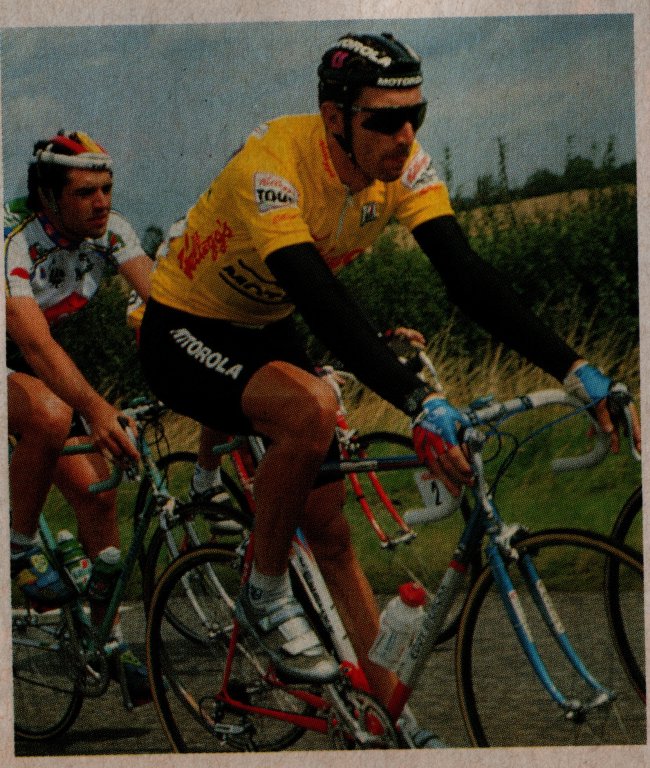
Max Sciandri on his way to winning the Kellogg's Tour of Britain in late 1992. Pretty sure he's riding an early MX Leader, based on the fork crown, size of tubes, etc.

Sunday, December 02, 2007

Mavic 631 Triple

While I haven't written about anything Mavic in a while, my love for the quirky stuff they produced is still strong. Good or bad, their products always displayed a uniqueness that I really like.


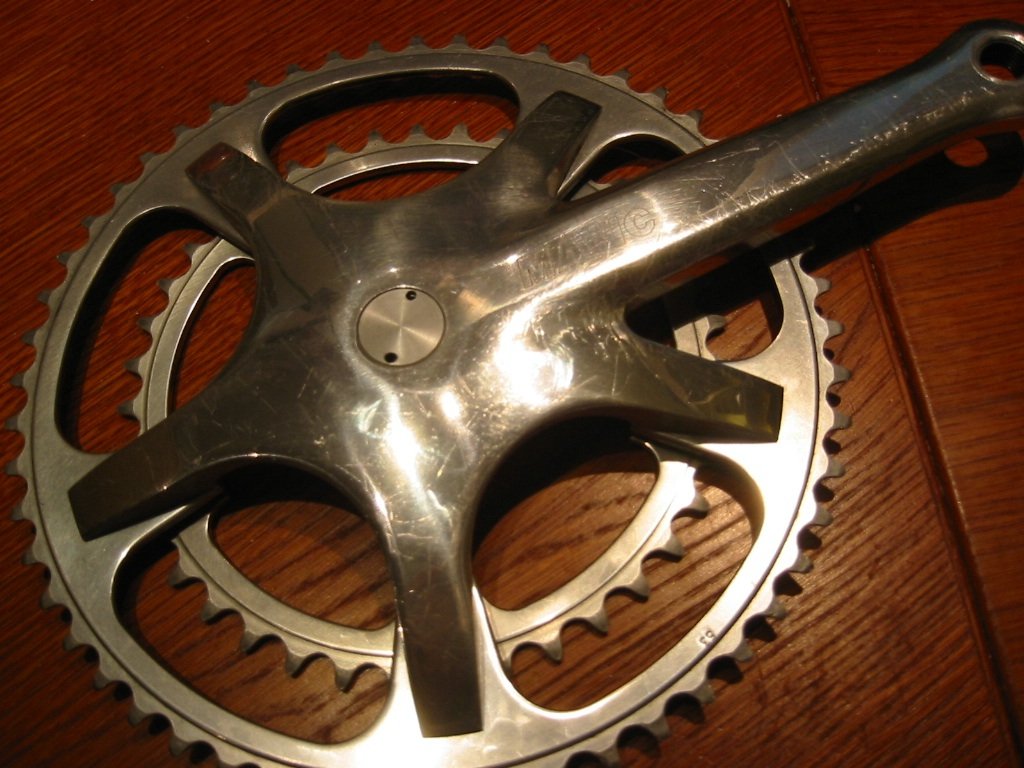
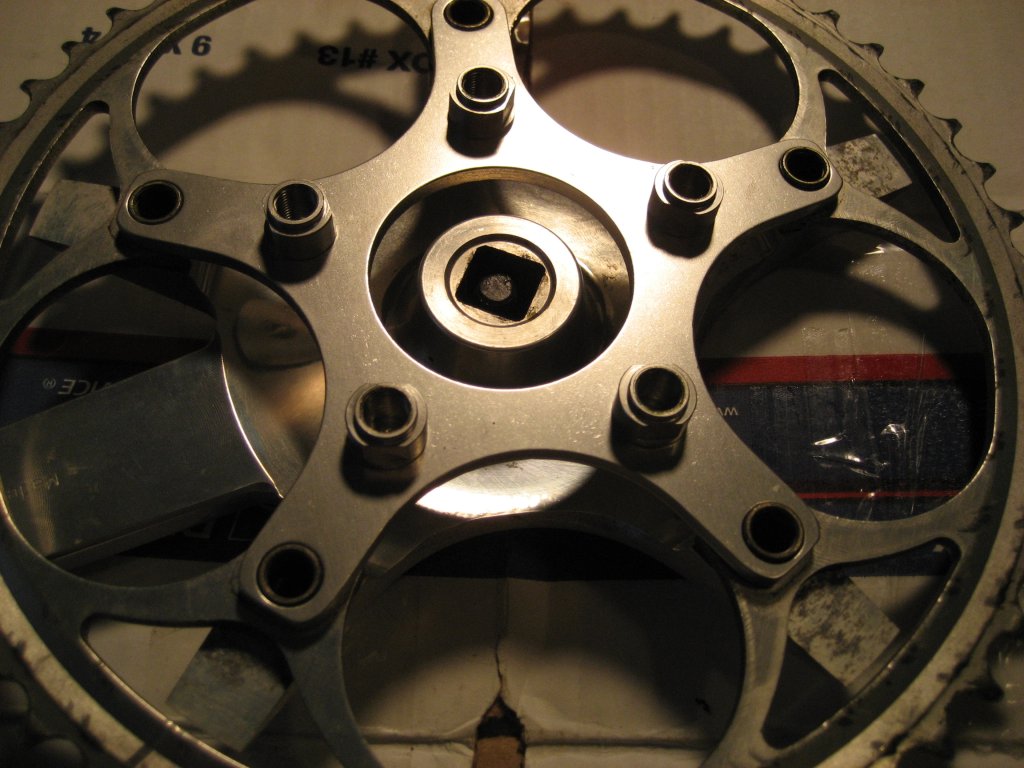
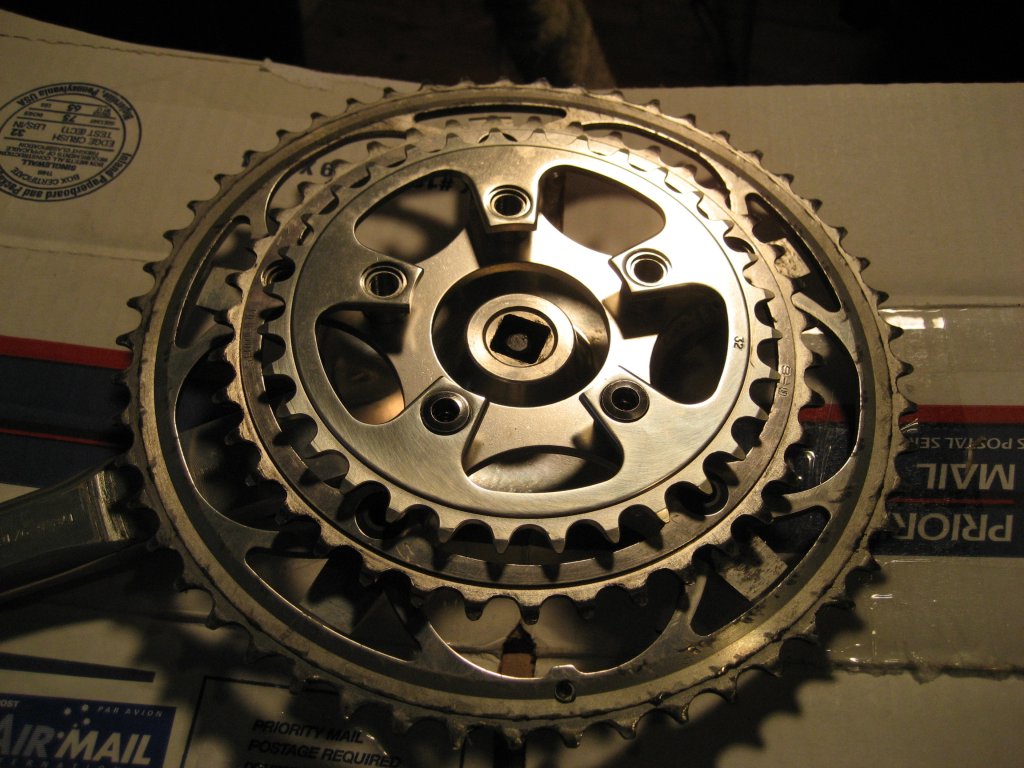
The 631 crank is unique in its aesthetic, but the thing that really sets it apart from other cranks is it was designed to be used as a single, double or triple crank. As a single, the original design allowed you to run down to a 48t outer ring, though a redesign in the early 90's (94 perhaps?) allowed for a 44t outer ring.


When used a a double, spacers are used to seperate the outer and inner rings.

Things get interesting when using the 631 as a triple.


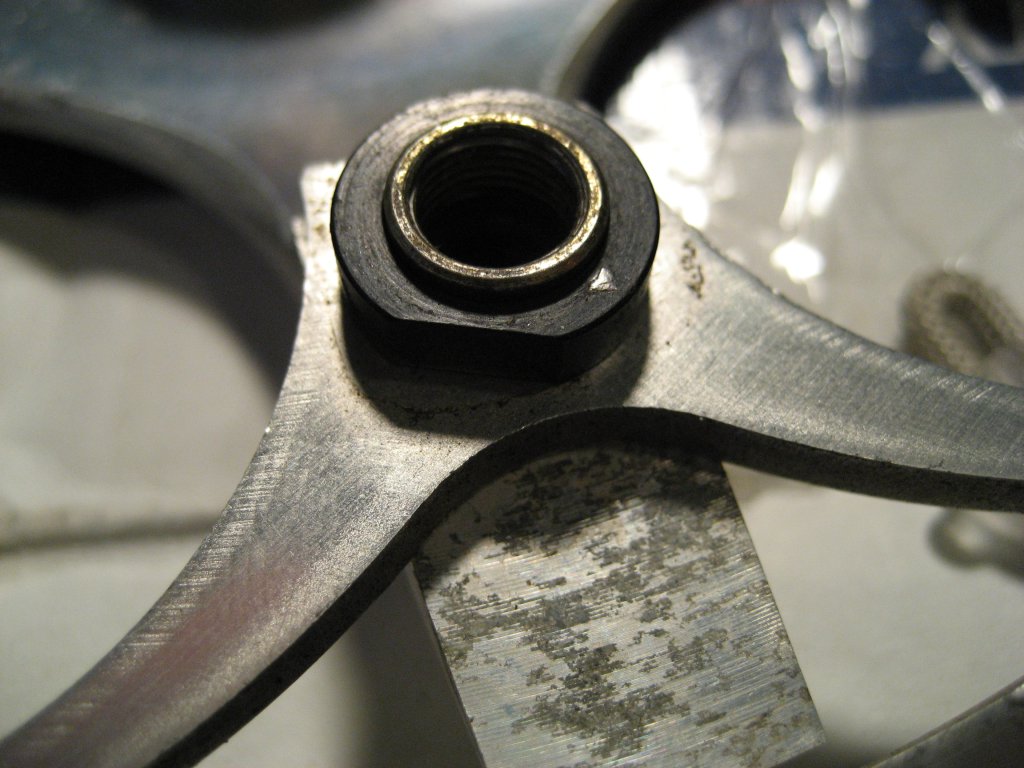
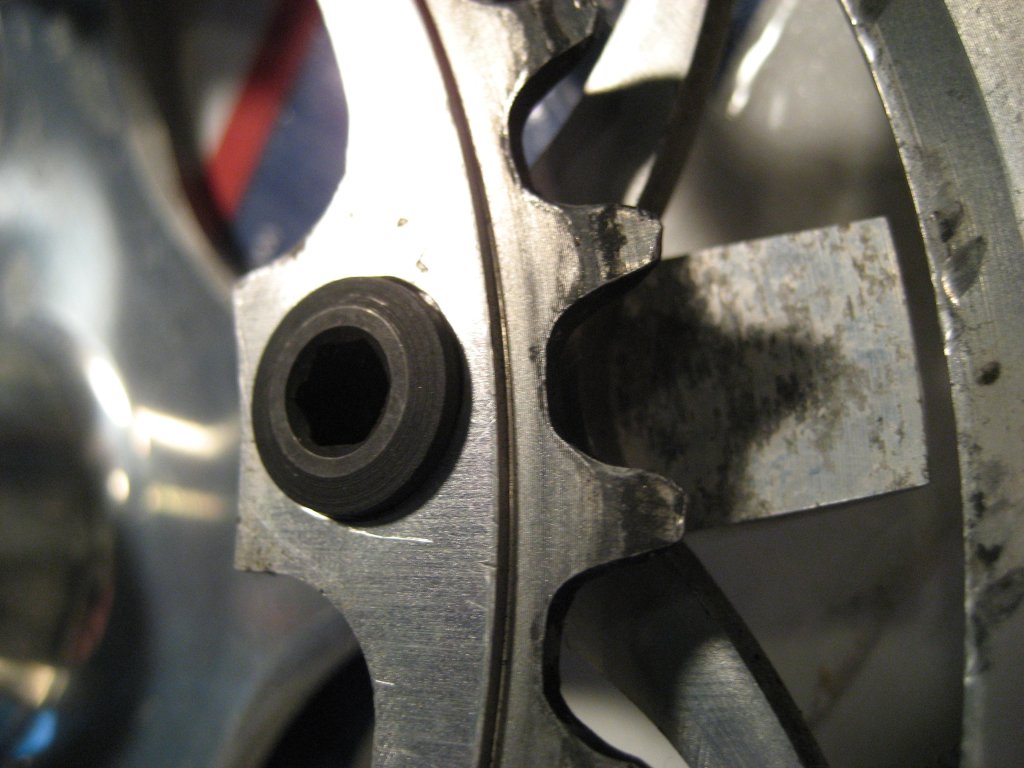
A third ring carrier replaces the spacers normally found between the outer and double-inner ring. The middle ring is bolted in place as the inner ring normally is followed by the 74mm BCD inner ring


Et voilà, a triple. Where a 631 double was designed for a 113mm bottom bracket, the triple uses a 119mm.

Tuesday, November 20, 2007

La Vuelta 1986

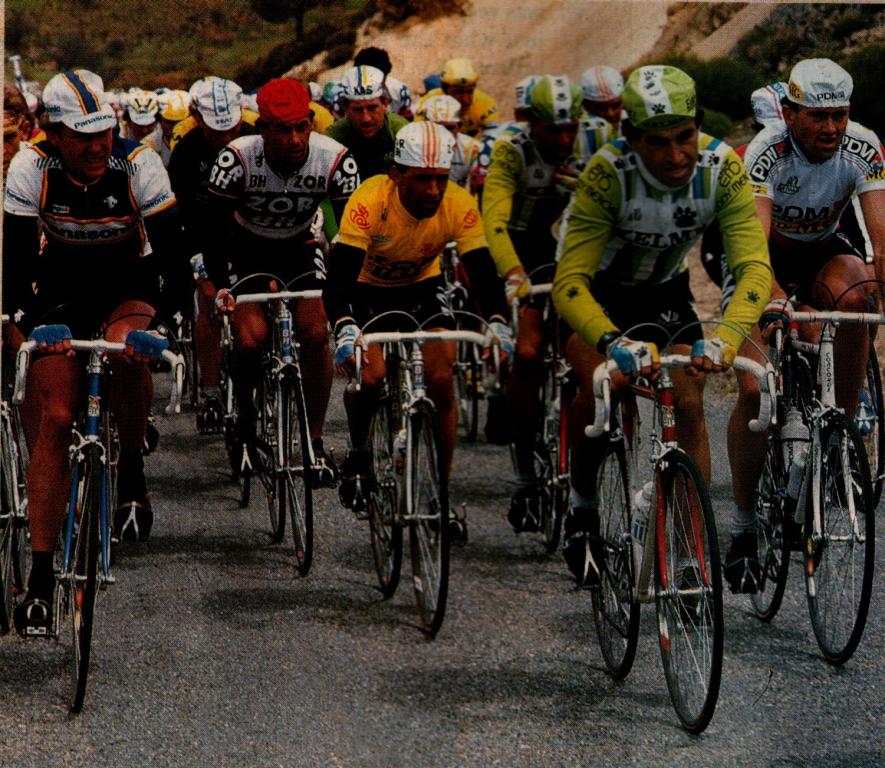
Here's a cool picture of two of the teams riding Merckx frames in 1986 -- Kelme and Panasonic.


From Winning magazine, June 1994. It was one of two pictures meant to illustrate the ever interesting topic of shoes in the peloton. I'll post the matching picture, which shows the 1994 peloton and their shoes (and another pair of Merckx teams) shortly. Enjoy!

Tuesday, November 06, 2007

The Syncro Rainbow

Its no secret that I have an unhealthy love of quirky, late 80's/early 90's bike stuff. In my drive to corner the market in obsolete shifters, I've amassed a pretty scary amount of Campy Syncro equipment. Shifters, unlike frames, are small and easily hidden from the prying eyes of those who'd question my strange obsession. Good thing too.

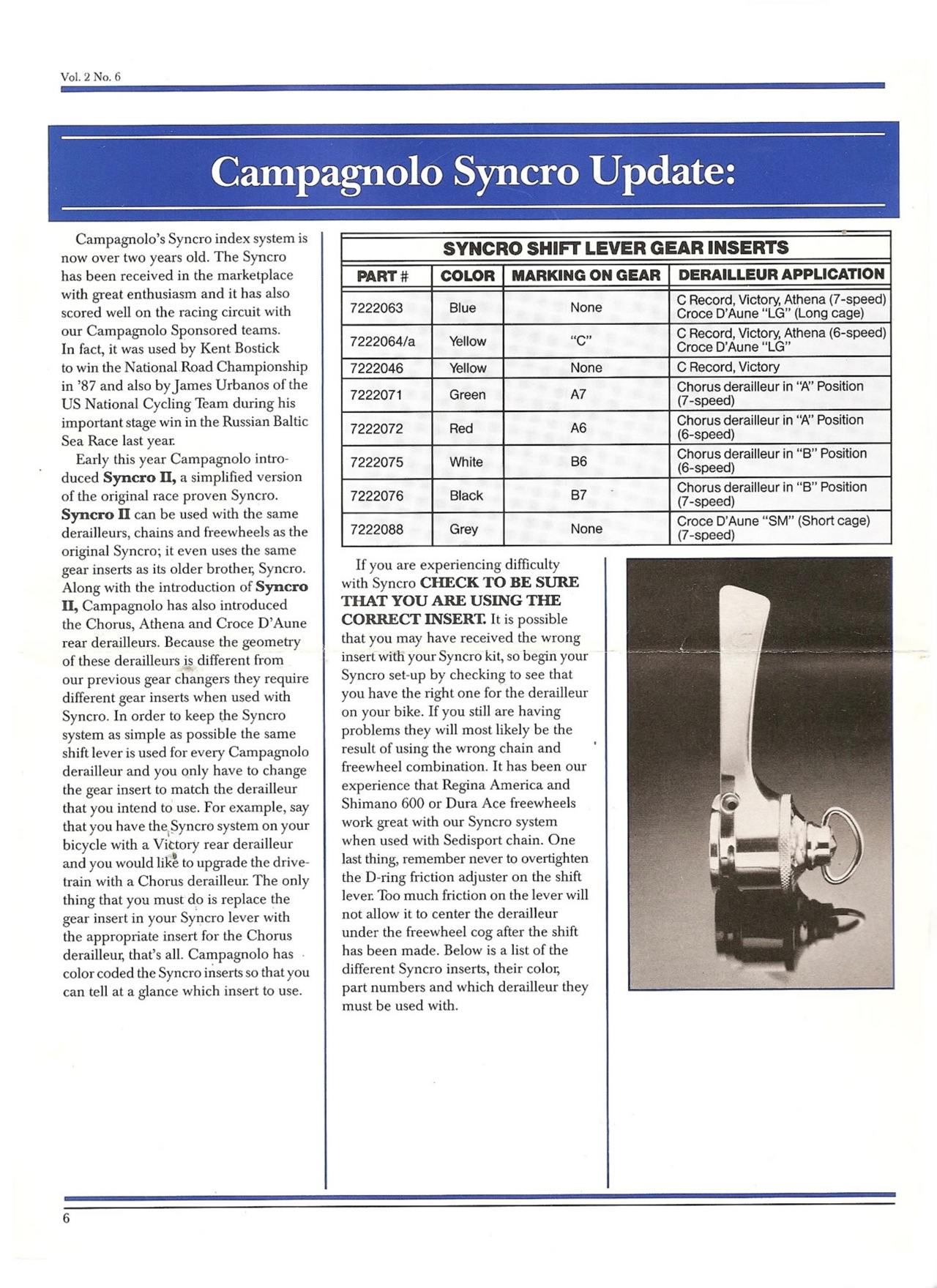
I recently came across a Syncro article in the Summer 1988 Record News, a news letter put out by Campagnolo USA in the 80's. Some interesting information in there. It confirmed the existence of 2 yellow insert variants, and maybe gave a little more clarity on what inserts work with what. Maybe. Still no listing for the Croce d'Aune small cage with 6 speeds that makes any sense. Good job guys!

Here's a little pictorial of the Syncro inserts.


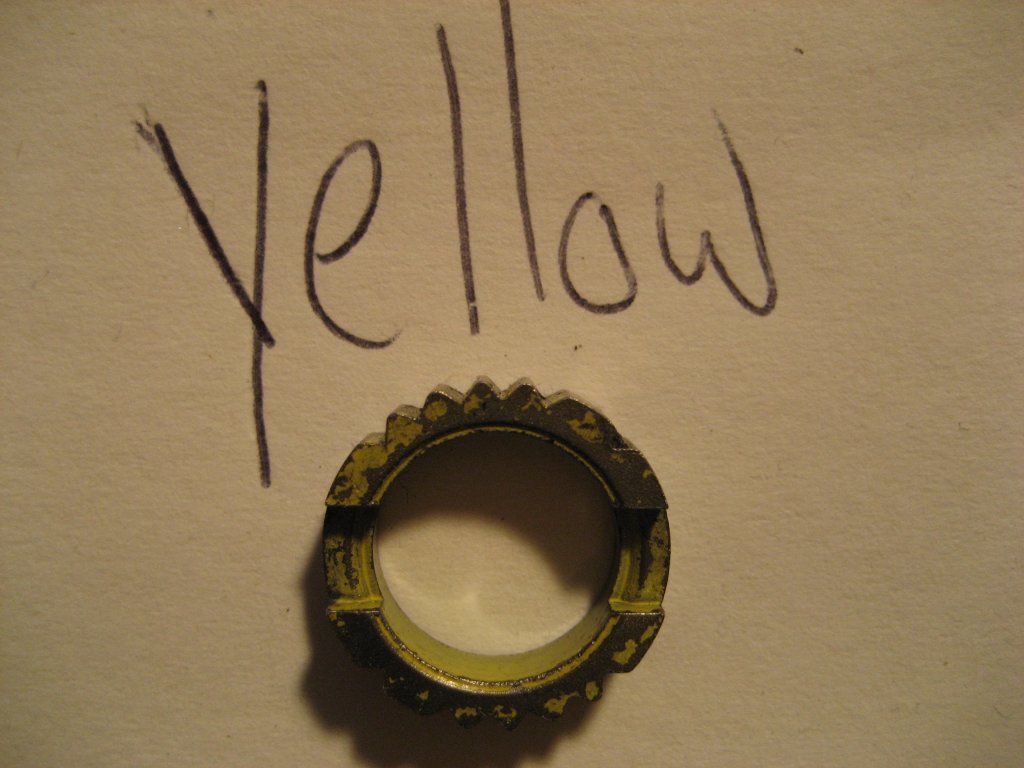
The yellow "6V" insert.


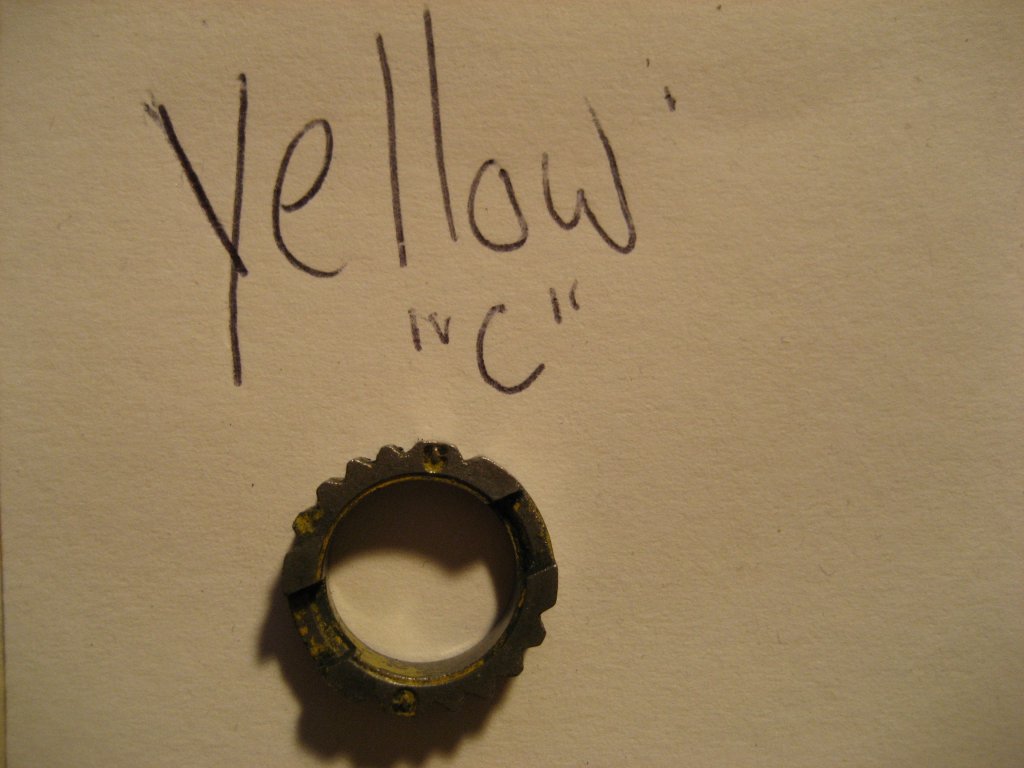
The yellow "C" insert.


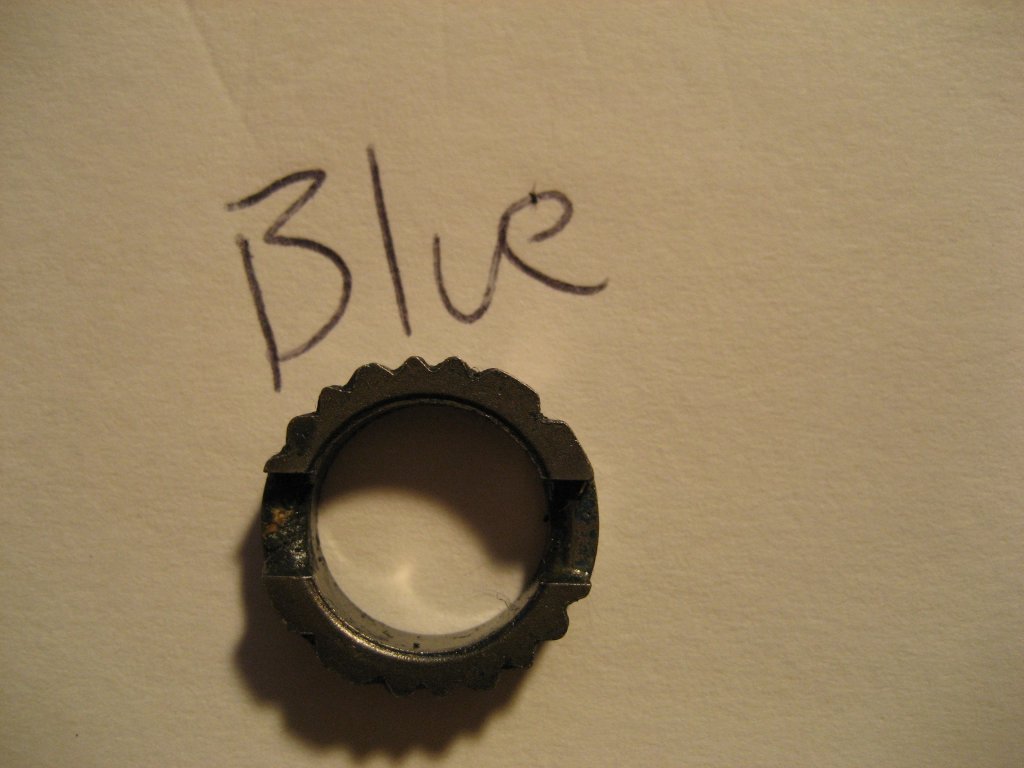
The blue "7V" insert.


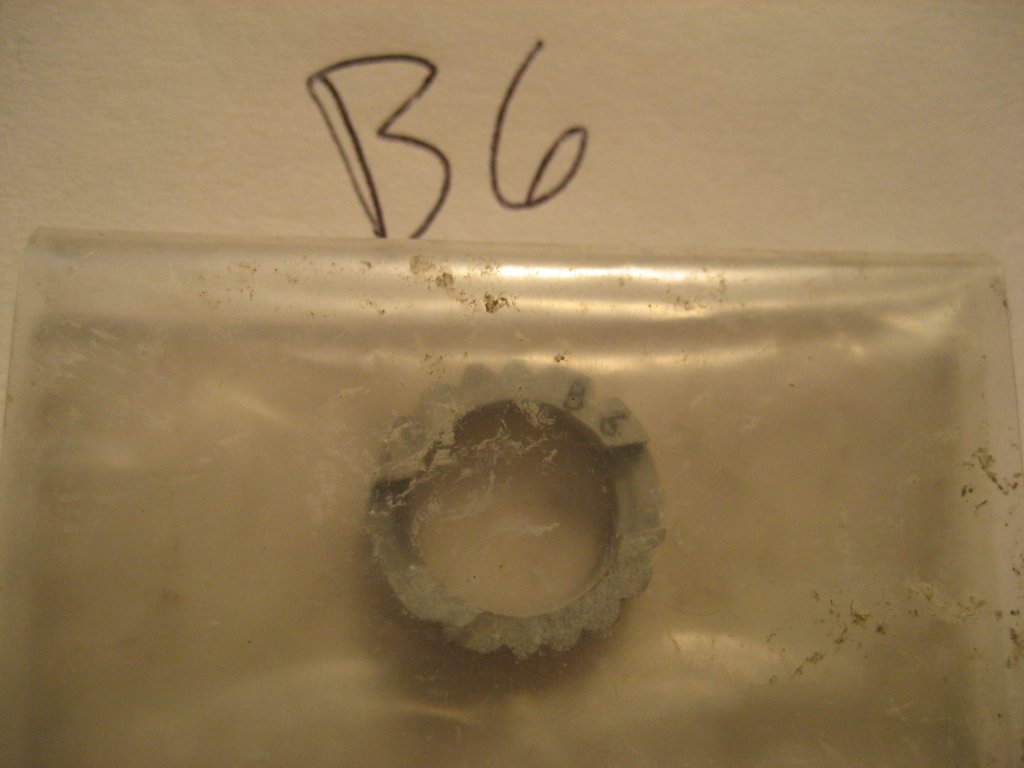
The white "B6" insert. Sorry about the plastic.


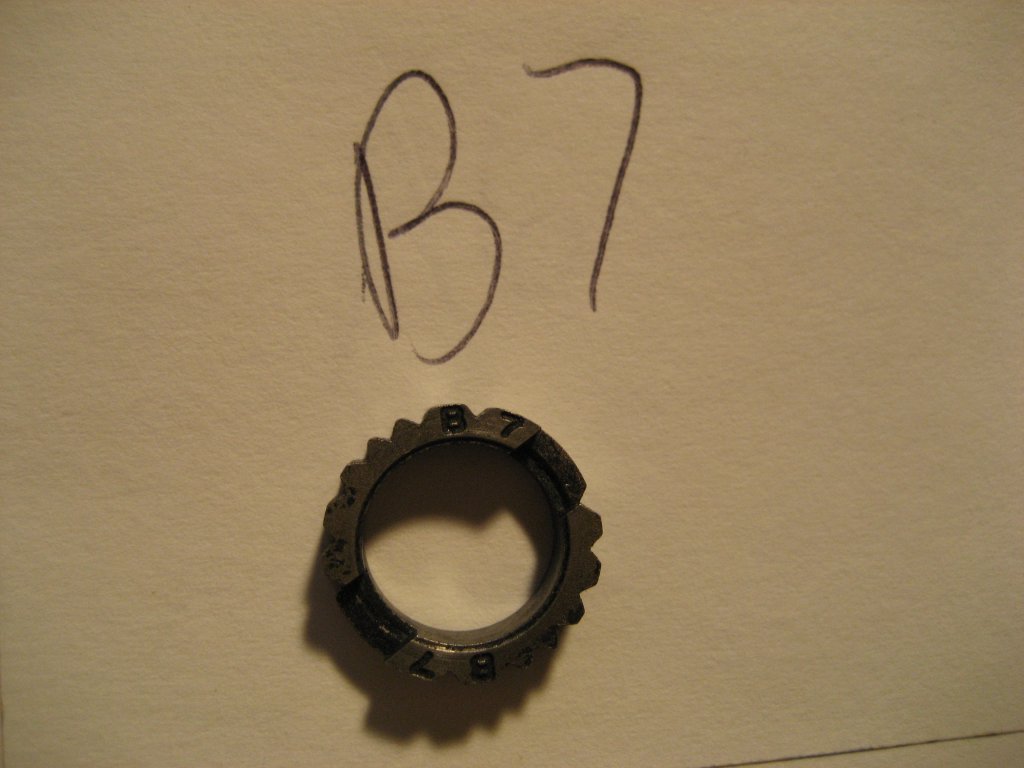
The black "B7" insert.


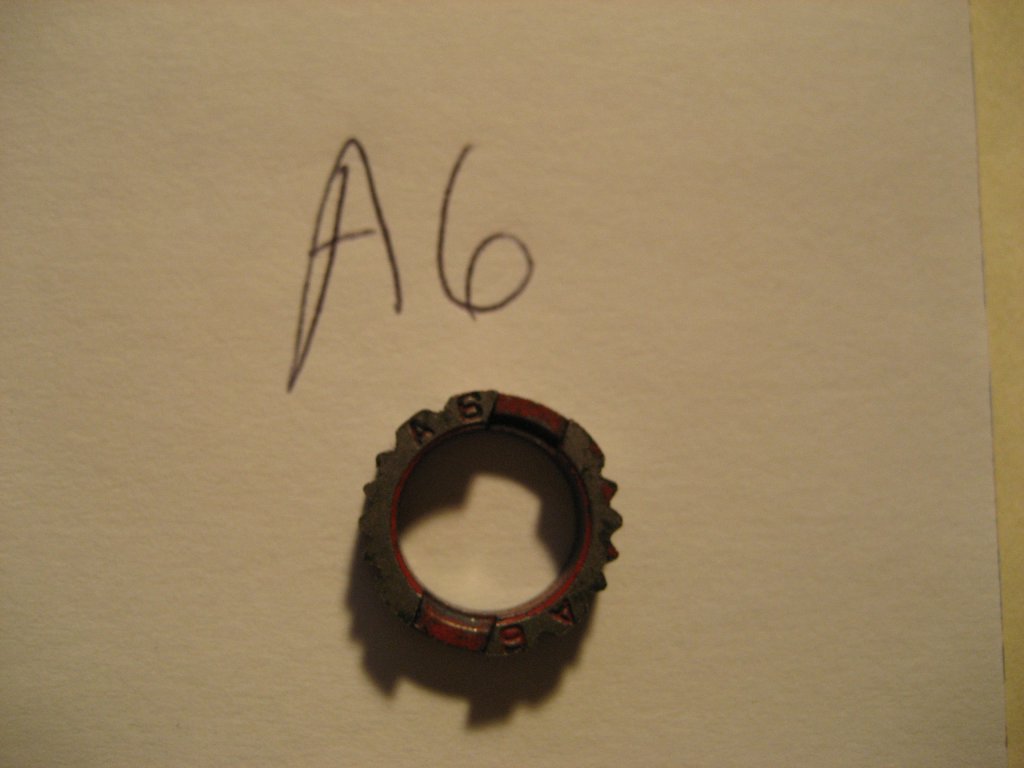
The red "A6" insert.


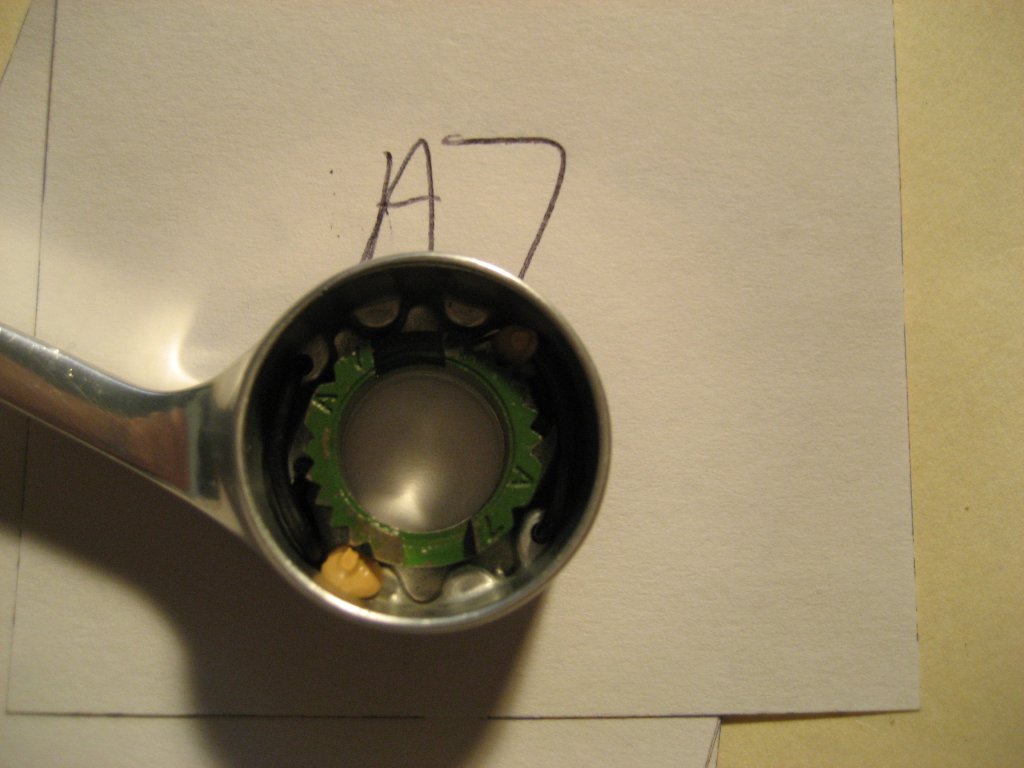
The green "A7" insert.


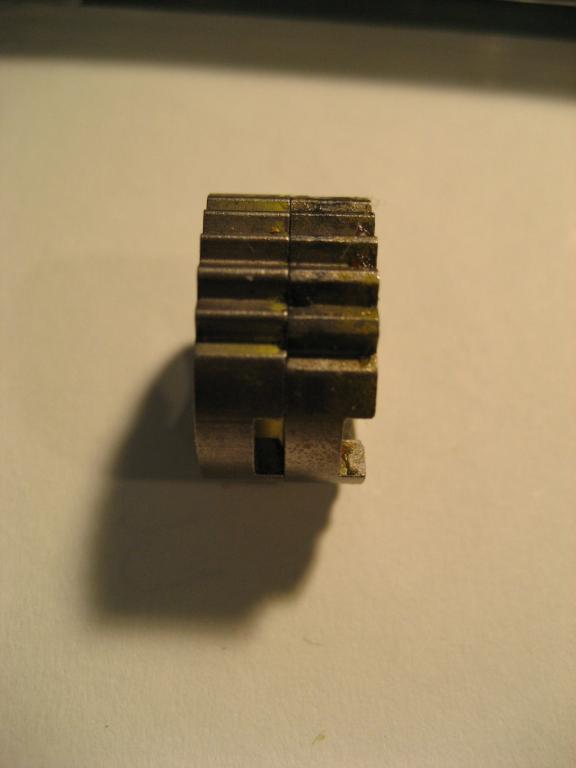
Thats all of the 6/7 speed inserts, except the grey "7V" one thats used for Croce d'Aune in 7 speed. That seems to be the only one thats ridiculously hard to find. If you have one, you really ought to send it to me - I promise to give it a good home.


The yellow inserts are pretty close to being the same, except for a very subtle difference in the 5th gear, and a more pronounced one in the sixth. I suspect the differences become more apparent in freewheels that aren't tight-ratio'd.

Thursday, November 01, 2007

A Tale of Two Cities

I have a pretty nice collection of team jerseys, if I do say so. A few (ok, 5) of them are various Merckx sponsored team jerseys. One of them is newly acquired, and is an interesting one to me, at least.


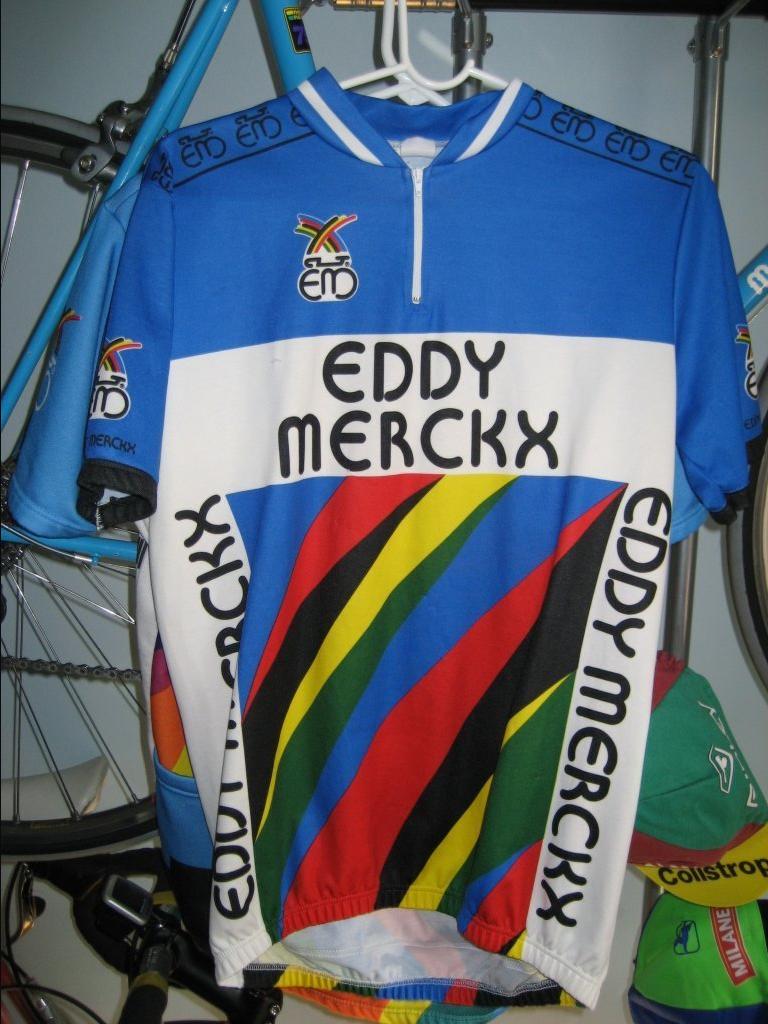
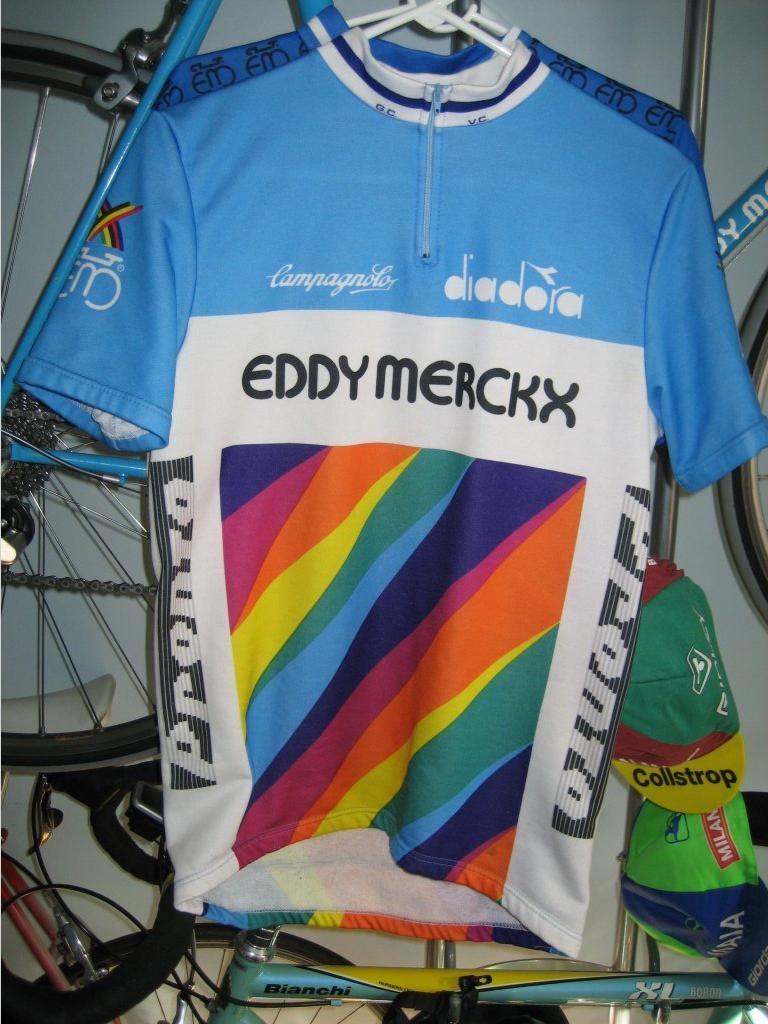
The above is the normal, common Eddy Merckx jersey. I thought this was the design used in 1985 + 1986 Eddy Merckx sponsored teams (scroll down a little), which I'm pretty sure were cyclocross only. Most sites have 2 teams listed -- one being a Belgian team, notable for having Roger De Vlaeminck in the very end of his career, and the other being a Luxembourg team, which seems to have been an amateur team. The above isn't an exact jersey, but its pretty close. The rainbow colors aren't quite the same, but the Eddy Merckx lettering is the same -- seems like a general consumer version of a team jersey. Ok, great, makes perfect sense.


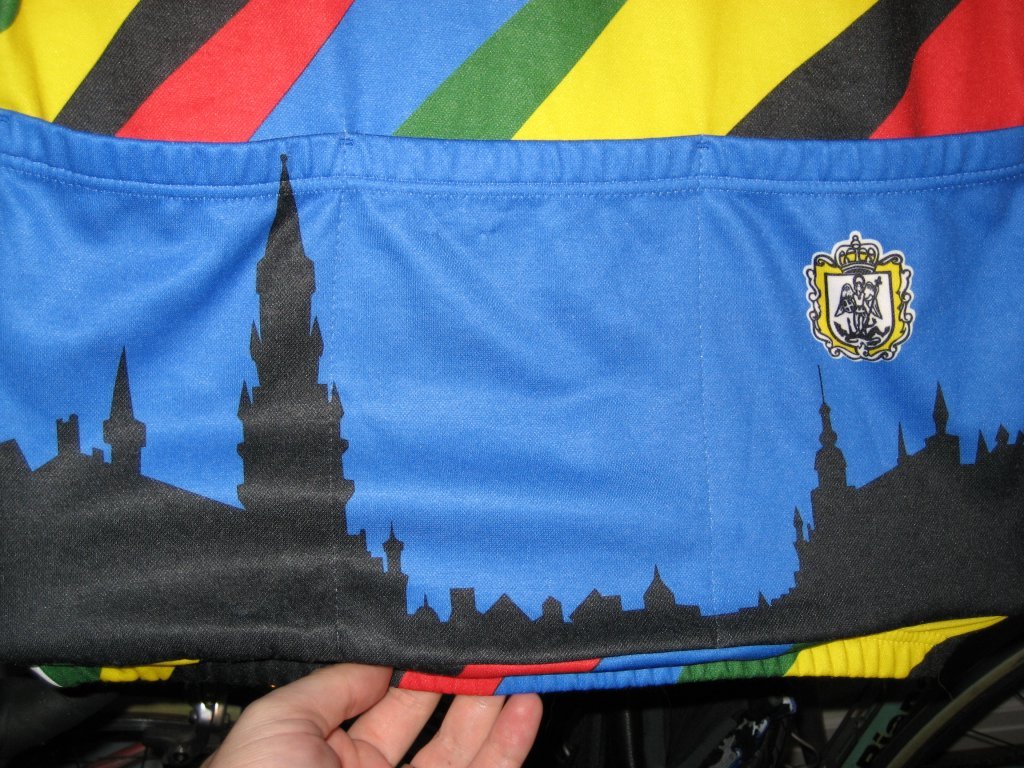
The skyline on the back of the jersey seems to be Brussels -- the tallest building sort of looking like the Grand Place. The little seal which seems to depict St. Michael stomping on a dragon works too, being part of the seal of Brussels.


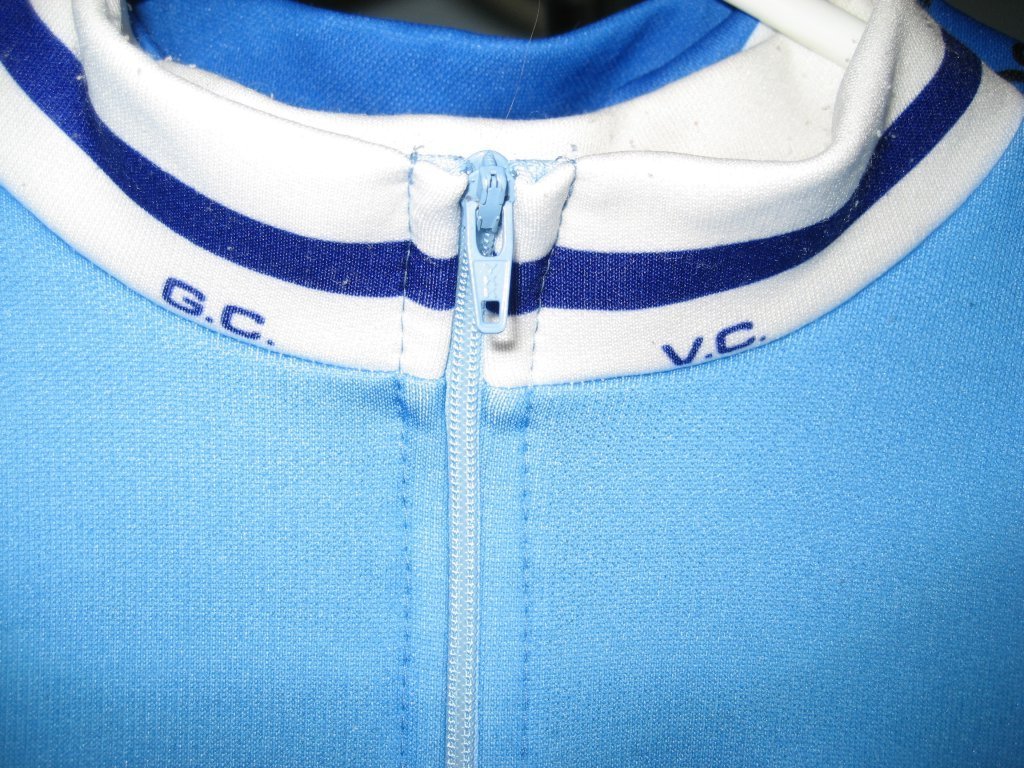
This jersey, however, is something of a mystery. Its an old-style label, Giordana jersey. It has the textured inside, thats composed of loops of thread, that you saw in nice jerseys in the mid-to-late 80's. High collar. The Eddy Merckx lettering is straight across, instead of over/under. It contains a full array of sponsor logos -- aside from Merckx, there's Diadora, Campagnolo, Pronto, and on the collar...


G.C.V.C. Or maybe thats G.C. V.C. Something-something venture capital? velo club? Beats me. Not so sure on what Pronto is either...


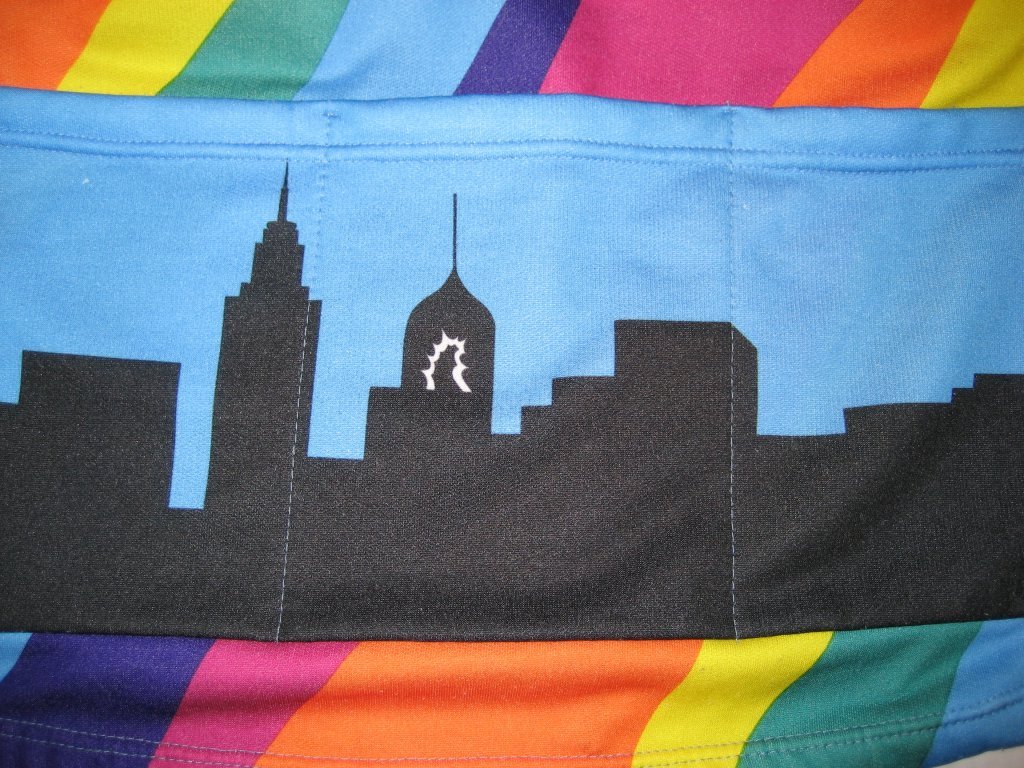
No clue what city's skyline this is. A very boxy city, with a building that looks little like a syringe (whats with the weird lightning, glow worm thing?), and one that looks like the Empire State building.

What is this jersey? The proper 85/86 Merckx team jersey? Some small club or shop team? One of the myriad of Belgian trade teams? What skyline is that? Is anybody out there? Help!

Tuesday, October 30, 2007

Yay for me, boo to all of you

Here's another Merckx team -- Capri-Sonne


Yep, Capri-Sonne, known here in the US as Capri Sun, those funny little silver juice pouches from the early 80's, that apparently are still around. Who knew?

They rode a silver frame, as seen a little better here. Calling some of these solid colors "team colors" is pushing it a bit, but it fits my criteria. Too bad I'm the one who found it, otherwise someone might have found themselves with a nice, 100% free jersey. Still plenty of teams out there to identify, and a couple of days to do so...

Sunday, September 23, 2007

The Tears for Gears Merckx Team bike challenge

So as I noted in my last post, there are probably a ton of Merckx team frames I know nothing about. There are some main stream(ish) teams I haven't been able to track down, and dozens and dozens of continental teams I've never heard of, let alone seen a picture of.

There are also a couple of frames I suspect are team frames I've just never been able to figure out, including


and


So here's the challenge. The person who can find and identify the most Merckx team frames which I do NOT have not talked about in my blog posts or in the serial list will win a prize:


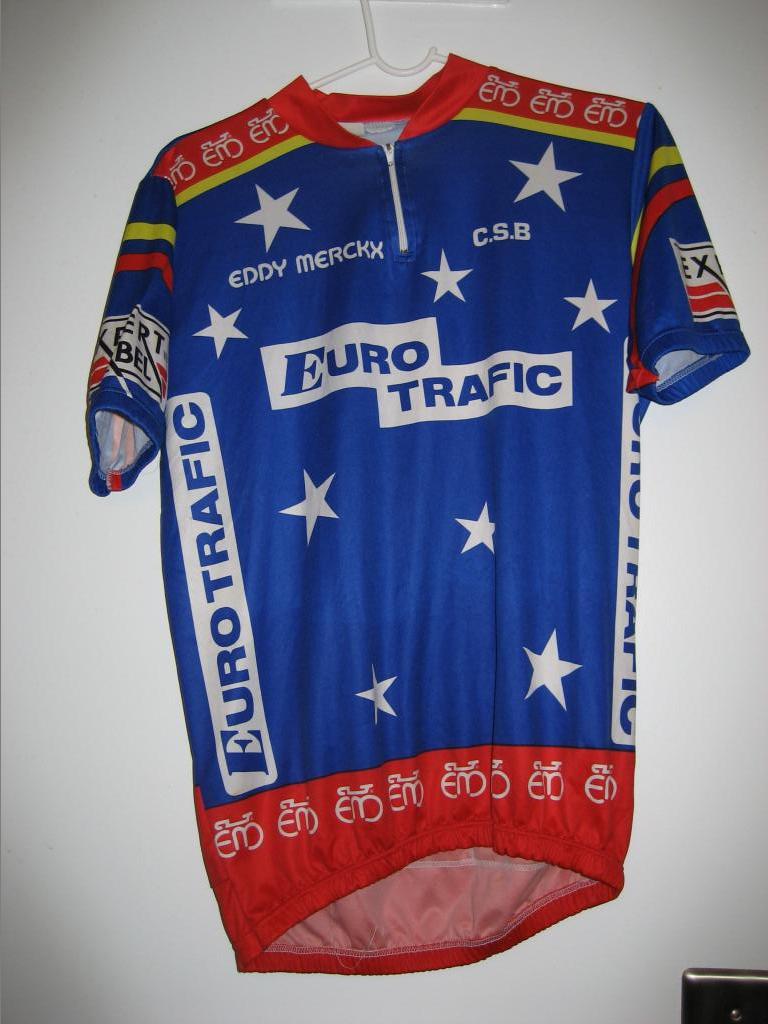
A Euro Trafic Merckx team jersey. Its not a new jersey, its actually a former team jersey, so it has some wear and tear, but I bet no one else will show up at your next club ride wearing one! I'll pay shipping and everything...all you have to do is follow some simple rules...

I'm looking for more teams riding Eddy Merckx bikes from 1980 through about 1998. This primarily means steel frames, built in the Merckx factory in Belgium. To positively identify a Merckx team color scheme, you need only send me a clear picture of a team rider on the frame that shows the primary details of the color scheme. A team color scheme means that the whole team rode/rides that scheme. If there's a color scheme i've missed for a team I've already identified, that counts -- I bet there's at least 1 other Kelme. I'll set a deadline of November 1, 2007.

You can send me info at merckxteams AT tearsforgears DOT com. The two frames above are a decent place to start -- that I can't ID them is driving me crazy. The top is from 1986/87, and the bottom from 1988/89. Good luck, and send me what you have! If you're the only person to respond, you just may win!

Still no new teams sent in! All it takes at this point to walk away with the super cool jersey above is identifying one new team. That's it! I'll mail the jersey anywhere in the world, postage paid for by me!

The last of the Merckx team frames...

Wow, today is going to be a 3 post day. I figure, before my little challenge can begin, I need to put out the last of the team frames I know about up. Without further ado...


The United States' first team to make it in the pro peloton ranks, 7-Eleven! After years of having their downtubes sullied with Huffy and Murray decals, they switched in 1989 to Eddy Merckx frames for their final two seasons.

In 1990, 7-Eleven folded and was reborn as...


Motorola. The above is Michael Dernies' team issue Motorola Merckx, in Columbus TSX. Motorola is best known by many as the team Lance Armstrong rode for when he won the worlds in 1993. Here's a picture of Michael Dernies on his Motorola Merckx. Maybe its the same one (or maybe not).

OK, we're on a roll. Here are some of the Merckx riding teams in the last years of steel:


In 1996, Gan rode blue MX Leaders and Arcabaleno's, as you can see in this picture. In 1997, they switched to white frames, that look like steel -- . If they were riding steel in 1998, I'd be pretty surprised.

And contrary to what I thought, they were riding white Arcabaleno's as late as 1998


Vlaanderen 2002 rode yellow MX Leaders, as seen here, here, and here.

Finally, it looks like S.E.F.B. Spaarbank rode the same colors as Domex/Weinmann in 1989.

So thats all of the Merckx team frames I've found. There are a few I know I'm missing, including IPSO/Euroclean, Hueso, Westwood...I know someone out there knows a couple of those. With my next post, hopefully I'll motivate some of you to lend me a hand.

Telekom and Kelme Merckx Team Bikes

The procrastination has gone on long enough! It's time to publish my next installment of Merckx team bike frames. Let's go!


Telekom used Merckx frames from 1991-1995. The above is the color scheme I most associate with Telekom -- you can see it in this team photo from 1994.

What you might not know is, in 1995, Telekom changed its name to Team Deutsche Telekom, and changed its bike color scheme to the one you can just make out in this picture of a young Jan Ullrich. Its a pink head and top tube, with purple points. Its more or less as if they flipped the colors on their previous scheme, and called it new. At least they didn't have to change their jersey colors. They shifted to Pinarello frames in '96, so this color scheme only lasted a year -- so if they were available to the public, it would have been a pretty short time frame.

OK, its Kelme time. Given how long Kelme was around, you'd think I'd have seen more examples of bikes in the public sporting Kelme colors, but you'd be wrong.

In early years, Kelme rode an all white frame, as seen here, as well as a all blue frame, as seen here.

In 1985 and/or 1986, Kelme used the same red/pink/white frames that Lotto and Teve Blad did, as seen here.

In 1987, they switched to what I think is a pretty awesome color scheme, seen here, that matched their jersey's perfectly. I think they kept this frame through 1989.

At some point, for reasons I can't fathom, they switched to this color scheme. The switch was in either 1990 or 1991...I can find pictures in this scheme that I'm sure are 1991, but I haven't found any good shots of a rider on one wearing the Kelme/Ibexpress jersey from 1990. Anyhow, the color scheme looks a lot like Telekom, but with a green bottom bracket and rear triangle. Its fine, but its no '87-89 color scheme if you ask me. Not that you did.

Next team post will cover the 7/11, and two of the last pro teams that Merckx sponsored on steel, Motorola and Gan.

This post is a little light on the eye candy...so light in fact, that later tonight I'm going to post a CHALLENGE! With a really excellent prize! Stay tuned...

Wednesday, September 12, 2007

Still more Merckx team colors...

Still hanging in there? Only 10 or so more teams to go! And this post is going to be a big one...


Panasonic seems to be primarily thought of as a Raleigh team, but in 1986, they were riding white with blue points Merckxes.

The color scheme was a popular one. Another top pro team got the same color scheme, relabled as Caloi, in 1993/1994...that team being Lotto.

Speaking of Lotto...those guys rode quite a few different Merckx color schemes.


No, not all of the above! In 1985, they rode a yellow with white panels color scheme, as seen in this team photo. To be honest, I'm not sure they used the font in the picture above. It's possible it was the same font that...

Europ Decor rode in 1984. Prior to that, they rode blue metallic with white panels.

Back to Lotto. In 1986, they moved to an all red scheme, and kept it (I think!) through 1987. The only thing that differentiates it from the normal stock frames is that the seat tube has vertical Eddy Merckx lettering, while bikes for us mortals just had the EM logo and the France/Italy world champ bands. Here's a mediocre picture where you can see what I'm talking about.


In 1988, they moved to the above, red and white, pointed scheme, as seen here. And in 1989, they moved off Merckx bikes, and on to Vitus.
Michel Dernies seems to have ridden on teams Merckx sponsored for all but the earliest years of his career -- starting in 1985 for Lotto, to Domex/Weinmann in 1989-1991, to Motorola through 1995. Being from Belgium, I guess its not that odd, but I thought it was worth noting. It also has nothing to do with team paint schemes.

Remember that red and white pointed bike I was talking about before that nonsequitor? Well, it was also ridden by Teve Blad, in 1986 and 1987. I highly recommend looking at the pics of their riders -- they did a photoshoot that makes them all look fairly ridiculous. I have no idea what color frames they rode in 1985, so let me know if you do.

Wow, I'm tired! I know I promised Kelme in this post too, but its too much! Panasonic, Lotto, Europ Decor and Teve Blad, combined, rode 5 color schemes. I think Kelme rode at least 3, possibly 4, so they have to wait. I'll get to them in the next post, along with Telekom.